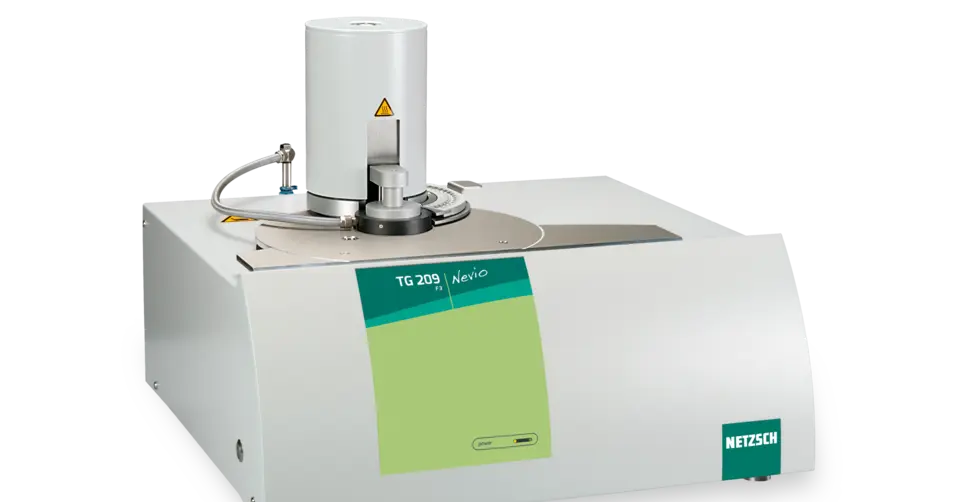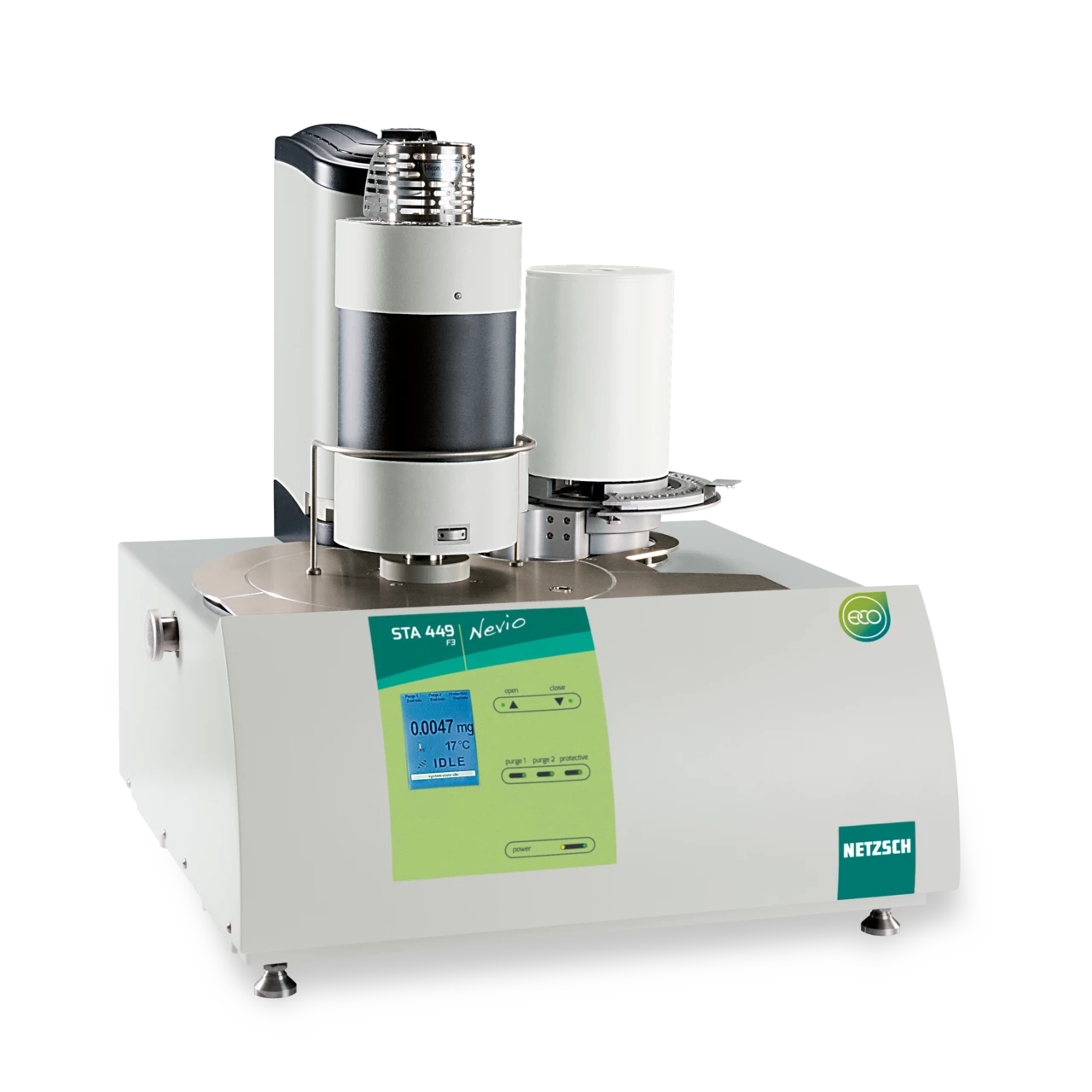
STA 449 F3 Nevio
Specialized for Demanding Tasks in Research & Development
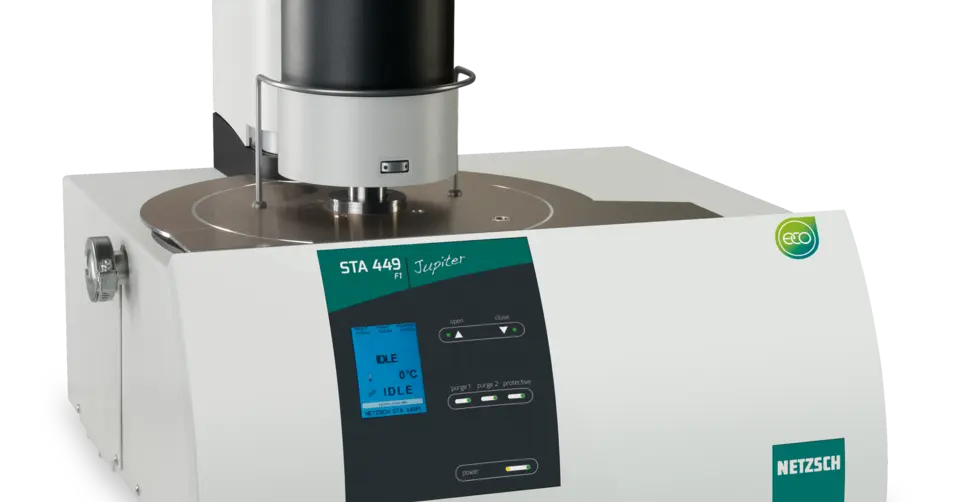
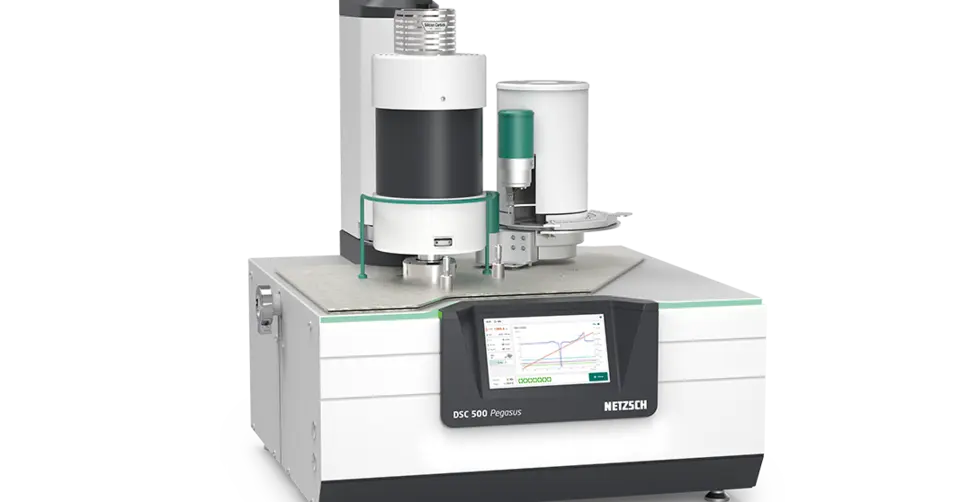
The simultaneous thermal analyzer NETZSCH STA 449 F3 Nevio allows the measurement of mass changes and thermal effects under identical conditions at the same specimen.
Thus it makes it feasible to differentiate between e.g., structural changes and degradation phenomena within just one measurement up to675°C1. The high flexibility caused by the various sensors, the great variety of sample crucibles and the wide TGA-measuring range make the system applicable for analysis of different kinds of pharmaceuticals, cosmetic samples or food including also inhomogenous substances. The vacuum-tight design of the instrument is an essential requirement for evolved gas analysis, i.e., the coupling of the thermal analyzer to a gas analyzing system such as FT-IR, MS or GC-MS.
Various furnaces, easy interchangeable by the user, cover a very broad temperature range (please see accessories). In addition, due to its modular setup the STA 449 F3 Nevio is also prepared to investigate samples under defined humid atmosphere. The analysis of measuring data runs under a standard PC and the innovative NETZSCH Proteus® software.
1⁾ optimized temperature range for pharmacy, cosmetics and foodstuffs; depending on the selected furnaces: total temperature range: -150°C up to 2400°C

Technical Data
Enthalpy accuracy:
± 1 ... 3 %
TG resolution:
0.1 µg (over entire weighing range)
Cooling options:
compressed air (<0°C to 675°C 1)), liquid nitrogen (-150°C to 675°C 1))
Atmospheres:
inert, oxidizing, reducing (forming gas), humid, vacuum, static, dynamic
Vacuum-tight:
Yes
1) optimized temperature range for pharmacy, cosmetics and foodstuffs; depending on the selected furnaces: total temperature range: -150°C up to 2400°C
2) minus weight of crucible
3) for thermocouple type E

This instrument is LabV®®️-primed
LabV®®️ takes the data from your analytical instrument: It automatically imports all measurement data into a central and secure database solution, the LabV®®️ software. This allows you to visualize the data in LabV®®️ and to make them searchable. Your data will now be accessible from anywhere. Moreover you have the possibility to generate reports.
| Type | Temperature range | Cooling system |
|---|---|---|
| Silver furnace | -120°C to 675°C | liquid nitrogen |
| Copper furnace | -150°C to 500°C | liquid nitrogen |
| Steel furnace | -150°C to 1000°C | liquid nitrogen |
| Platinum furnace | RT to 1500°C | forced air |
| Silicon carbide furnace | RT to 1600°C | forced air |
| Rhodium furnace | RT to 1650°C | forced air |
| Graphite furnace | RT to 2000°C | tap or chilled water |
| Water vapor furnace | RT to 1250°C | forced air |
| High-speed furnace | RT to 1250°C | forced air |
| Tungsten furnace | RT to 2400°C | tap or chilled water |
The STA 449 F3 Nevio runs under Proteus® Software on Windows®. Through the combination of easy-to-understand menus and automated routines, a tool has been created that is extremely user-friendly and, at the same time, allows sophisticated analysis. The Proteus® software is licensed with the instrument and can of course be installed on other computer systems.
Features concerning TGA plus DSC:
- Proteus® Protect (option) - meeting the requirements of 21 CFR Part 11 and EU Annex 11
- AutoEvaluation - autonomous and user-independent evaluation of thermal effects
- Identify (option) - curve recognition and database system for library search purpose
- SuperPosition - Simulation of the thermal behavior of physical mixtures by overlapping the curves of the mixture components incl. freely selectable mass ratios
- Average curves - absolute (taking the sample masses of the various measurement s into account) or relative (applies just the number of measurements as denominator)
- Report generator - based on a Microsoft Word plug-in each operator can easily create his own report template for reports – including logos, tables, description fields and plots.
TGA-specific evaluation features:
- Mass changes in wt% or mg
- Determination of residual mass
- Extrapolated onset and end temperatures
- Peak temperatures of the1st and2nd derivative of the mass-change curve
- Automatic baseline and buoyancy correction
- c-DTA® for calculated DTA signal with evaluation of characteristic temperatures and the peak area (optional for TGA measurements)
DSC-specific evaluation features:
- Determination of onset, peak, inflection and end temperatures
- Transformation enthalpies:
- Analysis of peak areas (enthalpies) with selectable baseline and partial peak area analysis
Enthalpy determination allowing for mass changes
Complex peak analysis with all characteristic temperatures, area, peak height and half-width - Comprehensive analysis of Glass Transition TemperatureThe glass transition is one of the most important properties of amorphous and semi-crystalline materials, e.g., inorganic glasses, amorphous metals, polymers, pharmaceuticals and food ingredients, etc., and describes the temperature region where the mechanical properties of the materials change from hard and brittle to more soft, deformable or rubbery.glass transitions
- Automatic baseline correction
- Degree of Crystallinity / Degree of CrystallinityCrystallinity refers to the degree of structural order of a solid. In a crystal, the arrangement of atoms or molecules is consistent and repetitive. Many materials such as glass ceramics and some polymers can be prepared in such a way as to produce a mixture of crystalline and amorphous regions.crystallinity
- Oxidative-Induction Time (OIT) and Oxidative-Onset Temperature (OOT)Oxidative Induction Time (isothermal OIT) is a relative measure of the resistance of a (stabilized) material to oxidative decomposition. Oxidative-Induction Temperature (dynamic OIT) or Oxidative-Onset Temperature (OOT) is a relative measure of the resistance of a (stabilized) material to oxidative decomposition.OIT (oxidative induction time) evaluation
- Specific Heat Capacity (cp)Heat capacity is a material-specific physical quantity, determined by the amount of heat supplied to specimen, divided by the resulting temperature increase. The specific heat capacity is related to a unit mass of the specimen.Specific heat capacity (optional)
Determination of the DSC conversion curve (in %) related to a partial peak area evaluation of a melting effect
- TM-DSC module software extension for temperature-modulated DSC tests (optional)
- Lissajous diagram for TM-DSC curves (optional)
- Purity Determination (optional)
You can use the following software with this product
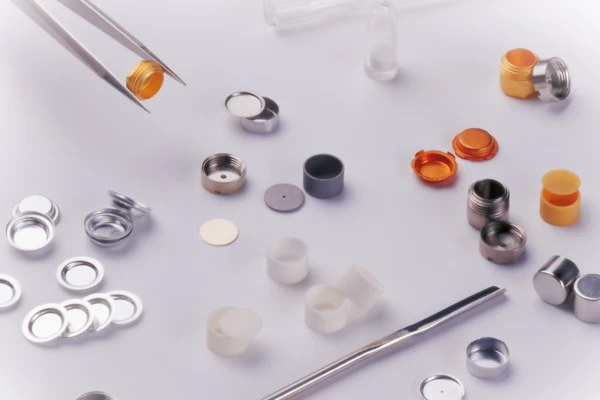
Different sample properties need different crucible materials/types. Therefore, a variety of sample crucibles (pans) made of alumina, platinum, aluminum, graphite, fused silica, etc. is available in different sizes.
Specific Furnaces for Specific Tasks
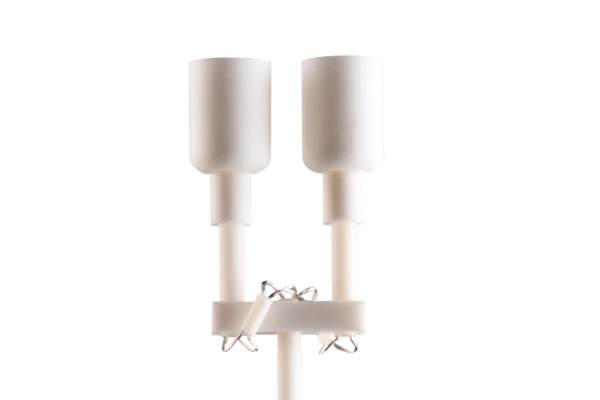
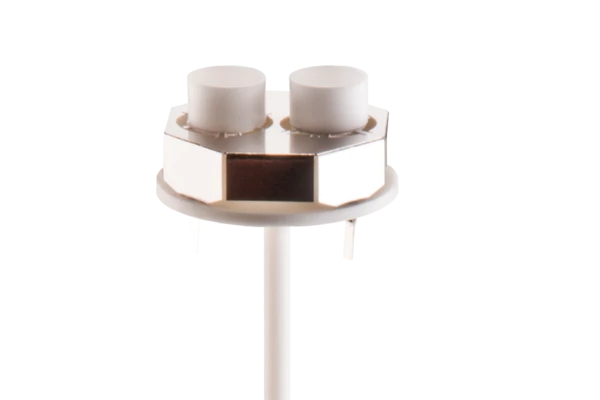
Due to its modular concept the STA can be equipped with standard furnaces for various temperature ranges but also with special furnaces - either alone or in combination by using a double hoisting device.
For TGA measurements under defined relative humidity the copper furnace plus the humidity generator can be applied. Regarding higher water concentrations (up to 100% water vapor) it is possible to use the water vapor furnace in combination with the water vapor generator.
The high speed furnace which can realize heating rates up to 1000 K/min is designed for TGA experiments as well.

ASC - for Continous Operation
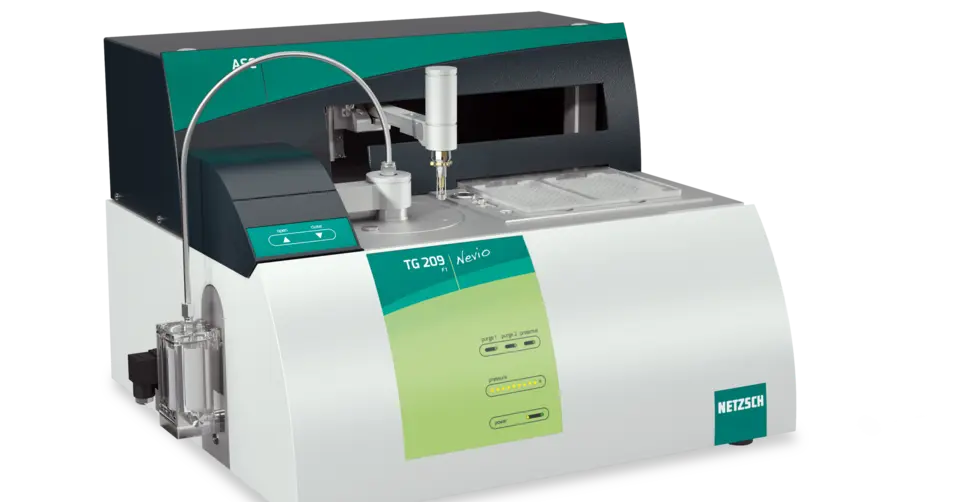
The automatic sample changer works day and night, giving you time for other tasks, and provides for optimal use of the STA 449 F3 Nevio (e.g. calibrations on the weekend).
A carousel is available for up to 20 sample and reference crucibles (pans) which can be automatically run in any order. The controlled generation of the required gas atmosphere in the sample chamber and cooling are automatic.
Of course, each sample can be assigned an individual measurement and evaluation procedure.
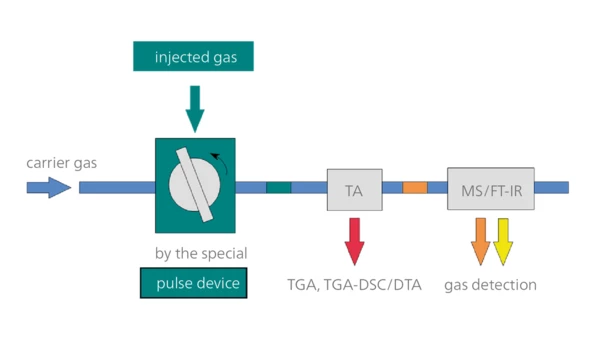
PulseTA®
With the PulseTA® technique an exactly defined quantity of gas is injected to the purge gas of the thermobalance (TGA) or the simultaneous thermal analysis instrument (STA).
This clearly increases the measuring possibilities:
- Defined/incremental chemical reactions or adsorption of the injection gas with the sample
- Quantification of gases evolved from the sample.
Crucibles (Pans) Made of Aluminum for the STA 449 F3 Nevio
| Material (Purity) | Temperature Range | Consisting of | Dimension/ Volume | Remarks | Order Number |
|---|---|---|---|---|---|
| Al (99.5%) | Max. 600°C | Crucible + lid | ø 6 mm / 25/40 μl | Set of 100, cold weldable* | 6.239.2-64.5.00 |
| Al (99.5%) | Max. 600°C | Crucible + lid | ø 6 mm / 25/40 μl | Set of 500, cold weldable* | 6.239.2-64.51.00 |
| Al (99.5%) | Max. 600°C | Crucible + punched lid (0.05mm) | ø 6 mm / 40 μl | Set of 100, cold weldable* | 6.239.2-64.8.00 |
| Al (99.5%) | Max. 600°C | Crucible + punched lid (0.05mm) | ø 6 mm / 40 μl | Set of 500, cold weldable* | 6.239.2-64.81.00 |
| Al (99.5%) | Max. 600°C | Crucible | ø 6.7 mm / 85 μl | Set of 100 pieces, non-weldable | NGB810405 |
| Al (99.5%) | Max. 600°C | Lid | Set of 100 pieces, for NGB810405 | NGB810406 |
* Please note: One and the same sealing press is capable of sealing all the Al crucibles (pan + lid), order no. 6.240.10-80.0.00A