DSC 404 F3 Pegasus®
High-Temperature DSC up to 2000°C
Highlights
Fascinating Flexibility in Thermal Analysis
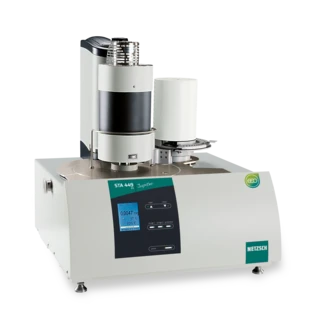
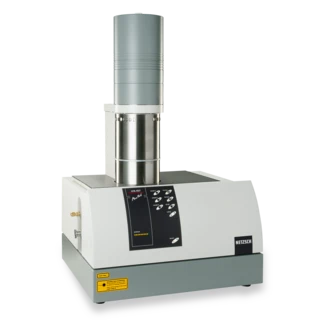
The DSC 404 F3 Pegasus® , High-Temperature Differential Scanning Calorimeter, is part of the economical NETZSCH F3 -product line, which is specially tailored to the requirements of comparative material characterization and quality control.
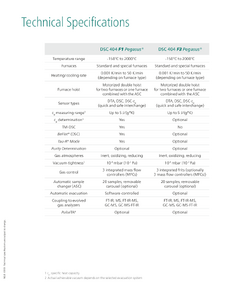
The DSC 404 F3 Pegasus® , High-Temperature Differential Scanning Calorimeter, can be operated from -150°C to 2000°C with various DTA and DSC sensors that are easily exchangeable by the user and various furnace types (please see accessories).
The sample chamber can be purged with inert or oxidizing gases in order to remove gases evolved from the sample.
The measuring system is vacuum tight (10-4 mbar).
Method
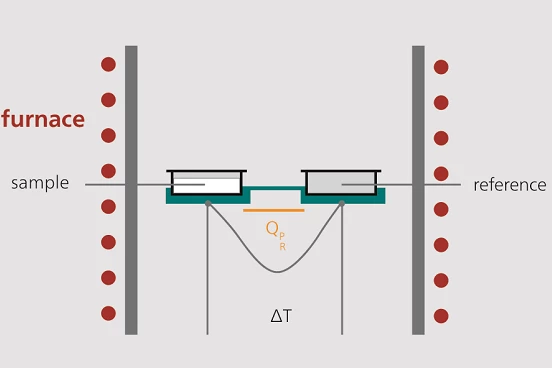
The DSC 404 F1 as well as the F3 Pegasus® systems operate according to the heat flux principle. With this method, a sample and a reference are subjected to a controlled temperature program (heating, cooling or IsothermalTests at controlled and constant temperature are called isothermal.isothermal). The actual measured properties are the temperature of the sample and the temperature difference between sample and reference. From the raw data signals, the heat flow difference between sample and reference can be determined.
More on the Functional Principle of a Heat-Flux DSC
A DSC measuring cell consists of a furnace and an integrated heat-flux sensor with designated positions for the sample and reference pans.
The sensor areas are connected to thermocouples or may even be part of the thermocouple. This allows for recording both the temperature difference between the sample and reference side (DSC signal) and the absolute temperature of the sample or reference side.
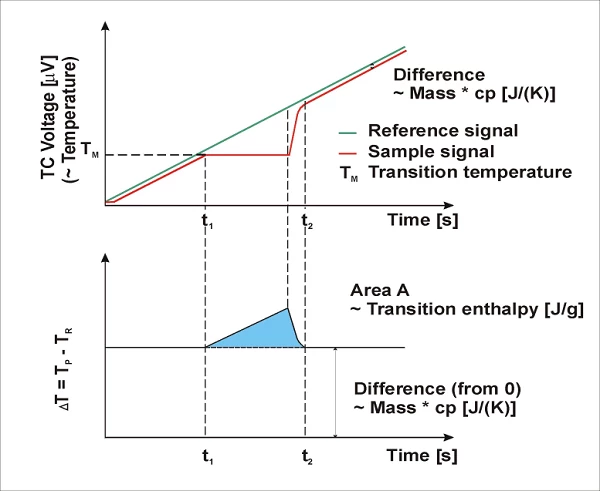
Due to the heat capacity (Specific Heat Capacity (cp)Heat capacity is a material-specific physical quantity, determined by the amount of heat supplied to specimen, divided by the resulting temperature increase. The specific heat capacity is related to a unit mass of the specimen.cp) of the sample, the reference side (usually an empty pan) generally heats faster than the sample side during heating of the DSC measuring cell; i.e., the reference temperature (TR, green) increases a bit faster than the sample temperature (TP, red). The two curves exhibit parallel behavior during heating at a constant heating rate – until a sample reaction occurs. In the case shown here, the sample starts to melt att1. The temperature of the sample does not change during melting; the temperature of the reference side, however, remains unaffected and continues exhibiting a linear increase. When melting is completed, the sample temperature also begins to increase again and, beginning with the point in timet2, again exhibits a linear increase.
The differential signal (ΔT) of the two temperature curves is presented in the lower part of the image. In the middle section of the curve, calculation of the differences generates a peak (blue) representing the EndothermicA sample transition or a reaction is endothermic if heat is needed for the conversion.endothermic melting process. Depending on whether the reference temperature was subtracted from the sample temperature or vice versa during this calculation, the generated peak may point upward or downward in the graphs. The peak area is correlated with the heat content of the transition (enthalpy in J/g).
Specifications
Technical Data
0.001 K/min to 50 K/min

Thermocouple types:
S, E, K, B, W/Re,SProtected, P
Atmospheres:
inert, oxidizing, static, dynamic
Extension with unique OTS®® system
(option)
| Type | Temperature range | Cooling system |
|---|---|---|
| Silver furnace | -120°C to 675°C | liquid nitrogen |
| Copper furnace | -150°C to 500°C | liquid nitrogen |
| Steel furnace | -150°C to 1000°C | liquid nitrogen |
| Platinum furnace | RT to 1500°C | forced air |
| Silicon carbide furnace | RT to 1600°C | forced air |
| Rhodium furnace | RT to 1650°C | forced air |
| Graphite furnace | RT to 2000°C | tap or chilled water |
Three magnetic valves with frits are available for reproducible gas flow. Optionally the system can be equipped with a mass flow controller.
A wide range of crucibles (pans) (aluminum, platinum, alumina, etc.) is available for nearly all possible applications and materials.
Complete sets of standards for metallic and ceramic sample containers are available for calibration of temperature and enthalpy values.
The concept allows for equipping a measuring instrument with a double-furnace hoisting device for two furnaces. The furnace can therefore be mounted on the double hoisting device combined with other furnaces.
Instead of a second furnace, an automatic sample changer (ASC) can optionally be used. Modular flexibility saves a great amount of time and thus directly results in an increased sample throughput. Optionally available, the OTS® system allows for reducing effectively the oxygen partial pressure at the sample vicinity.
The automatic sample changer (ASC) is designed for routine measurements. It works day and night, giving you time for other tasks, and provides for optimal use of the DSC 404 F3 Pegasus® (e.g. calibrations on the weekend).
A carousel is available for up to 20 sample and reference crucibles (pans) which can be automatically run in any order. The controlled generation of the required gas atmosphere in the sample chamber and cooling are automatic.
Of course, each sample can be assigned an individual measurement and evaluation macro. Easy-to-understand input masks lead you through the programming of the measurement series. And it is always possible to insert unplanned analyses into a preprogrammed series of measurements that is already in progress.

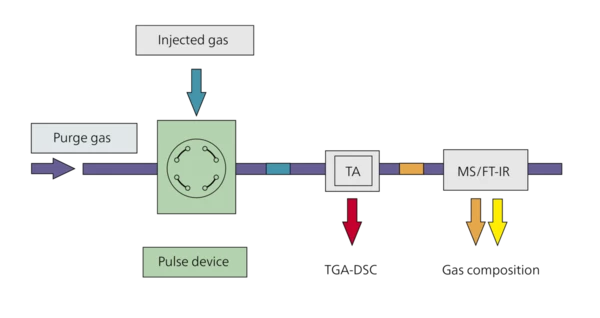
PulseTA®
With the PulseTA® technique an exactly defined quantity of gas is injected to the purge gas of the thermobalance (TGA) or the simultaneous thermal analysis instrument (STA).
This clearly increases the measuring possibilities:
- Defined/incremental chemical reactions or adsorption of the injection gas with the sample
- Quantification of gases evolved from the sample.
Crucibles (Pans) for the DSC 404 F1 /F3 Pegasus®
| Material (Purity) | Temperature Range | Consisting of | Dimension/ Volume | Remarks | Order Number |
| PtRh/Al2O3 | Max. 1700°C | Crucible + liner + lid | For metal melts and other reactive materials | 6.225.6-93.2.00 | |
| Al2O3 ( 99.7%) | Max. 1700°C | Crucible | ∅6.8mm/85µl | GB399972 | |
| Al2O3 ( 99.7%) | Max. 1700°C | Lid | For GB399972 | GB399973 | |
| Pt/Rh (80/20) | Max. 1700°C | Crucible | ∅6.8mm/85µl | GB399205 | |
| Pt/Rh (80/20) | Max. 1700°C | Crucible | ∅6.8mm/0.19ml | Height 6mm | NGB801556 |
| Al (99.5) | Max. 600°C | Crucible | ∅6.7mm/85µl | Set of 100 pieces | NGB810405 |
| Al (99.5) | Max. 600°C | Lid | For NGB810405 | NGB810406 | |
| Gold (99.9) | Max. 900°C | Crucible + lid | ∅6.7mm/85µl | 6.225.6-93.3.00 | |
| ZrO2 | Max. 2000°C | Crucible | 85µl | CaO-stabilized | GB397053 |
| ZrO2 | Max. 2000°C | Lid | For GB397053 | GB397052 |
* Please note: One and the same sealing press is capable of sealing all the Al crucibles (pan + lid), order no. 6.240.10-80.0.00A
Software
Proteus®: Excellent Thermal Analysis Software
The DSC 404 F3 Pegasus® runs under Proteus®Software on Windows®. The Proteus® Software includes everything you need to carry out a measurement and evaluate the resulting data. Through the combination of easy-to-understand menus and automated routines, a tool has been created that is extremely user-friendly and, at the same time, allows sophisticated analysis.The Proteus® software is licensed with the instrument and can of course be installed on other computer systems.
DSC features:
- Determination of onset, peak, inflection and end temperatures
- Automatic peak search
- Transformation enthalpies: analysis of peak areas (enthalpies) with selectable baseline and partial peak area analysis
Complex peak analysis with all characteristic temperatures, area, peak height and half-width - Comprehensive Glass Transition TemperatureThe glass transition is one of the most important properties of amorphous and semi-crystalline materials, e.g., inorganic glasses, amorphous metals, polymers, pharmaceuticals and food ingredients, etc., and describes the temperature region where the mechanical properties of the materials change from hard and brittle to more soft, deformable or rubbery.glass transition analysis
- BeFlat® for Automatic baseline correction (DSC, DTA)
- Degree of Crystallinity / Degree of CrystallinityCrystallinity refers to the degree of structural order of a solid. In a crystal, the arrangement of atoms or molecules is consistent and repetitive. Many materials such as glass ceramics and some polymers can be prepared in such a way as to produce a mixture of crystalline and amorphous regions.crystallinity
- Oxidative-Induction Time (OIT) and Oxidative-Onset Temperature (OOT)Oxidative Induction Time (isothermal OIT) is a relative measure of the resistance of a (stabilized) material to oxidative decomposition. Oxidative-Induction Temperature (dynamic OIT) or Oxidative-Onset Temperature (OOT) is a relative measure of the resistance of a (stabilized) material to oxidative decomposition.OIT (oxidative induction time) evaluation
- Specific Heat Capacity (cp)Heat capacity is a material-specific physical quantity, determined by the amount of heat supplied to specimen, divided by the resulting temperature increase. The specific heat capacity is related to a unit mass of the specimen.Specific heat capacity determination (optional)
- DSC correction: evaluation of exo- and endothermal effects under consideration of system time constants and thermal resistance values (optional)
Further Advanced Software Options
The Proteus® modules and expert software solutions offer further advanced processing of the thermoanalytical data for more sophisticated analyses.
Tau-R®Mode takes into account the time constant and thermal resistance of the instrument and reveals thus sharper DSC effects from the sample.
The DSC curve incorporates not only important information about the sample, but also residual information from the instrument. To correct for this established fact, the Tau‐R Mode has been developed. This method is based on two essential correction factors: the thermal resistance (R) and the time constant (τ). The determination and creation of a correction file need only be carried out once for identical measurement parameters. The true raw data can then be accessed by just one click of the mouse
Peak Separation permits accurate separation and evaluation of overlapping transitions.
PeakSeparation allows for the presentation of experimental data in the form of the additive overlapping of peaks. This program offers different curve types such as Pearson, Gauß, Cauchy, etc.
Purity Determination is a program for determining the purity of a material through analysis of the DSC melting peak.
Prediction of Material Behavior and Reaction Processes:
Materials with accurately defined properties can be transformed into other substances with other properties by chemical reactions. The reactions can take place within a fraction of a second – like in the case of explosions – or take hundreds of thousands of years, as is the case in the formation of minerals. This is because processes like decomposition, curing, crystallization and sintering of materials are dependent on time and temperature. Knowledge about the speed of these processes is therefore important in order to simulate material behavior or optimize a process.
Kinetics, also called reaction kinetics or chemical kinetics, studies the rate of chemical processes and allows for determination of reaction rates. It also takes the factors, which control these reactions, into account.
NETZSCH Kinetics Neo software is used to analyze chemical processes. The software allows for the analysis of temperature-dependent processes. The result of such analysis is a kinetics model or method correctly describing experimental data under different temperature conditions. Use of the model allows for predictions of a chemical system’s behavior under user-defined temperature conditions. Alternatively, such models can be used for process optimization.
The software can analyze different types of thermal curves that depict the changes in a given material property measured during a process. Potential data sources include studies using Differential Scanning Calorimetry (DSC), Thermogravimetry (TGA), Dilatometry (DIL), Dielectric Analysis (DEA), Accelerating Rate Calorimetry (ARC)The method describing isothermal and adiabatic test procedures used to detect thermally exothermic decomposition reactions.Accelerating Rate Calorimetry (Accelerating Rate Calorimetry (ARC)The method describing isothermal and adiabatic test procedures used to detect thermally exothermic decomposition reactions.ARC®), Rheology and Viscosity (Torque).