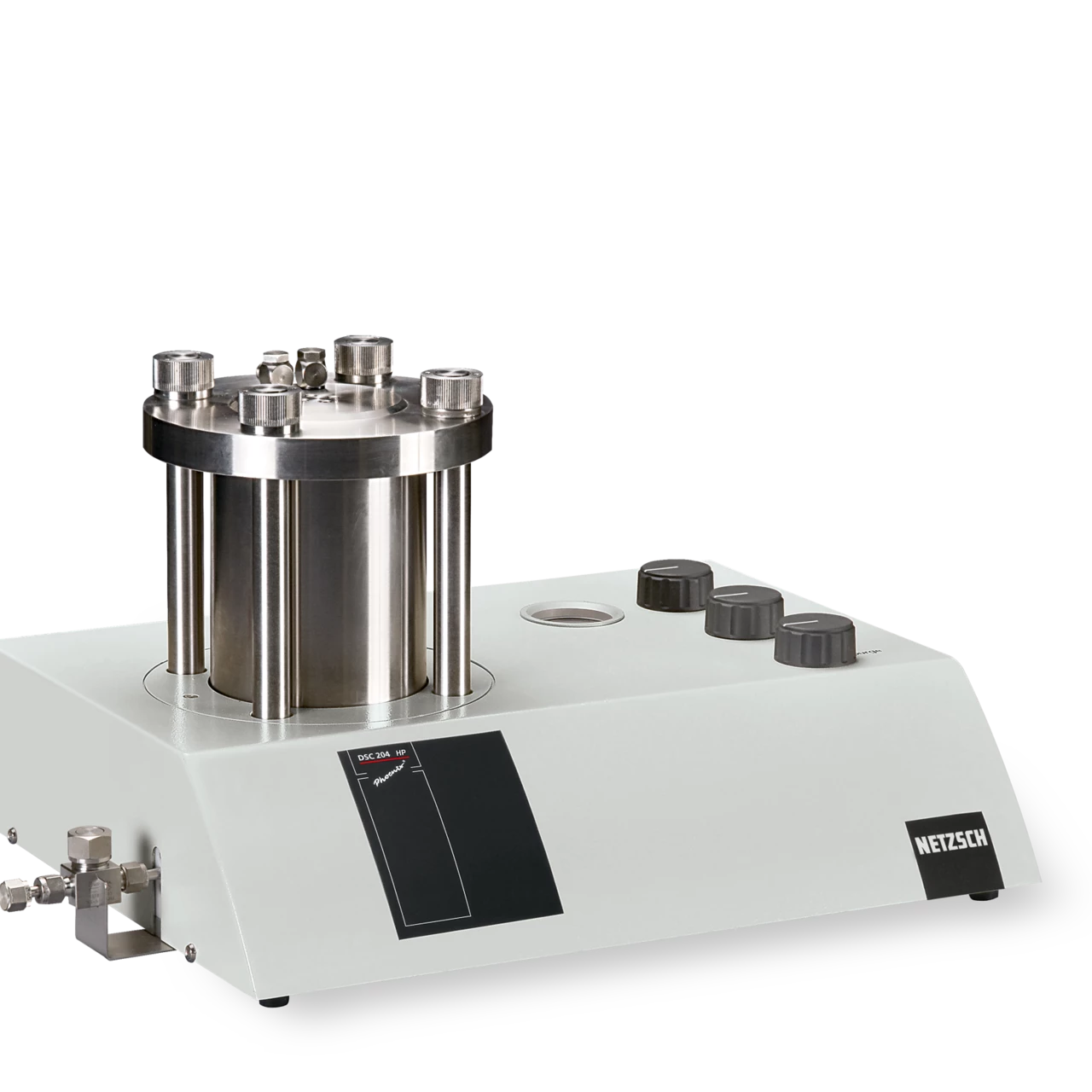
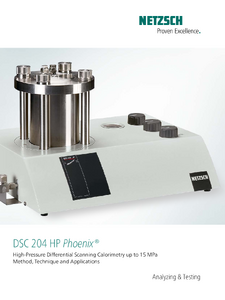
DSC 204 HP Phoenix®
High-pressure DSC up to 150 bar
Highlights
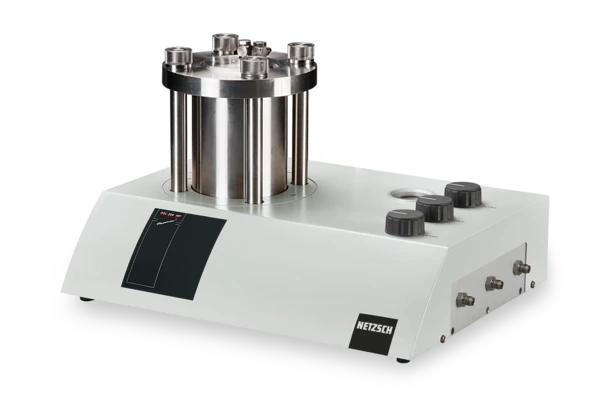
The high-pressure DSC for measurements in inert or reactive gas atmospheres
Numerous physical processes and chemical reactions are influenced by the surrounding gas pressure. In practise it is therefore often necessary to conduct DSC measurements under an increased pressure.
With the high-pressure Differential Scanning Calorimeter, DSC 204 HP Phoenix®, thermal effects in a sample can be analyzed in the pressure range from vacuum to 15 MPa (150 bar) and at temperatures from -150°C to 600°C, depending on the type of gas.
The sample chamber atmosphere can be static or dynamic. The electronic pressure monitor and control, along with exact regulation of the purge gas flow, provide for excellent accuracy and reproducibility of the measurement results.
The proven CC 200 L for liquid nitrogen cooling is available for the low-temperature range.
The safety of the high-pressure DSC system has been certified through design tests and is guaranteed during operation by the appropriate safety components.


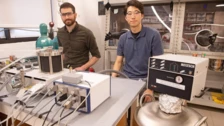
NETZSCH Analysis Instruments at Harvard University
"We chose to work with NETZSCH’s HP-DSC because of its versatility and robustness. By allowing us to reliably access high pressures up to 150 bar with a wide range of gas environments, NETZSCH’s HP-DSC has greatly facilitated our group’s efforts to investigate Phase TransitionsThe term phase transition (or phase change) is most commonly used to describe transitions between the solid, liquid and gaseous states.phase transitions in next-generation thermal materials."
Prof. Jarad Mason - Assistant Professor of Chemistry and Chemical Biology at Mason Group at Harvard University
Method
High-Pressure Differential Scanning Calorimetry (HP-DSC)
Differential Scanning Calorimetry (DSC) allows not only for the determination of phase transformation temperatures but also for the quantification of transformation enthalpies.
A type of modified DSC, in which the measurement cell is installed in an autoclave (a "pressure DSC"), allows measurements to be carried out at pressures ranging from 5 kPa to 15 MPa (high-pressure DSC).
High-pressure DSC measurements can be performed in inert or reactive gas atmospheres. When an inert gas is used, the pressure dependence can be studied when the sample transformation (usually a caloric effect) is also accompanied by a volume change. This allows dehydration and Decomposition reactionA decomposition reaction is a thermally induced reaction of a chemical compound forming solid and/or gaseous products. decomposition reactions with gas release to be studied by pressure DSC. When a reactive gas is used, the gas becomes one of the reactants and the pressure is a measure of its concentration. This method can be used to perform aging tests on organics (such as oils, fats, waxes, greases, etc.) and polymers.

Measuring Principle of a High-Pressure DSC
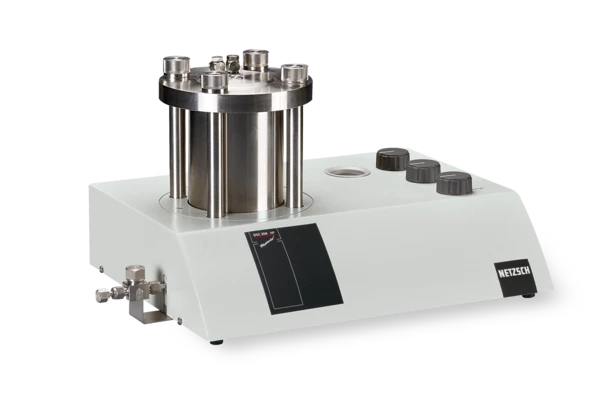
In contrast to the setup of a regular DSC, the measuring cell of a high-pressure DSC (HP-DSC) is surrounded by an autoclave which is supported by pressure and gas flow control systems.
Pressure and purge gas flow are adjusted via a separate control board. With the help of liquid nitrogen cooling, it is even possible to achieve temperature programs in the subambient range.
The heating and cooling rates achieved (0.01 K/min to 100 K/min and to 50 K/min, respectively) as well as the maximum and minimum temperatures are significantly influenced by the atmosphere and pressure used.
Specifications
Technical Data
High-Pressure DSC for the most varied applications:
- Determination of vapor pressure and evaporation heat (ASTM E1782)
- Separation of reactions with overlapped evaporation
- Measurement of adsorption and desorption, e.g. on metallic compounds
- OxidationOxidation can describe different processes in the context of thermal analysis.Oxidation stability of oils, fats and lubricants (ASTM E1858, ASTM D6186, ASTM E2009, ASTM D5483)
- Curing of thermosets, e.g. phenolic resin
- Vulcanization of rubbers
- Hydration of unsaturated fatty acids
DSC measurements under ambient pressure can, of course, also be conducted with the DSC 204 HP Phoenix®.
The DSC 204 HP Phoenix® can either be equipped with only an electronic pressure regulator for static pressure or additionally with an electronic flow controller for work under dynamic gas atmospheres. The digital display for pressure and flow rate guarantee control independent of the computer. Pressure reducers and fittings with different adapters for the various gases are available.
A vacuum pump serves both for evacuation of the autoclave, followed by backfilling with a defined gas, and for measurements in static vacuum.
The CC 200 L is used for work at sub-ambient temperature for controlled cooling with liquid nitrogen.Open aluminum crucibles (pans) or crucibles (pans) with punched lids are used for most applications.A special temperature and enthalpy calibration kit is available for the high-pressure DSC.
Temperature range
(depending on the gas type)
-150°C to 600°C (at 1 bar)
-90°C to 600°C (at 50 bar)
-50°C to 450°C (at 150 bar)
Measurements in different atmospheres
inert:N2, noble gases
reducing:H2
oxidizing:O2,CO2, air
Exact gas flow regulation
up to 500 ml/min
Software
Proteus®: Excellent Thermal Analysis Software
The DSC 204 HP Phoenix® runs under Proteus® Software on Windows®. The Proteus® Software includes everything you need to carry out a measurement and evaluate the resulting data. Through the combination of easy-to-understand menus and automated routines, a tool has been created that is extremely user-friendly and, at the same time, allows sophisticated analysis. The Proteus® Software is licensed with the instrument and can of course be installed on other computer systems.
DSC features:
- Determination of onset, peak, inflection and end temperatures
- Automatic peak search
- Transformation enthalpies: analysis of peak areas (enthalpies) with selectable baseline and partial peak area analysis
- Evaluation of CrystallizationCrystallization is the physical process of hardening during the formation and growth of crystals. During this process, heat of crystallization is released.crystallization
- Comprehensive Glass Transition TemperatureThe glass transition is one of the most important properties of amorphous and semi-crystalline materials, e.g., inorganic glasses, amorphous metals, polymers, pharmaceuticals and food ingredients, etc., and describes the temperature region where the mechanical properties of the materials change from hard and brittle to more soft, deformable or rubbery.glass transition analysis
- Automatic baseline correction
- Specific heat determination
- Recording and evaluation of the pressure signal

Downloads and Media
Brochures
- DSC 204 HP Phoenix®Brochure(pdf – 2.02 MB)
- DSC 204 HP Phoenix®Data Sheet(pdf – 27 KB)

- Accessories for Differential Scanning Calorimeters and ThermobalancesAccessories Catalogue(pdf – 7.37 MB)

- Thermal and Rheological Characterization of PolymersBrochure(pdf – 6.2 MB)

- Shape the future of paints and coatingsBrochure together with Malvern Panalytical(pdf – 1.45 MB)