Highlights
HFM 706 Lambda Series: Precision Thermal ConductivityThermal conductivity (λ with the unit W/(m•K)) describes the transport of energy – in the form of heat – through a body of mass as the result of a temperature gradient (see fig. 1). According to the second law of thermodynamics, heat always flows in the direction of the lower temperature.Thermal Conductivity Measurements
Tailored to Your Sample Size
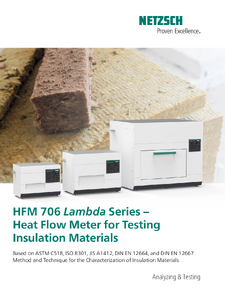
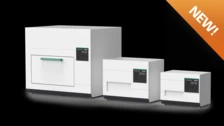
Three Instrument Versions for Every Sample Size: Small, Medium, and Large
The HFM 706 Lambda Series offers three versatile instrument versions designed to fit your unique sample dimensions perfectly. Whether you're testing small laboratory specimens or large industrial materials, our models ensure precise and reliable measurements.
The HFM 706 Lambda Medium is Ideal for Samples up to 305 mm x 305 mm x 105 mm in Height
The Small and Large versions can accommodate smaller and larger samples, providing flexibility across applications.
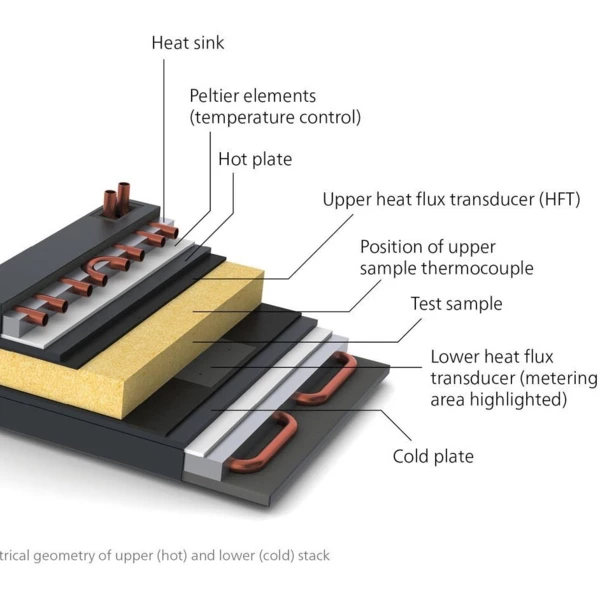
High-Sensitivity Heat Flux Transducers for Accurate Thermal Analysis
The HFM 706 Lambda Series is equipped with dual heat flux transducers that continuously monitor heat flow with exceptional sensitivity and accuracy. Our advanced calibration process uses reference materials with known Thermal ConductivityThermal conductivity (λ with the unit W/(m•K)) describes the transport of energy – in the form of heat – through a body of mass as the result of a temperature gradient (see fig. 1). According to the second law of thermodynamics, heat always flows in the direction of the lower temperature.thermal conductivity. By combining multiple calibration methods, we offer a high measurement precision. This way, you get reliable, reproducible data, every time.
Achieve Faster Results and Enhanced Performance with Modern Peltier Technology
Experience precise temperature management with our advanced Peltier temperature control system for hot and cold plates. Powerful, bidirectional Peltier elements paired with an external chiller ensure rapid and accurate heating and cooling of each plate. This optimized temperature control quickly achieves thermal equilibrium, providing reliable, consistent data in less time and boosting your laboratory’s productivity and efficiency.
Optimized Test Chamber Design Provides Reliable Results and Minimal Condensation
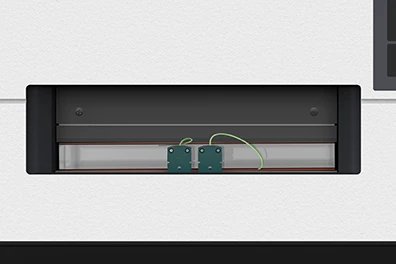
Our innovative test chamber minimizes environmental interference and significantly reduces reduces condensation effects inside the testing chamber and on the plate surfaces. For even better control, an optional dry gas purge feature maintains optimal humidity levels, creating consistent test conditions and enhancing measurement reliability.
Beyond Thermal ConductivityThermal conductivity (λ with the unit W/(m•K)) describes the transport of energy – in the form of heat – through a body of mass as the result of a temperature gradient (see fig. 1). According to the second law of thermodynamics, heat always flows in the direction of the lower temperature.Thermal Conductivity: Analysis of the Specific Heat Capacity (Specific Heat Capacity (cp)Heat capacity is a material-specific physical quantity, determined by the amount of heat supplied to specimen, divided by the resulting temperature increase. The specific heat capacity is related to a unit mass of the specimen.cp)
The HFM 706 Lambda hardware and software determine the Specific Heat Capacity (cp)Heat capacity is a material-specific physical quantity, determined by the amount of heat supplied to specimen, divided by the resulting temperature increase. The specific heat capacity is related to a unit mass of the specimen.specific heat capacity (Specific Heat Capacity (cp)Heat capacity is a material-specific physical quantity, determined by the amount of heat supplied to specimen, divided by the resulting temperature increase. The specific heat capacity is related to a unit mass of the specimen.cp) of your samples, providing a complete thermal profile. This dual-function capability enhances the versatility of your measurements and provides deeper insights into material properties for research and quality control.

Energy-saving Eco and Idle modes
Today, global attention towards saving and efficiently using energy has never been higher. Industries and academia worldwide are actively researching ways to conserve energy and utilize alternative resources.
To support this, the HFM 706 Lambda Series offers two programmable energy-saving standby modes: Eco Mode and Idle Mode. In Eco Mode, both the plate temperature control and the chiller are completely turned off, which reduces energy consumption to nearly zero during long idle periods, such as nights and weekends. This significantly lowers operational costs and environmental impact. In Idle Mode, the chiller runs at low power (0.5–1.0 kW) to maintain plate temperatures at preset levels, enabling a fast restart of measurements while still saving energy compared to full operation.
These modes optimize energy efficiency, reduce CO₂ emissions, and enhance lab sustainability without compromising readiness or performance.
Method
Measurement of Thermal ConductivityThermal conductivity (λ with the unit W/(m•K)) describes the transport of energy – in the form of heat – through a body of mass as the result of a temperature gradient (see fig. 1). According to the second law of thermodynamics, heat always flows in the direction of the lower temperature.Thermal Conductivity - Improving Energy Efficiency
Thermal conductivity is a measure of a material's ability to transport energy. It quantifies how well heat can move through a substance. The most common method for measuring Thermal ConductivityThermal conductivity (λ with the unit W/(m•K)) describes the transport of energy – in the form of heat – through a body of mass as the result of a temperature gradient (see fig. 1). According to the second law of thermodynamics, heat always flows in the direction of the lower temperature.thermal conductivity is the steady-state method, also known as the heat flow meter method.


The HFM is an exact, fast and easy-to-use instrument for measuring the low Thermal ConductivityThermal conductivity (λ with the unit W/(m•K)) describes the transport of energy – in the form of heat – through a body of mass as the result of a temperature gradient (see fig. 1). According to the second law of thermodynamics, heat always flows in the direction of the lower temperature.thermal conductivity λ of insulation materials.
In a heat flow meter (HFM), the test specimen is placed between two heated plates controlled to a user-defined mean sample temperature and temperature gradient to measure heat flowing through the specimen. The sample thickness L is measured by an internal thickness gauge. Alternatively, the user can enter and drive to the desired thickness, which is of particular interest for compressible samples. The heat flow Q through the sample is measured by two calibrated heat flux transducers covering a large area of both sides of the specimen.
After reaching thermal equilibrium, the test is done. The heat flux transducer output is calibrated using a reference standard. For the calculation of the Thermal ConductivityThermal conductivity (λ with the unit W/(m•K)) describes the transport of energy – in the form of heat – through a body of mass as the result of a temperature gradient (see fig. 1). According to the second law of thermodynamics, heat always flows in the direction of the lower temperature.thermal conductivity λ and the thermal resistance R, the average heat flux Q/A, the sample thickness L, and the temperature gradient ΔT are used, in accordance with Fourier’s Law.
- What is the heating/cooling load of a building?
- How does this change with the weather and how can you improve it?
- How can I ensure the quality of my insulation material production?
- What is the right thickness for my insulation material so that it meets the national and international guidelines for building insulation?
To answer questions like these, material properties such as Thermal DiffusivityThermal diffusivity (a with the unit mm2/s) is a material-specific property for characterizing unsteady heat conduction. This value describes how quickly a material reacts to a change in temperature.thermal diffusivity and Thermal ConductivityThermal conductivity (λ with the unit W/(m•K)) describes the transport of energy – in the form of heat – through a body of mass as the result of a temperature gradient (see fig. 1). According to the second law of thermodynamics, heat always flows in the direction of the lower temperature.thermal conductivity must be known.
For the analysis of lower-conductivity materials such as fiber insulations or vacuum insulation panels, NETZSCH stands out with various types of heat flow meters (HFM) for diverse sample dimensions and temperature ranges.
The most important role here is played by the material parameter thermal conductivity (amount of heat per second flowing through a material layer of a thickness of 1 meter and an area of 1 m² when the temperature difference amounts to 1 K). The thicker the material layer through which the heat flows, the higher the thermal resistance (R-Value) that the material layer presents to the quantity of heat to be transported. The reciprocal value of the thermal resistance is the thermal transmittance (U-Value), usually specified for structural components.
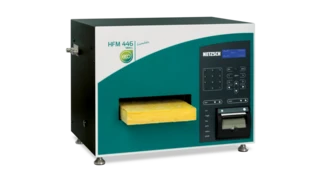
No matter whether for expanded polystyrene (EPS), extruded polystyrene (XPS), PU rigid foam, mineral wool, bloated perlite or foam glass, cork, fleece or natural fiber materials – no matter whether for building materials containing phase change materials, aerogels, concrete, plaster or polymers or even high performing insulation materials like vacuum insulation panels (VIP's) – the new HFM 446 Lambda Eco-Line features a new standardized method for the measurement of thermal conductivity which is equally applicable in research and development and in quality assurance.
he HFM 706 Lambda Series is an advanced instrument range designed for accurate and efficient thermal conductivity measurements of a wide variety of materials, including insulating materials, polymers, phase-change materials, aerogels, and non-wovens. Designed for accuracy and efficiency, this advanced instrument features a quick setup process that uses factory calibration with international certified reference material to ensure reliable results from the outset.
It offers measurement speeds up to 40% faster than previous models and features energy-saving Eco and Idle modes that reduce power consumption without compromising performance. The closed test chambers maintain optimal conditions by minimizing environmental interference and preventing condensation, ensuring consistent, high-quality data.
Innovative capabilities include:
- Precise sample thickness and parallelism measurement via a two-axis inclinometer
- High throughput enabled by motorized plate and door movement
- Extended thermal conductivity range with external thermocouple support
Advanced features, such as the drive-to-thickness function and heat flux transducer (HFT) multi-calibration, enhance measurement accuracy and precision. The HFM 706 Lambda Series supports full quality assurance documentation and complies with industry standards through stability configuration management.
Its user-friendly design ensures smooth operation across multiple operating systems and languages. Additionally, the instrument offers Specific Heat Capacity (cp)Heat capacity is a material-specific physical quantity, determined by the amount of heat supplied to specimen, divided by the resulting temperature increase. The specific heat capacity is related to a unit mass of the specimen.specific heat capacity (Cp) measurement using the step method, providing comprehensive thermal analysis in one versatile device.
The HFM 706 Lambda Series is based on various relevant standards, e.g., ASTM C518, ISO 8301, JIS A1412, DIN EN 12664* and DIN EN 12667.
* not for HFM 706 Lambda Large
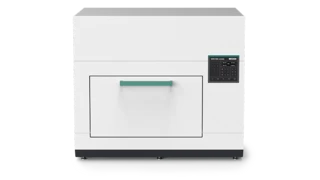
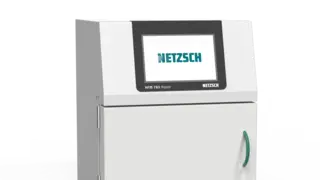
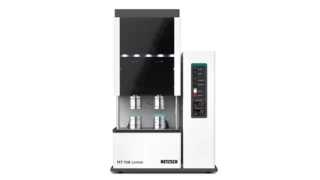
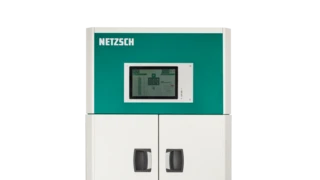
NETZSCH offers more exciting products that support you in measuring Thermal Conductivity:
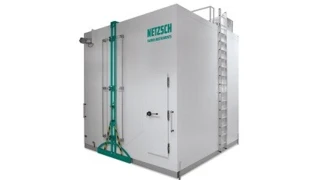
Specifications
| HFM 706 Lambda Medium | |
|---|---|
| Standards | ASTM C518, ISO 8301, JIS A1412, DIN EN 12667, DIN EN 12664 |
| Type | Bench-top device |
| Thermal conductivity range | 0.002 to 2 W/(m·K)** Small and Medium: 2.0 W/(m·K) achievable with optional instrumentation kit, recommended for hard materials and those with higher thermal conductivity Performance data:
→ All performance data is verified with NIST SRM 1450 D (thickness 25 mm) |
| Plate temperature range | -20°C to 90°C, optional: -30° to 90°C |
| Air-tight system | Sample compartment with possibility to introduce purge gas |
| Metering area heat flux transducer | 102 mm x 102 mm |
| Chiller system | External; constant temperature setpoint over plate temperature range |
| Plate temperature control | Peltier system |
| Plate motion | Motorized |
| Plate thermocouples | Three thermocouples on each plate, type K (two extra thermocouples with instrumentation kit) |
| Thermocouple resolution | ± 0.01°C |
| Number of setpoints | Up to 99 |
| Specimen sizes (max.) | 305 mm x 305 mm x 105 mm |
| Variable load/ contact force | 0 to 1930 N (21 kPa on 305 x 305 mm²) Force-controlled adjustment of the contact force or the desired thickness, and thus DensityThe mass density is defined as the ratio between mass and volume. density, of compressible materials |
| Thickness determination |
|
| Software features |
|
** Please note: In the very low thermal conductivity range, accuracy of Lambda (λ) values can be limited.
Accessories and more:
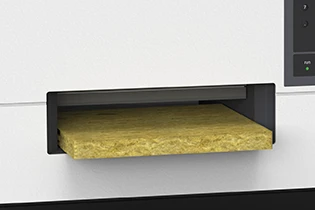
NETZSCH offers the internationally certified ERM-440 standard, as well as its own factory-certified NETZSCH EPS (expanded polystyrene) standard. The EPS standard is designed specifically for calibrating and validating all HFM 706 Lambda instruments to ensure precise and reliable measurements. Effective within a temperature range of 8°C to 40°C, it supports consistent performance in thermal conductivity testing.
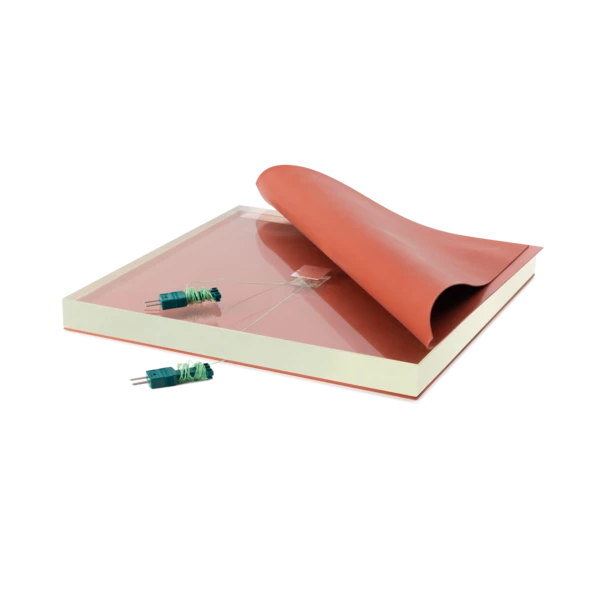
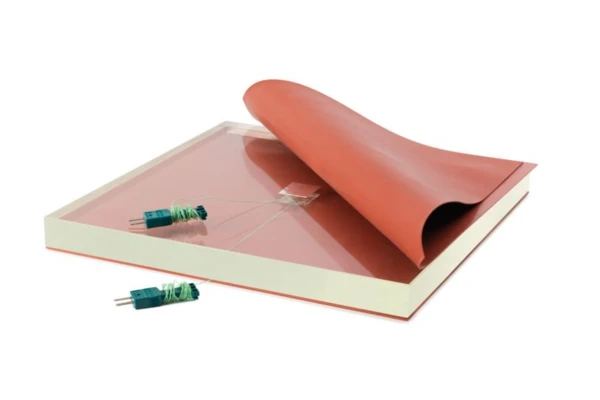
The HFM 706 Lambda series offers an optional instrumentation kit for testing low thermal resistance materials like concrete, wood, and brick (down to 0.02 (m²·K)/W). The kit includes thin rubber pads and auxiliary thermocouples for specimen surfaces, boosting temperature accuracy for precise measurements.
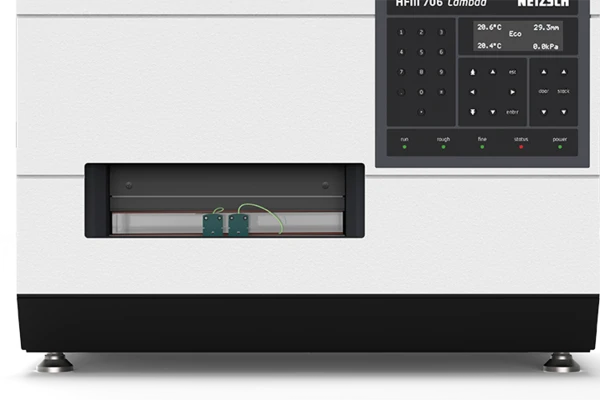
Along with the thermal conductivity, the HFM 446 Lambda Small and Medium instruments allow for determination of the Specific Heat Capacity (cp)Heat capacity is a material-specific physical quantity, determined by the amount of heat supplied to specimen, divided by the resulting temperature increase. The specific heat capacity is related to a unit mass of the specimen.specific heat capacitySpecific Heat Capacity (cp)Heat capacity is a material-specific physical quantity, determined by the amount of heat supplied to specimen, divided by the resulting temperature increase. The specific heat capacity is related to a unit mass of the specimen.cp by using the calibration factors and accounting for contribution of the thermal mass of the plates
Brochures and Data Sheets

Software
Software highlights at a glance
Highest level of comfort
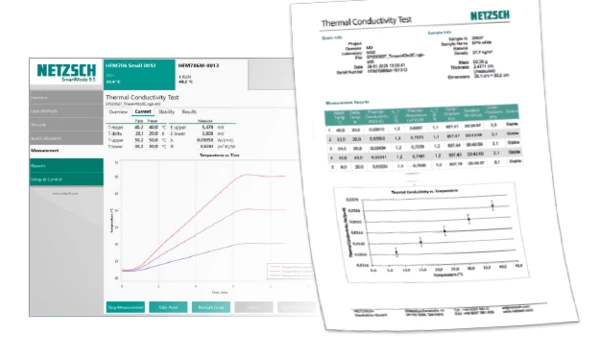
SmartMode is the user-friendly, smoothly running user interface of the HFM Proteus® software. It is characterized by a logical structure which quickly gives a clear overview of the current measurement status and provides various report and export possibilities. After completing the test, all relevant results can be directly printed out by the integrated printer or a report can be created by the software when a PC is connected.
Calibration in Next to no Time
For calibration purposes, the thermal conductivity values of the most common certified reference materials, such as NIST SRM 1450d, are already stored in the software. However, AutoCalibration also offers the ability to create calibration curves for any user-defined material on the basis of up to 99 freely selectable temperatures.
The MultiCalibration function combines calibrations of the same type and thickness to reduce uncertainty or of different types and thicknesses to measure samples of different thicknesses. It's more flexible and convenient.
Find out even more:
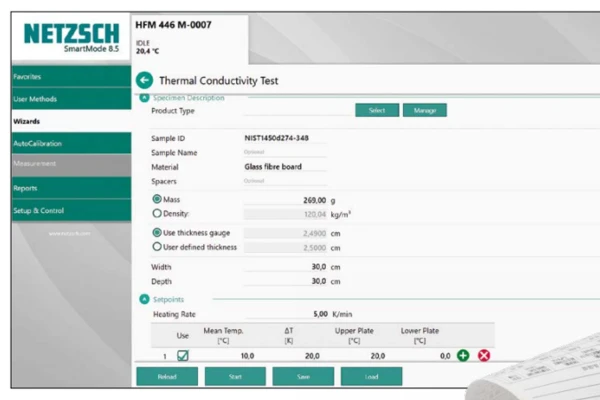
The “Wizards” button allows for manual parameter input, while the User Methods button retrieves parameter sets defined by the user beforehand. Such “User Methods” can also be transferred to “Favorites” for faster access if they are used frequently.
The button “Reports” allows for reports to be generated quickly and easily by granting access to various templates; one of these templates meets all of the requirements stipulated by ASTM C518. Each report can be adapted to the customer‘s own corporate identity. In addition, data can easily be exported into either Word or Excel format with just a few mouse clicks. The “Full” export button exports data, graphs and results together into a single file. Measurement data is stored in binary format and is thus fully tamperproof.
Theλ90/90 value is the basis for determination of the declared value of the thermal conductivity within the realm of CE declarations of building materials. It is calculated from a measurement series of at least 10 measurements and states which thermal conductivity values to a probability of 90%, can be achieved for 90% of the output production volume. The integrated report calculates the λ90/90 value by a mouse mouse click. The calculation is based on your measurements; no additional documentation and calculation are required.
Any measurement can be started by using the pre-defined instrument parameters (including number and position of thermocouples, stability criteria, etc.). However, experienced users who wish to apply their own parameter sets can define them under “Setup & Control”.
E-Learning

Downloads and Media
Brochure
Videos
Engineered for Excellence – Discover the New HFM 706 Lambda Series by NETZSCH
Application Literature
Blog Articles
- 14.01.2026
Learn, Apply, Achieve: NETZSCH Launches Free E-Learning Courses on Thermoanalytical Methods

- 08.10.2025
NETZSCH Group Publishes First Sustainability Report

- 23.07.2025
Precise, Fast, and Intuitive Measurement of Thermal Conductivity: Discover the New NETZSCH HFM 706 Lambda Series
- 03.06.2025
NEW NETZSCH TECH TALK: Discover the Future of Thermal Analysis in Just 30 Minutes!