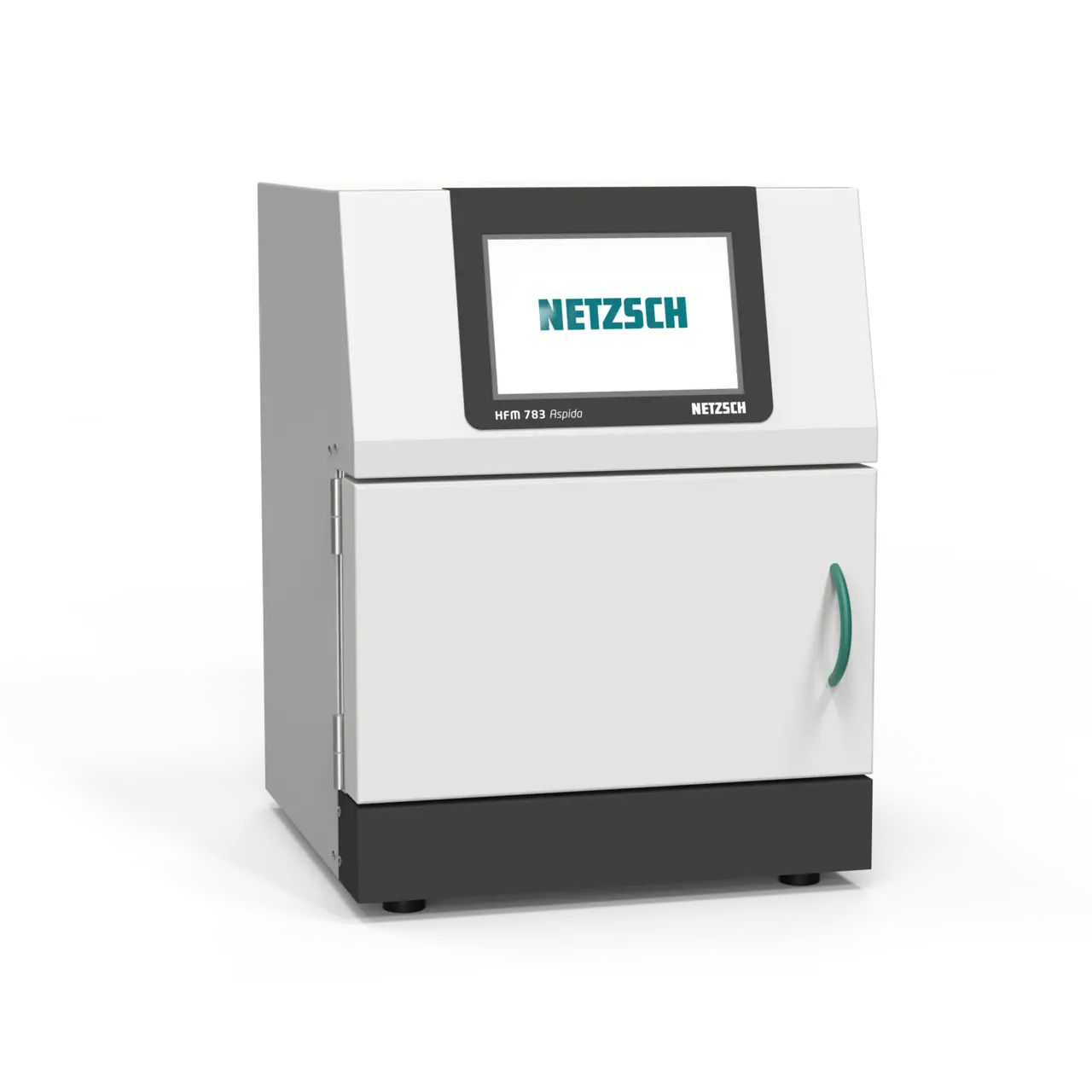
HFM 783 Aspida
Heat Flow Meter
Highlights
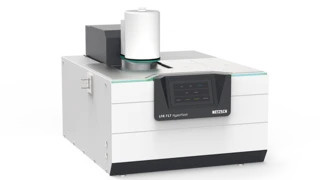
HFM 783 Aspida: Exceptional Value for Quality Control and Research
Excellent Price/Performance Ratio
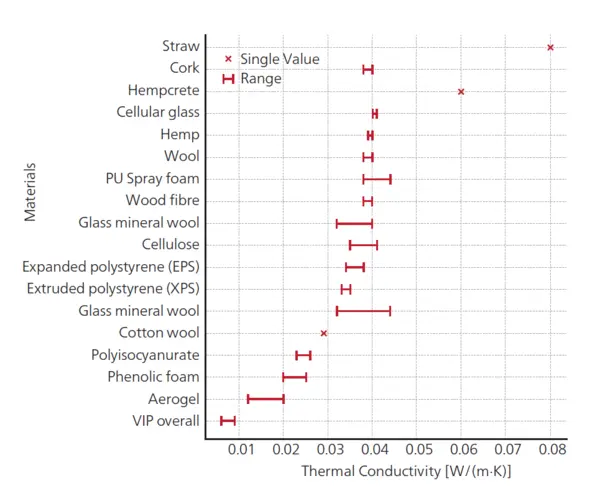
Economical solution for analyzing Thermal ConductivityThermal conductivity (λ with the unit W/(m•K)) describes the transport of energy – in the form of heat – through a body of mass as the result of a temperature gradient (see fig. 1). According to the second law of thermodynamics, heat always flows in the direction of the lower temperature.thermal conductivity in a compact size. Ideal as an entry level device for quality control in insulation industry.
User friendly Design for Standard Sample Sizes
Designed to handle square samples up to 300 mm wide and 100 mm thick, delivering exceptional flexibility across a broad range of applications. User-friendly software over touch display make it the ideal choice for both novice and experienced users.
Wide measurement range
Measure Thermal ConductivityThermal conductivity (λ with the unit W/(m•K)) describes the transport of energy – in the form of heat – through a body of mass as the result of a temperature gradient (see fig. 1). According to the second law of thermodynamics, heat always flows in the direction of the lower temperature.thermal conductivity across an extensive range of λ values from 0.002 to 0.5 W/m·K while operating seamlessly within temperatures from -10°C to 70°C
Achieve Faster Results and Enhanced Performance with Modern Peltier Technology
Experience precise temperature management with our advanced Peltier temperature control system for hot and cold plates. Powerful Peltier elements paired with an external chiller ensure rapid and accurate heating and cooling of each plate. The optimized temperature control quickly achieves thermal equilibrium, providing reliable results.
Service and maintenance friendly design
Designed with service andmaintenance in mind, the stainless steel chamber provides easy access and quick cleaning. Its highly service-friendly design supports efficient maintenance, and its simple operation improves ease of use.
Improving Energy Efficiency
Accurate heat flow measurements provide insight into the efficiency of insulation materials and help Identify areas prone to energy loss.
This information is essential for developing energy-efficient solutions in building and machinery design.
Method
Thermal ConductivityThermal conductivity (λ with the unit W/(m•K)) describes the transport of energy – in the form of heat – through a body of mass as the result of a temperature gradient (see fig. 1). According to the second law of thermodynamics, heat always flows in the direction of the lower temperature.Thermal Conductivity - Measurement of the Relative Heat Flow
using a Heat Flow Meter (HFM)
Thermal conductivity is a measure of a material's ability to transport energy. It quantifies how well heat can move through a substance. The most common method for measuring Thermal ConductivityThermal conductivity (λ with the unit W/(m•K)) describes the transport of energy – in the form of heat – through a body of mass as the result of a temperature gradient (see fig. 1). According to the second law of thermodynamics, heat always flows in the direction of the lower temperature.thermal conductivity is the steady-state method, also known as the heat flow meter method.

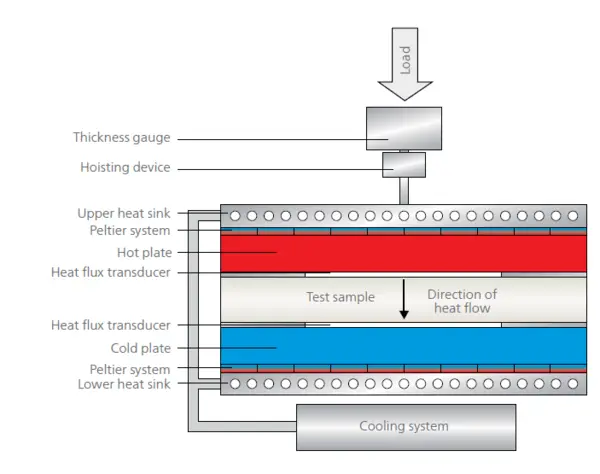
The HFM is an exact, fast and easy-to-use instrument for measuring the low Thermal ConductivityThermal conductivity (λ with the unit W/(m•K)) describes the transport of energy – in the form of heat – through a body of mass as the result of a temperature gradient (see fig. 1). According to the second law of thermodynamics, heat always flows in the direction of the lower temperature.thermal conductivity λ of insulation materials.
In a heat flow meter (HFM), the test specimen is placed between two heated plates controlled to a user-defined mean sample temperature and temperature gradient to measure heat flowing through the specimen. The sample thickness L is measured by an internal thickness gauge. Alternatively, the user can enter and drive to the desired thickness, which is of particular interest for compressible samples. The heat flow Q through the sample is measured by two calibrated heat flux transducers covering a large area of both sides of the specimen.
After reaching thermal equilibrium, the test is done. The heat flux transducer output is calibrated using a reference standard. For the calculation of the Thermal ConductivityThermal conductivity (λ with the unit W/(m•K)) describes the transport of energy – in the form of heat – through a body of mass as the result of a temperature gradient (see fig. 1). According to the second law of thermodynamics, heat always flows in the direction of the lower temperature.thermal conductivity λ and the thermal resistance R, the average heat flux Q/A, the sample thickness L, and the temperature gradient ΔT are used, in accordance with Fourier’s Law.
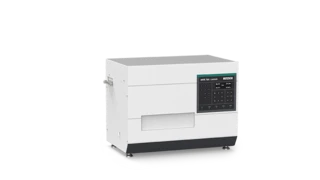
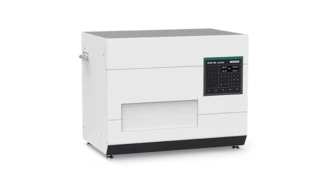
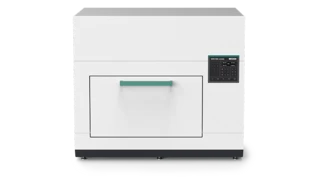
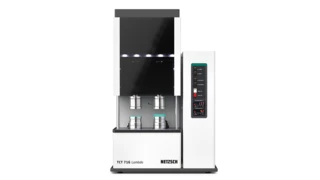
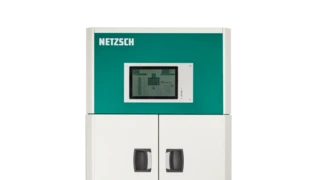
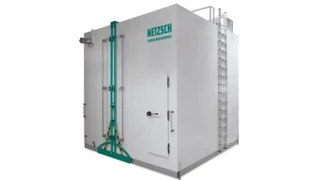
NETZSCH offers more exciting products that support you in measuring Thermal Conductivity:
Specifications
| HFM 783 | |
|---|---|
| Standards* | Heat flow meter method according to ISO 8301, ASTM C 518, DIN EN 12664, EN 12667, JIS A1412-2 |
| Type | Stand-alone, with integrated touch display |
| Thermal conductivity range | 0.002 to 0.5 W/(m·K)** Performance data:***
|
| Plate temperature range | -10°C bis 70°C |
| Metering area heat flux transducer | 100 mm x 100 mm |
| Specimen size (max.) | 300 mm x 300 mm x 100 mm |
| Chiller system | External; constant temperature setpoint over plate temperature range |
| Plate temperature control | Peltier system |
| Plate motion | Motorized |
| Plate thermocouples | PT 100 |
| Thermocouple resolution | ± 0.01K |
| Variable load/ contact force | 0 - 500 N (5.5 kPa) |
*Additionally for product and measurement technique related standards, e.g., DIN EN 13162, EN 13163, EN 13164, EN 13165, EN 12939, EN 1946-3
** others on request
*** All performance data is verified with NIST SRM 1450d (thickness 25 mm). Please note: in the very low thermal conductivity range, accuracy of Lambda (λ) values can be restricted.
Accessories and more:
Brochures and Data Sheets


Software
Software highlights
Everything at a glance
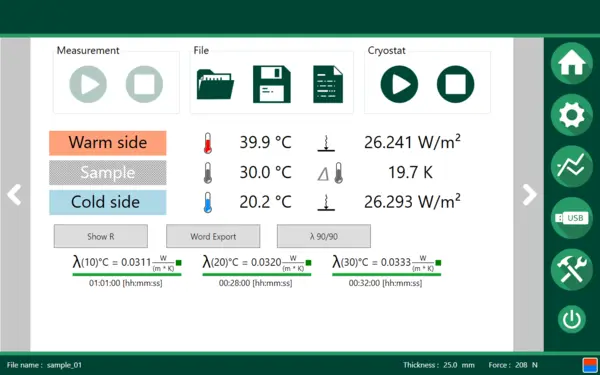
The integrated, full-color display provides instant access to all critical measurement data, making testing faster, easier, and more intuitive. You can clearly view the hot and cold plate temperatures, mean temperature, temperature difference, and heat flow on both the hot and cold sides in real time. The measurement results are presented in a clear, easy-to-read format, enabling quick analysis, improved accuracy, and greater confidence in every test.
Highest level of comfort
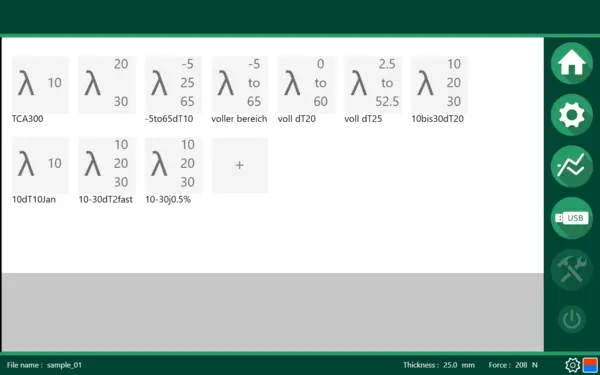
Predefined measurement methods simplify operation and ensure consistent, repeatable testing across your organization. Ideal for quality assurance environments with multiple operators, predefined setups allow users to begin the correct measurement with a single selection. Whether you are performing time-based tests or measurements with stability criteria, every test follows the same validated procedure, reducing operator error, improving efficiency, and delivering reliable, comparable results every time.
Calibration in next to no time
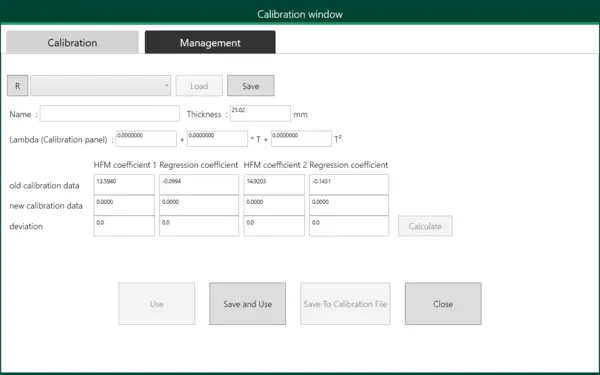
For calibration purposes, the thermal conductivity values of the provided reference material such as NIST SRM 1450d, are already stored in the software. However, other reference data can always be integrated into the software.
Find out even more:
E-Learning
Become an Expert with our Free E-Learning Courses
All NETZSCH E-Learning Basic Courses are free of charge! The content is created by our laboratory method experts, who share their personal experiences with you. Take advantage of flexible online learning, fully adapted to your training needs!
Related Devices

Consultancy & Sales
Do you have further questions about the instrument or the method and would like to speak to a sales representative?
Service & Support
Do you already have an instrument and need technical support or spare parts?