TG 309 Libra® Classic
Ensure product quality and safety by detecting mass changes.
Highlights
Analyze the unique thermal behavior of materials and their components
TG 309 Libra® Classic
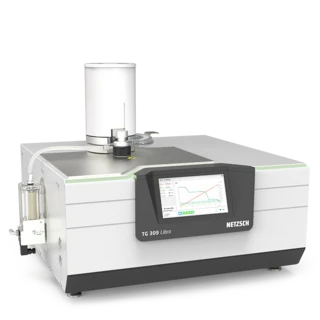
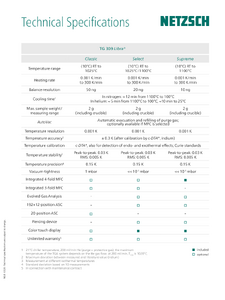
The TG 309 Libra® Classic is the device with the best price-performance ratio in the Libra® series. It is the ideal instrument for Quality Control. The Classic offers a temperature range from 10 °C up to 1025 °C. In addition, it can be equipped with a 20-position ASC (Automatic Sample Changer).
Get Results Faster Without a Baseline Run
To ensure accurate mass change values, a baseline run is typically conducted under test conditions that are identical in terms of heating rate, gas type, and gas flow.
The baseline takes factors such as heating rate, crucible type and geometry into account while also accounting for instrument and buoyancy effects, thus allowing these to be subtracted from the sample measurement.
The TG 309 Libra® typically eliminates the need for a separate baseline run when using the integrated BeFlat® baseline run for typical temperature measurements. This significantly speeds up tests.

20 Times Faster Thanks to High Heating Rates
The TG 309 Libra® has a low-volume furnace. It supports rapid heating rates of up to 300K/min over the entire temperature range and fast ballistic cooling from 1025°C down to room temperature. This allows for faster analysis results, even at high temperatures, with a turnaround time of just a few minutes.
More Comprehensive and Faster Characterization by Patented c-DTA®
In direct contact with the sample crucible, the sample thermocouple measures temperature variations in the material. This enables more thorough characterization of sample properties and determination of EndothermicA sample transition or a reaction is endothermic if heat is needed for the conversion.endothermic (e.g., melting) and ExothermicA sample transition or a reaction is exothermic if heat is generated.exothermic (e.g., OxidationOxidation can describe different processes in the context of thermal analysis.oxidation) effects during thermogravimetric investigations. In addition,c-DTA® allows for temperature calibration using DSC reference materials.

Our Quality Promise:
NETZSCH’s Unlimited Warranty
At NETZSCH, our commitment to quality goes beyond the instruments themselves. We understand that your investment in advanced technology is a long-term one, and and that’s why we offer something truly unique – our Unlimited Warranty.
Method
Thermogravimetric Analysis / Thermogravimetry
What is Thermogravimetry?
Thermogravimetry has the ability for differentiation between individual components based on their distinct thermal behavior. By analyzing weight-loss profiles, users can deduce the composition of complex samples, enabling deeper understanding of their structure and properties.
Revealing the Mysteries of Complex Mixtures and Material Transformations
Thermogravimetry (TG) is renowned for its precision and sensitivity. By subjecting a sample to controlled temperature increments while continuously measuring its weight change, TGA can detect even the slightest alterations in a material‘s mass. This level of sensitivity allows for pinpointing the exact temperatures at which various transformations occur, such as Decomposition reactionA decomposition reaction is a thermally induced reaction of a chemical compound forming solid and/or gaseous products. decomposition, volatilization, or OxidationOxidation can describe different processes in the context of thermal analysis.oxidation. As a result, TGA provides valuable insights into a material‘s composition, providing such information as stability and degradation data for polymers along with data for material characterization and formulation.
Ensuring Product Quality and Safety
For industries like pharmaceuticals, chemicals, and food, ensuring product stability is very important. Thermogravimetry plays a vital role in evaluating the Thermal StabilityA material is thermally stable if it does not decompose under the influence of temperature. One way to determine the thermal stability of a substance is to use a TGA (thermogravimetric analyzer). thermal stability of materials over time. By subjecting samples to extended thermal cycling, researchers can assess their long-term stability, obtain initial information about shelf-life, and identify potential degradation pathways. This information is critical for quality control and regulatory compliance.
Unlimited Versatility: Tailored for Diverse Applications
One of the remarkable qualities of thermogravimetry is that it can be adapted to a wide range of applications. From the polymer industry to materials engineering, and from pharmaceutical research to environmental science, TGA is a versatile technique that transcends disciplinary boundaries. Its capability of providing fundamental insights into materials makes it indispensable for materials characterization, from quality control to industrial research and academic applications.
- Mass changes
- Identification
- Compositional analysis
- Decomposition reactionA decomposition reaction is a thermally induced reaction of a chemical compound forming solid and/or gaseous products. Decomposition
- OxidationOxidation can describe different processes in the context of thermal analysis.Oxidation
- Thermal stability
- Reduction behavior
- Thermal Corrosion StudiesThermal corrosion or high-temperature corrosion is a chemical interaction of a material (typically a metal) with the surrounding gas atmosphere as a result of heating.Corrosion studies
- Determination of filler content
- Influence of aging
- Determination of plasticizer content and other additives
- Determination of moisture content
- Determination of Ash ContentThe ash is a measure of the mineral oxide content on a weight basis. Thermogravimetric analysis (TGA) in an oxidative atmosphere is a well-proven method to determine the inorganic residue, commonly referred to ash, in organic materials such as polymers, rubbers, etc. Therefore, the TGA measurement will Identify if a material is filled and calculates the total filler content.ash content
- Determination of Added Carbon BlackCarbon black acts as a reinforcing filler in tires and other rubber products. In other materials such as plastics, paints, and inks, carbon black is used as a color pigment or as filler to achieve electric conductivity.added carbon black
- Curie temperatures
- Reaction kinetics

Measuring Principle
Thermogravimetric analysis (TGA) is a precise analytical technique used to track changes in the mass of a sample over time and/or temperature under a defined and controlled environment with respect to heating rate, gas atmosphere, flow rate, crucible type, etc. It can accurately detect weight changes down to fractions of a microgram. This high sensitivity allows for the determination of even the smallest changes in the physical and chemical properties of a material.
Specifications
Technical Data

Temperature precision:
0.15 K
Wide measuring range:
2000 mg
Vacuum-tightness:
1 mbar
Sample crucible volume:
up to 350 µl
Atmospheres:
inert, oxidizing, reducing, static, dynamic


Compact 20-Sample ASC on a Removable Sample Carousel
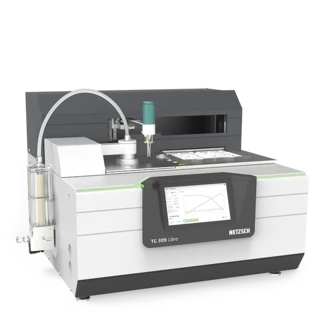
The cost-effective TG 309 Libra® Classic can be equipped with an optional automatic sample changer (ASC) for up to 20 samples and references. The gripper safely removes the crucible from the magazine and gently places it in position on the sensor. The samples are placed in a removable ASC insert which allows for preparation away from the instrument.
TGA features:
- Mass changes − Compositional analysis − Identification − Decomposition reactionA decomposition reaction is a thermally induced reaction of a chemical compound forming solid and/or gaseous products. Decomposition − OxidationOxidation can describe different processes in the context of thermal analysis.Oxidation − Thermal stability − Reduction behavior − Thermal Corrosion StudiesThermal corrosion or high-temperature corrosion is a chemical interaction of a material (typically a metal) with the surrounding gas atmosphere as a result of heating.Corrosion studies − Determination of:
- Filler content
- Plasticizer content
- Residual solvents
- Moisture content
- Added Carbon BlackTemperature and atmosphere (purge gas) affect the mass change results. By changing the atmosphere from, e.g., nitrogen to air during the TGA measurement, separation and quantification of additives, e.g., carbon black, and the bulk polymer can become possible.carbon black
- Ash content
- Purity
- Influence of aging - Curie temperatures - Reaction kinetics - State of hydration - Residual solvents
Automatic Sample Changer (ASC)
The ASC of the TG 309 Libra® Classic can be equipped with an optional automatic sample changer (ASC) for up to 20 samples and references. The samples are placed in a removable ASC insert which allows for preparation away from the instrument.
Interchangeable, Automatically Recognized Sample Holders
There are several sample carriers available, such as high-sensitivity c-DTA sensors for better monitoring of endo- and ExothermicA sample transition or a reaction is exothermic if heat is generated.exothermic effects, corrosion-resistant sensors, and specialized sensors for large sample masses. The sample carrier is instantly recognized by the device and can be changed out in less than a minute.
Magnetic Shock Absorbers
An optional magnetic levitation device can be used to elevate the instrument off the work bench. This eliminates the effect of external factors such as VibrationA mechanic process of oscillation is called vibration. Vibration is a mechanical phenomenon whereby oscillations occur about an equilibrium point. In many cases, vibration is undesirable, wasting energy and creating unwanted sound. For example, the vibrational motions of engines, electric motors, or any mechanical device in operation are typically unwanted. Such vibrations could be caused by imbalances in the rotating parts, uneven friction, or the meshing of gear teeth. Careful designs usually minimize unwanted vibrations.vibration and contact, thus decreasing the number of measurements needed to produce reliable results.
Crucibles (Pans) for General Applications – TG 309 Libra® Series
The TG 309 Libra® series offers crucibles for regular and large sample masses, guaranteeing broad applications in the temperature range from room temperature to 1100°C.
There are a number of different crucibles (pans) of aluminum oxide, platinum, aluminum, graphite and fused silica available in different sizes up to 350 µl.


Software

AutoEvaluation
Objective Results Right After a Measurement
AutoEvaluation is a self-acting evaluation routine for thermogravimetric (TGA) measurements. It autonomously evaluates all significant mass changes, including mass loss and mass gain, instantly; generates the DTG derivative curve; and automatically evaluates the corresponding peak temperatures. When incorporated into a measurement method, evaluated TGA and DTG curves appear immediately after the measurement is completed. Moreover, users can customize the size of mass changes to be detected and the selection of evaluation results to be displayed.
Identify
The Database for Material Identification and Quality Control
Identify is a unique software tool in the field of thermal analysis for the identification and classification of materials. Besides 1:1 comparisons with individual database measurements or literature data, it is also possible to compare a measurement with classes (groups of measurements or literature data). Such classes can consist of data of the same material type, allowing for material identification. A class can also contain reference curves for pass/fail testing in quality control. The included NETZSCH libraries contain more than 1300 entries from the application areas of polymers, organics, pharmaceuticals, food, cosmetics, inorganics, ceramics, metals and alloys. Signal types currently supported include DSC, DSC Specific Heat Capacity (cp)Heat capacity is a material-specific physical quantity, determined by the amount of heat supplied to specimen, divided by the resulting temperature increase. The specific heat capacity is related to a unit mass of the specimen.cp, TGA, STA, DIL/TMA and DMA. Users can expand the database with libraries containing an unlimited amount of their own data. Ultimately, this growing collection of database entries and measurement conditions can also be extremely useful in preparing future experiments.

It is particularly advantageous that Identify can even simultaneously incorporate two types of measurements, such as TGA and DSC or c-DTA®, during identification, this can significantly reduce multiple interpretations, and thus increase the chances of correct material identification. As shown in the example, the evaluated TGA and c-DTA® curves can be used together by Identify: Analysis reveals that the TGA Decomposition reactionA decomposition reaction is a thermally induced reaction of a chemical compound forming solid and/or gaseous products. decomposition result is very similar to that of the POM-H polymer found in the database; also, there is a DSC curve for POM-H that agrees well with the melting effect at a peak temperature of 183°C, which is also reflected in the c-DTA® curve of the input measurement. The material is thus identified as POM-H material with high confidence; all other polymer types present in the database can be ruled out.

Eco Mode – Uses Energy Only when Needed
FOCUS ON EFFICENCY AND A MORE SUSTAINABLE LABORATORY
To obtain accurate thermogravimetric results with low drift, a thermostat is used to condition the instrument. A constantly running thermostat not only consumes energy, but also produces waste heat that must be controlled by air conditioning systems.
On a busy day in the laboratory, the TGA instrument will be in use for around 10 to 12 hours. If no measurements are scheduled overnight or over the weekend, the instrument will either have to be shut down, resulting in a stabilization time before it can be used again, or it will remain on, consuming energy that is not technically required. Sustainability in the laboratory environment is becoming increasingly important.
The TG 309 Libra® offers an energy-saving Eco Mode, which allows the chiller to be switched off automatically via software, making it much more economical to run. The software provides a user-defined schedule to activate either Idle or Eco Mode. This eliminates the waiting time that would occur if the instrument was completely shut down, by reactivating the gas flow and thermostat as required, so that the instrument is ready for the first measurement on schedule. Switching the unit to Eco Mode will save 700 W of electricity, which can sum up to over 1700 kWh per year. This makes the instrument cheaper to run and effortlessly reduces your carbon footprint.

This instrument is LabV®️-ready.
Turn data into better products with LabV®—a centralized, AI-driven material intelligence platform that integrates data from this instrument and any other data sources. Designed for R&D and QC engineers, LabV® enables data-driven decision-making to drive innovation and ensure consistently high-quality results.
No Baseline Run Required – Get to Your Results Faster
In typical measurements, in order to ensure correct mass change values, a baseline run is carried out under identical test conditions for variables such as heating rate, gas type, gas flow rate, crucible type and geometry, etc., and subtracted from the sample measurement. The baseline takes instrument and buoyancy influences into consideration. In contrast, the TG 309 Libra®® generally no longer requires a separate baseline correction when using the integrated BeFlat®® baseline run for typical temperature profiles. This greatly simplifies routine test work, especially for quality control in industry.

AutoCalibration: Allows for Full Concentration on the Measurement Tasks
Calibration procedures should be straightforward and efficient, ideally conducted in real-time. AutoCalibration offers automatic functions to generate calibration curves. It handles the current temperature calibrations under consideration of the selected measurement conditions and monitors their validity periods through a watchdog function.
SmartMode for Routine Tasks – No More, No Less
SmartMode is an intuitive interface for fast measurement setup, designed specifically for the routine measurements often required in quality control. It allows you to quickly and easily prepare and start measurements for tasks using clearly defined measurement procedures. Wizards (quick start routines), userdefined measurement methods and predefined measurement methods are helpful assistants
ExpertMode – the Sky Is the Limit
For those who want to dive deeper into the software for advanced option setting or method definition, switching from SmartMode to ExpertMode is the answer. Here, the user has access to with its proven functionality of the Proteus® software, including dozens of features and all of the adjustment settings.
When dealing with measurement and evaluation data from different materials and obtained through different measurement setups, the ability to filter based on specific criteria is incredibly beneficial. Proteus® Search Engine provides fast and sophisticated filtering of your measurement data in seconds, serving as a powerful data management tool. Following the selection process, it automatically provides previews of measurements or analysis states. It also simplifies the process of opening folders in the file system by allowing this with a single click. Users have the flexibility to create personalized searches, such as “MyPolymers“, and easily switch between existing searches as needed.
Each operator can easily create their own report templates – including logos, tables, description fields and plots. Several report examples are already included as templates in the Proteus® software. Results derived from Identify searches can also be included in reports.
If your experimental curve exhibits complexity, featuring overlapping mass-loss steps, know that our software is designed to assist in the separation of these peaks. It facilitates the presentation of experimental data as a sum of individual peaks and enables analysis of each peak separately.
Kinetics Neo creates kinetic models of Decomposition reactionA decomposition reaction is a thermally induced reaction of a chemical compound forming solid and/or gaseous products. decomposition and evaporation processes based on a series of measurements under different temperature conditions. With the powerful NETZSCH Kinetics Neo software, even multi-step processes can be precisely modelled. Kinetic parameters such as activation energy, pre-exponential factor and order of reaction can be determined. Kinetics Neo can be used to predict the behavior of chemical systems under user-defined conditions for process optimization.
Revealing Caloric Effects by Means of c-DTA®
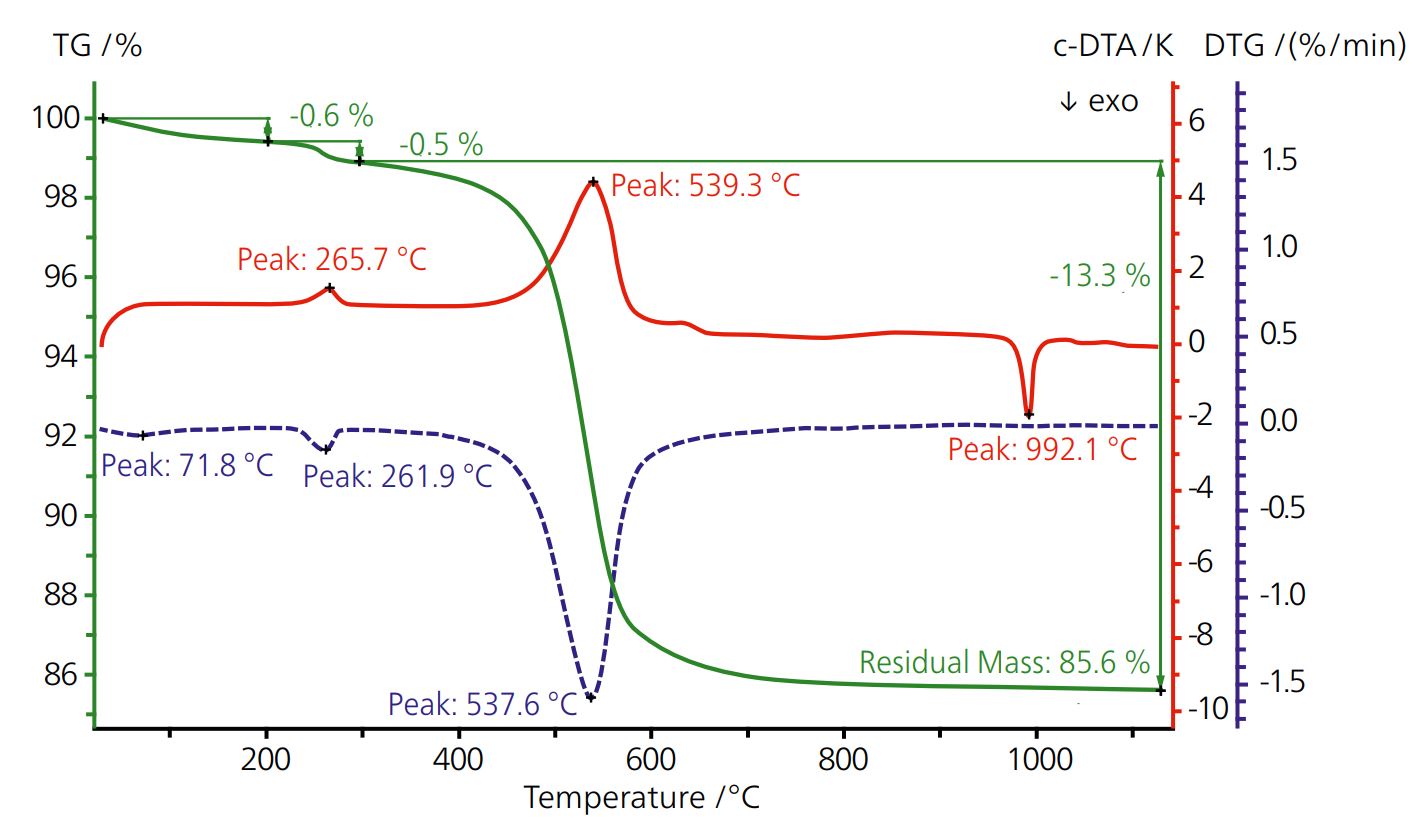
The sample thermocouple is capable of detecting temperature changes within the sample. This makes it possible to also determine EndothermicA sample transition or a reaction is endothermic if heat is needed for the conversion.endothermic (e.g., melting) and ExothermicA sample transition or a reaction is exothermic if heat is generated.exothermic effects during thermogravimetric experiments and to characterize sample properties in a more comprehensive way. In addition, this opens up a precise option for temperature calibration with DSC standard materials. The c-DTA® signal is calculated by comparing the measured sample temperature with the preset temperature-time program of the test run. The result is a DTA-like curve, as shown in red.
The two endothermal c-DTA® peaks (198°C and 535°C) in the TGA measurement on a kaolinite sample are directly related to the occurring mass-loss steps and are caused by dehydration and dehydroxylation: loss of adsorbed water from the surface (0.3%) and loss of water from inter layers (10.6%). The ExothermicA sample transition or a reaction is exothermic if heat is generated.exothermal c-DTA® peak at 999°C represents the formation of mullite.
| Classic | Select | Supreme | |
|---|---|---|---|
| ExpertMode | ✅ | ✅ | ✅ |
| SmartMode | ✅ | ✅ | ✅ |
| AutoCalibration | ✅ | ✅ | ✅ |
| AutoEvaluation | ✅ | ✅ | ✅ |
| Predefined Methods | ✅ | ✅ | ✅ |
| TGA-BeFlat®* | ✅ | ✅ | ✅ |
| c-DTA® | ✅ | ✅ | ✅ |
| Report Generator | ✅ | ✅ | ✅ |
| Eco Mode | ✅ | ✅ | ✅ |
| Identify | ? | ✅ | ✅ |
| Proteus® Search Engine | ? | ? | ✅ |
| Peak Separation | ? | ? | ✅ |
| Temperature modulated TGA (TM-TGA) | ? | ? | ✅ |
| SuperRes | ? | ? | ✅ |
| LabV® | ? | ? | ? |
| LIMS Support | ? | ? | ? |
| Proteus® Protect (CFR21 part 11) | ? | ? | ? |
| Kinetics NEO | ? | ? | ? |
| Thermica NEO** | ? | ? | ? |
| EGA support | ? | ? | ? |
✅ = Included
?= Optional
⛔️= Not available
* included when MFC is selected
** requires Kinetics Neo
More features on request.
E-Learning


Videos
Application Literature
Our latest blog articles
- 25.06.2026
Tracking Down the Chemistry of PUR Powder Coatings with TGA-FT-IR and DSC

- 15.06.2026
Understanding Molten Salts for the Next Generation of Nuclear Reactors

- 08.06.2026
6 Reasons Why Pharmaceutical Laboratories Trust NETZSCH Thermal Analysis
- 05.05.2026
Thermogravimetry Meets Hydrogen (Part 3): Investigating Cu and CuO Redox Reactions under Hydrogen Atmospheres
- 17.03.2026
Moisture Matters: Understanding the Decomposition of Potassium Clavulanate Using TGA-FT-IR

- 11.03.2026
Thermogravimetry Meets Hydrogen (Part 2): Studying the Reduction of Fe₂O₃ under Different Hydrogen Concentrations