Carbohydrates – One of the Major Energy Sources of Our Body
Alongside protein and fat, carbohydrates are one of the three macronutrients in a human diet. They include mono, di and oligosaccharides such as sugars as well as polysaccharides such as cellulose or starch.
Starch is of vegetable origin and found in such sources as potatoes, rice, cereals and cassava (manioc). Its area of application is primarily the food and beverage sector. In the food industry, starch is mainly used as a thickening, gelling, emulsifying or stabilizing agent. Often, it is added only in small concentrations. Nevertheless, it can have significant influence on the textural and organoleptic (color, smell, appearance, taste, etc.) properties of food.
In 2022, the estimated worldwide starch production amounted to approx. 134 million tons, with China as the largest starch market, followed by the US [1]. The most popular type of starch which is traded globally is manioc (or tapioca) starch, with corn starch in second place [2].
If starch is used in its native form, it is shown as “starch” in the list of ingredients. But if the substance is chemically altered, then it becomes an additive with an E number (for example, E1404 for oxidized starch or E1420 for acetylated starch) and appears as “modified starch” in the list of ingredients. Compared to native starch, modified starch is more stable against heat, cold or an acidic environment [3].
What Does Starch Consist of?
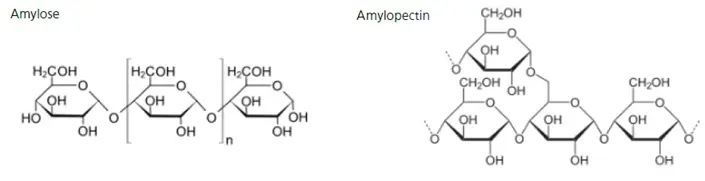
Starch is a long-chain polymer consisting of amylose and amylopectin in varying proportions, depending on the starch type and source. As a rule, the amylose content is between 15% and 30%, resulting in an amylopectin content between 70% and 85% by weight [4]. Pure starch is a white, tasteless and odorless powder that is insoluble in cold water or alcohol [5].
What Happens in the Presence of Water?
When starch is heated in contact with a sufficient amount of water (for example, during cooking or baking), gelatinization takes place. While heated, water penetrates into the granules and the molecules within the granules start to realign. This leads to swelling until the outer layers of the granules are disrupted. The granules start to break down. Amylose and amylopectin partially diffuse into the surrounding environment and disperse in the solution [10]. The result is a thick and viscous starch paste or gel which helps keep the various components – e.g., those of a pastry – together.
The gelatinization process can be monitored by DSC and produces an endothermal effect. However, the amount of water plays an important role. At low water content, only limited swelling or incomplete gelatinization of the starch granules can be observed, and even at higher water contents (water:starch = 1.5:1 or higher), the DSC endotherm does not always represent the entire process [7].
During cooling, starch undergoes a disorder-to-order transition. The gelatinized starch crystallizes again, water is released, and the substance becomes firmer. This process is called retrogradation. This is the reason why bread becomes stale after a while, especially when stored at lower temperatures (cool temperatures favor this process).
How Does Starch Behave During Heating and Cooling?
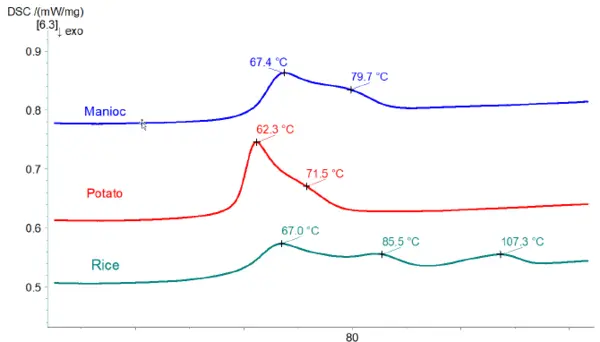
To study its thermal properties, various kinds of commercially available native starches (see table 1) were heated twice in combination with water (50 wt% starch and 50 wt% water) in a DSC in closed aluminum crucibles (Concavus®) at a heating rate of 5 K/min up to 140°C and down to RT in a nitrogen atmosphere.
Table 1: Sample masses (starch only) for the different types of starch
| Starch type | Starch mass (mg) | Temperature of the 1st peak (°C) |
|---|---|---|
| Manioc | 12.76 | 67.4 |
| Potato | 12.62 | 62.3 |
| Rice | 12.93 | 67.0 |
During the first heating of the different starch types, several endothermal DSC effects are visible (see figure 1). On the one hand, a first main peak with an additional (somewhat pronounced) shoulder occurs with manioc and potato starch, whereby the effect with potato starch is shifted to slightly lower temperatures. On the other hand, the DSC profile for rice starch shows three peaks, one of them at a much higher temperature (peak temperature at 107°C) than the other ones.
The effects in the temperature range around 60°C to 70°C reflect the gelatinization process. The endothermal effect around 107°C (concerning rice starch) presumably corresponds to an amylase-lipid complex which was also determined above 100°C in other rice studies [8, 9].
Literature (e.g., summarized in [6]) says that during heating, not only gelatinization but also melting occurs. According to this theory, melting during heating corresponds to an endothermal effect at higher temperatures and is typical for low water concentrations whereas gelatinization occurs in the presence of excess water (more than 70% for most starches) and corresponds to a lower temperature endotherm in the DSC curve. At intermediate moisture contents, both processes can be observed, which fits well with the present case (figure 2) and leads to peak temperatures of 67°C and 80°C for the manioc starch, for example.
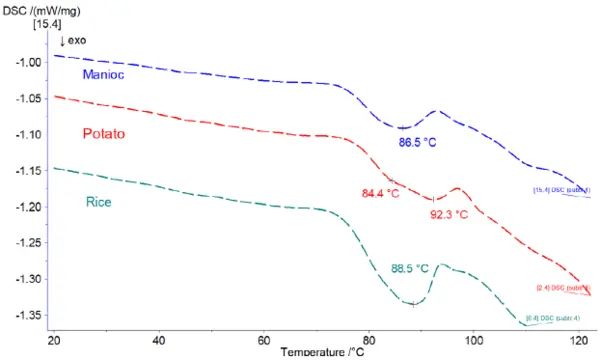
During controlled cooling (at 10 K/min) after the 1st heating, ExothermicA sample transition or a reaction is exothermic if heat is generated.exothermal events are visible in the temperature range between approx. 75°C and 95°C (figure 3).
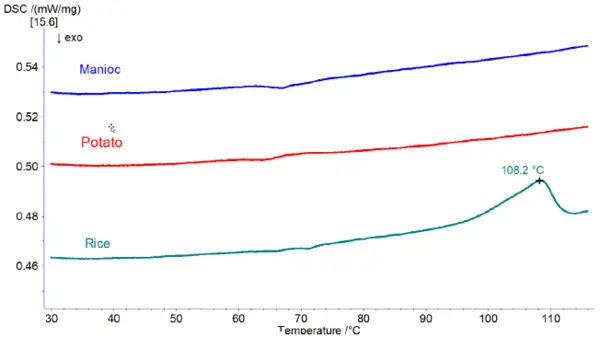
Most of these effects seem to be irreversible because in the corresponding second heating steps (figure 4, at a heating rate of 5 K/min), only rice starch again shows an endothermal effect at about 108°C (peak temperature) which is comparable to the endothermal effect appearing in figure 2. However, there are some very small, additional ExothermicA sample transition or a reaction is exothermic if heat is generated.exothermal effects visible in the temperature range between approx. 60°C and 80°C. This leads to the assumption that the structural rearrangement that took place during cooling was not yet finished before the second heating started.
In literature [10], we can read that when a gelatinized starch is cooled, the released amylose and amylopectin (chemical structures in figure 1) begin to retrograde and the dispersed amylose molecules begin to reassociate, leading to the formation of a three-dimensional network. It can be described as “a composite gel of undissolved granule remnants embedded in a continuous matrix of entangled amylose polymer chains and separated, highly branched amylopectin molecules”.
Conclusion
Although often used at home, starch proves to be a material exhibiting quite complex behavior. Both the applied temperature regime and the amount of water in the mixture have an influence on its gelatinization. However, thermal analysis, and here especially DSC, is capable of gleaning a lot of valuable information about this process based on just a few measurements.
The three starch types used (manioc starch, potato starch and rice starch) can clearly be distinguished from each other in the first heating phase (figure 1). The DSC curves differ significantly and only rice starch shows an additional endothermal effect above 100°C.