Introduction
Polypropylene (PP), as a crucial general-purpose plastic, has been widely used in the automotive, packaging, electronics, textile and other industries due to its excellent mechanical properties, chemical stability and processing performance. However, in order to further optimize the processing of PP materials and improve the product quality and performance, it is of great practical significance to conduct in-depth investigations of the rheological behavior of PP.
Viscosity, as a critical indicator of polymeric flow behavior, is closely related to material processing. In different manufacturing processes, PP must flow and take shape within specific temperature ranges. Therefore, precise understanding of how PP's viscosity varies with temperature enables engineers to accurately control processing parameters, ensuring optimal flowability and molding quality of PP during production.
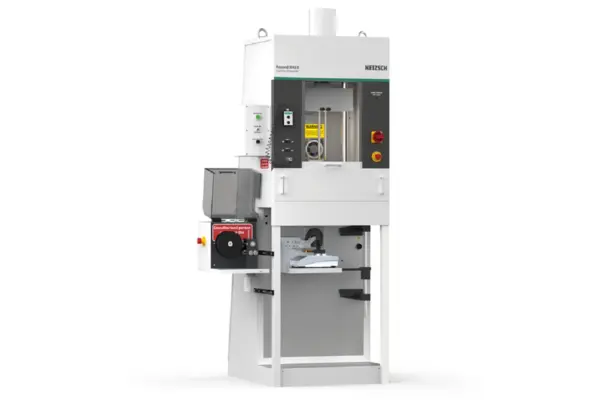
The capillary rheometer, a classic rheological testing instrument, is widely used in polymer research because of its ability to measure the rheological properties of materials over a broad range of shear rates and temperatures. In this study, a NETZSCH Rosand RH10 capillary rheometer (Figure 1) was employed to systematically investigate the effects of temperature and shear rate on the melt viscosity and viscous flow activation energy of PP. The findings provide a theoretical foundation for optimizing PP processing parameters, ultimately enhancing the quality and performance of PP products.
Measurement Conditions and Test Method
The measurement conditions are detailed in Table 1.
Table 1: Measurement conditions
| Instrument | NETZSCH Rosand RH10 |
| Samples | PP |
Pressure transducer | 10000 psi |
| Die specification | L = 16 mm, D = 1 mm |
| Test temperature | 180°C/190°C/200°C/210°C/220°C |
| Shear rate range | 10 - 10000 s-1 |
After installing the dies below the left barrel, and waiting for the temperature to be stabilized, PP pellets were slowly added to the barrel, compressurized to 1 MPa, and then preheated at a constant temperature for 5 min. Subsequently, the instrument automatically conducted the test, applying the shear rate and recording the pressure.
Measurement Results and Discussion
Figure 2 presents the shear viscosity versus shear rate curves of PP samples at different temperatures. As can be seen from Figure 2, the shear viscosity of the PP samples under all temperature conditions decreases gradually with increasing shear rate, demonstrating typical Shear ThinningThe most common type of non-Newtonian behavior is shear thinning or pseudoplastic flow, where the fluid viscosity decreases with increasing shear.shear-thinning behavior. This phenomenon occurs because the disentanglement of the PP macromolecular chains intensifies with higher shear rates, leading to a rapid decline in shear viscosity. However, with further increasing the shear rate, the effectiveness of shear StressStress is defined as a level of force applied on a sample with a well-defined cross section. (Stress = force/area). Samples having a circular or rectangular cross section can be compressed or stretched. Elastic materials like rubber can be stretched up to 5 to 10 times their original length.stress in promoting macromolecular disentanglement diminishes, resulting in slowing down the decreasing trend of the shear viscosity.
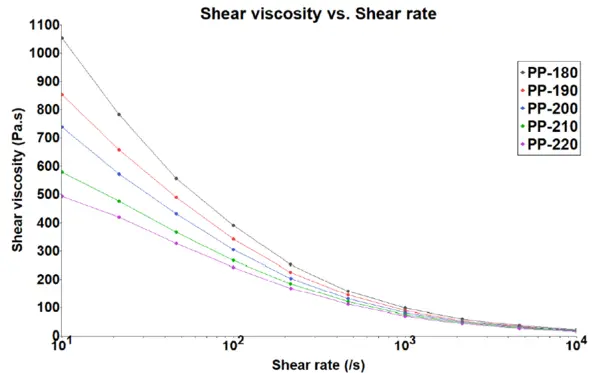
Furthermore, the shear viscosity of the PP samples decreases significantly with increasing temperature at the same shear rate. This is due to the fact that as the temperature rises, the free volume of the PP melt increases, which enhances the mobility of the chain segments, and decreases the intermolecular interaction force, thereby improving the flowability of PP. However, the difference in shear viscosity values at different temperatures decreases noticeably when the shear rate exceeds 500 s-1. Especially when the shear rate is increased to 5000 s-1, the shear viscosity curves at different temperatures tend to overlap, and the decreasing tendency of the shear viscosity becomes slower. This indicates that beyond a critical shear rate, the sensitivity of PP's shear viscosity to temperature decreases, suggesting an expanded processing temperature window for PP within this shear rate range.
The viscous flow activation energy (Eη) is an indicator of the sensitivity of a polymer melt's apparent shear viscosity to temperature. A higher Eη value signifies greater sensitivity of melt viscosity to temperature variations, whereas a lower value suggests reduced temperature dependence. Eη can be calculated using the Arrhenius equation (1):
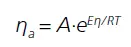
where ηa is the melt viscosity; Eη is the viscous flow activation energy; R is the gas constant (8.314 J·mol-1·K-1); A is a temperature-independent constant.
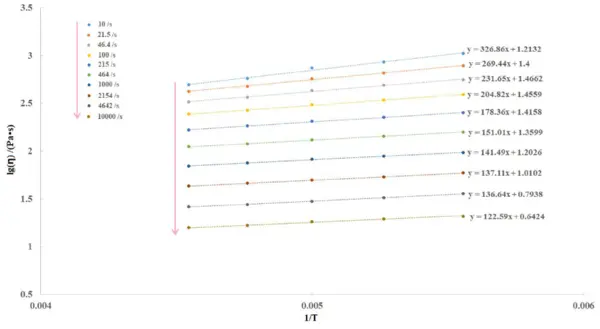
Based on the data measured in Figure 2, plots of lgηa against 1/T were constructed and fitted. Consequently, the relationship curves of lgηa ~1/T at different shear rates are presented in Figure 3 with the specific values listed in table 2. As shown, Eη of PP at various shear rates can be determined from the slopes of the fitted linear curves in Figure 3, with specific values listed in Table 2. Eη of PP decreases with increasing shear rate within the tested temperature range. This indicates that the shear viscosity of the PP melt is less sensitive to temperature at high shear rates. From a molecular dynamics perspective, this phenomenon can be explained by the fact that external shear forces disrupt the entanglement between PP molecules, thereby diminishing the sensitivity of the shear viscosity to temperature. This is reflected in the viscosity curves (Figure 2), where the curves at different temperatures nearly overlap at high shear rates. Therefore, increasing temperature proves less effective in reducing the shear viscosity of the PP melt at high shear rates. In contrast, at low shear rates, elevating temperature can significantly enhance PP's flowability, thereby reducing energy consumption during processing.
Table 2: Eη of PP at different shear rates
| Shear rate (s-1) | 10 | 21.5 | 46.4 | 100 | 215 | 464 | 1000 | 2154 | 4642 | 10000 |
| Eη (kJ/mol) | 62.6 | 51.4 | 44.4 | 39.2 | 34.2 | 28.9 | 27.1 | 26.3 | 26.2 | 23.5 |
Conclusion
In this Application Note, the rheological properties of PP at different temperatures and shear rates were investigated using a Rosand RH10 capillary rheometer. At relatively low shear rates (10 to 500 s-1), the shear viscosity of PP decreases significantly with increasing shear rate, while at high shear rates (500 to 10000 s-1), the reduction in shear viscosity becomes more gradual. Furthermore, Eη of PP decreases with increasing shear rate, indicating that higher shear rates effectively reduce the temperature sensitivity of the PP’s melt viscosity.