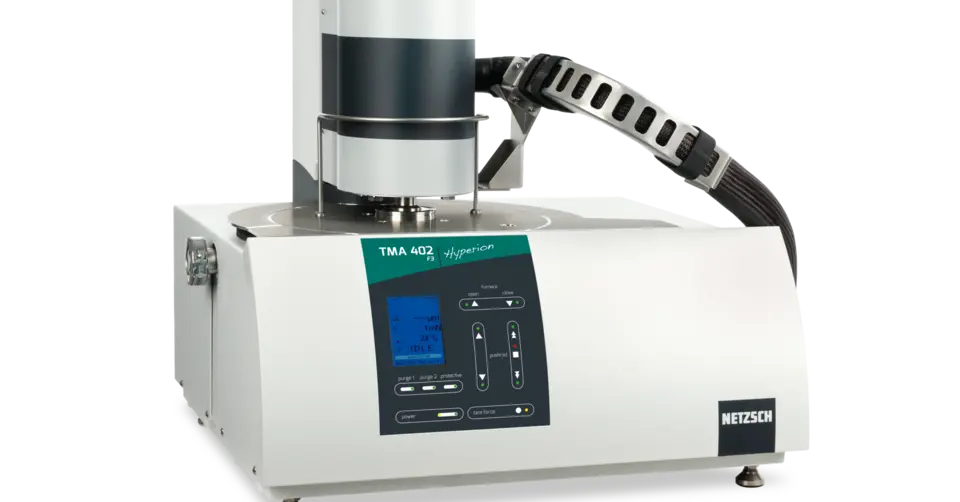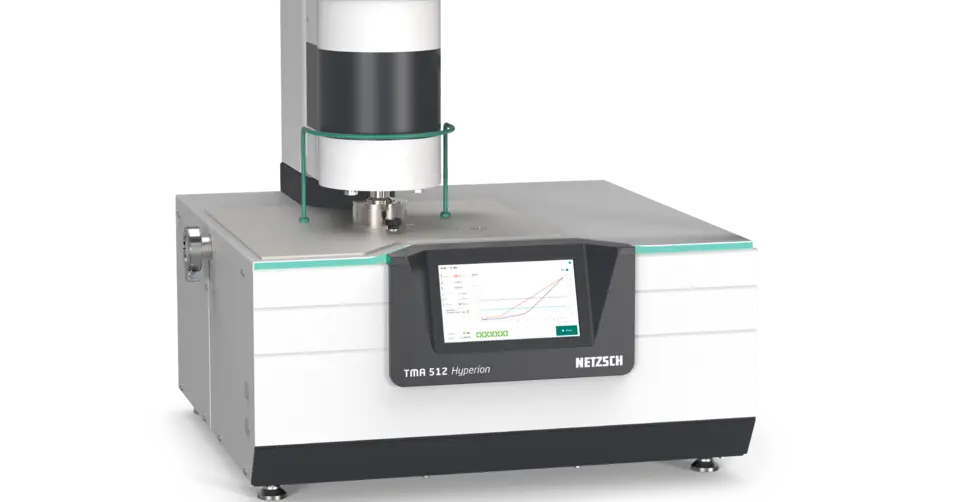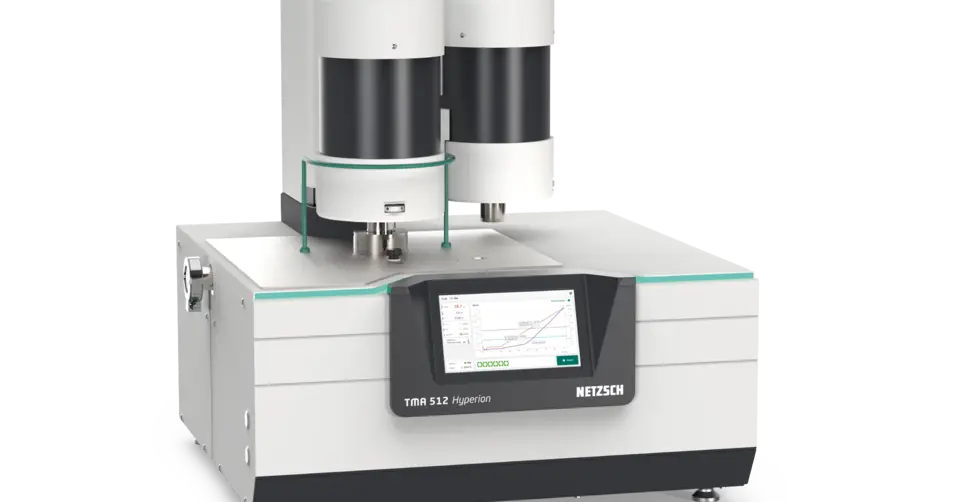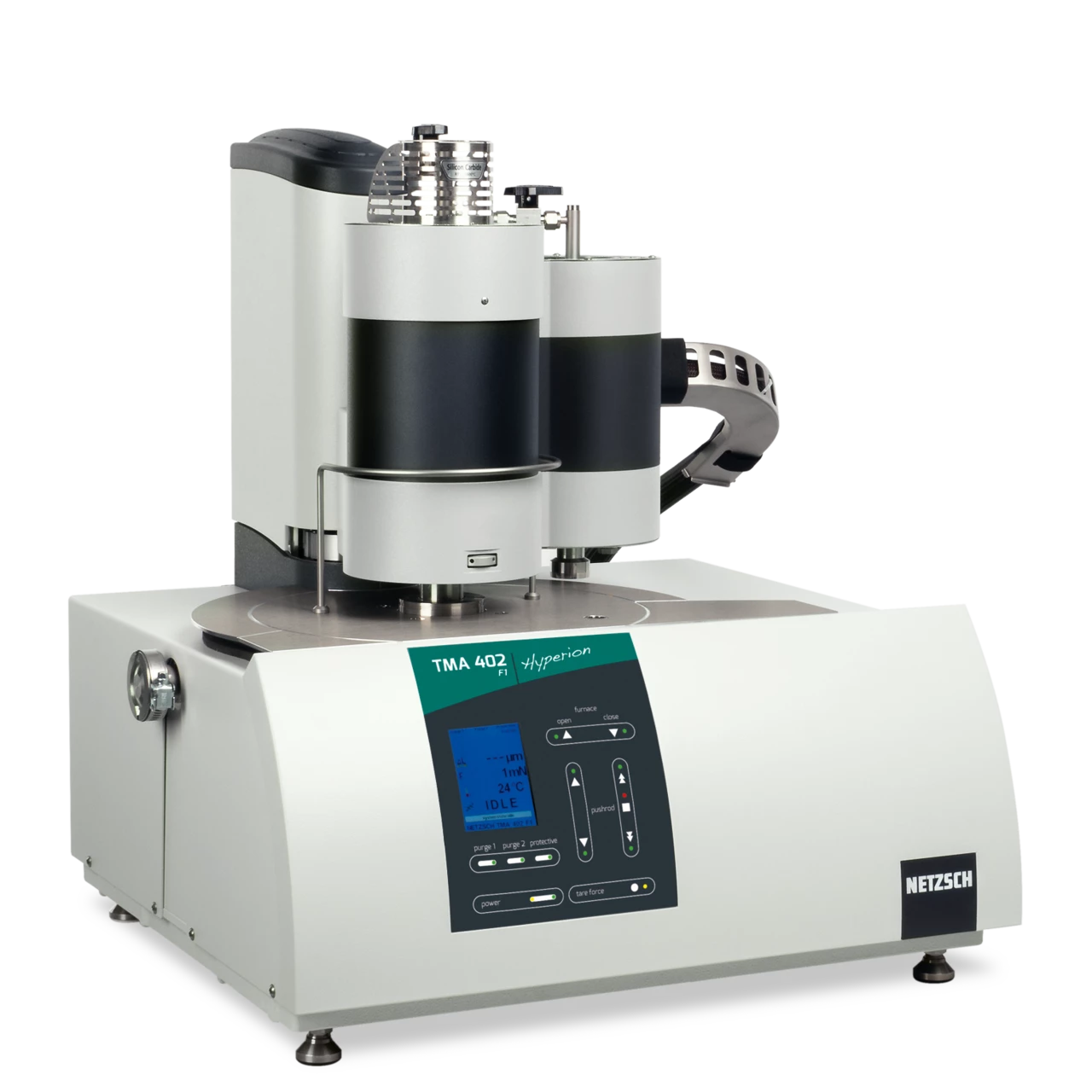
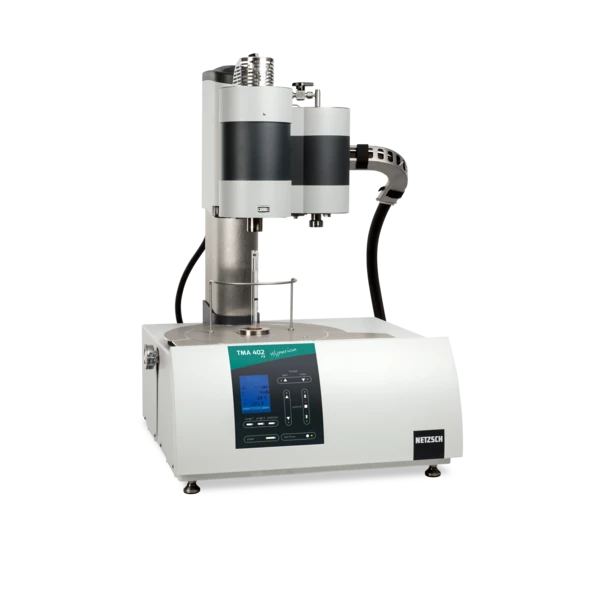
TMA 402 F1 /F3 Hyperion®
Thermomechanical Analyzer - Vertical Dilatometer
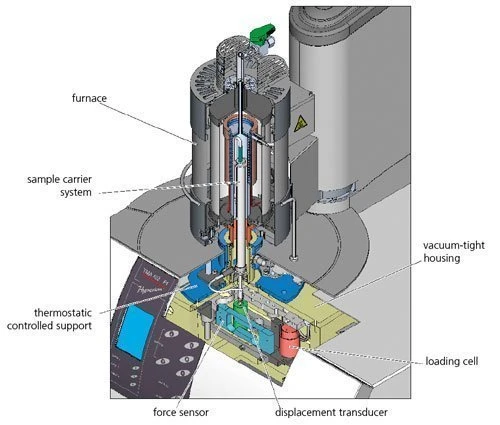
The heart of the TMA 402 Hyperion® is a highly precise inductive displacement transducer (LVDT).
This technology has stood the test of time; it is also used for dilatometers and allows measurement of even the smallest of length changes, into the nanometer range (digital resolution of 0.125 nm).
Simultaneous measurement of force and displacement signal
The force operating on the sample is generated electromagnetically in the TMA 402 Hyperion®. This guarantees a quick response time for experiments with a changing load, e.g. tests on CreepCreep describes a time and temperature dependent plastic deformation under a constant force. When a constant force is applied to a rubber compound, the initial deformation obtained due to the application of the force is not fixed. The deformation will increase with time.creep behavior. A highly sensitive force sensor (digital resolution < 0.01 mN) continuously measures the force exerted via the push rod and readjusts it automatically. This sets the TMA 402 Hyperion® apart from other instruments, which use only preset values.
Benefits for you
- Modular Concept with interchangeable furnaces (compatible with other NETZSCH instruments) for easy and cost-effective expansion and retrofitting
- Gas flows with up to 4 MFCs, controllable via software with programmable atmosphere change for the analysis of e.g. OxidationOxidation can describe different processes in the context of thermal analysis.oxidation behavior without manual valve operation
- Digitally programmable force or displacement control up to 4 N (only for F1 , 3 N for F3 ) with linear or stepwise force alteration and continuous force modulation for determining visco-elastic properties like RelaxationWhen a constant strain is applied to a rubber compound, the force necessary to maintain that strain is not constant but decreases with time; this behavior is known as stress relaxation. The process responsible for stress relaxation can be physical or chemical, and under normal conditions, both will occur at the same time. relaxation, CreepCreep describes a time and temperature dependent plastic deformation under a constant force. When a constant force is applied to a rubber compound, the initial deformation obtained due to the application of the force is not fixed. The deformation will increase with time.creep and StressStress is defined as a level of force applied on a sample with a well-defined cross section. (Stress = force/area). Samples having a circular or rectangular cross section can be compressed or stretched. Elastic materials like rubber can be stretched up to 5 to 10 times their original length.stress/StrainStrain describes a deformation of a material, which is loaded mechanically by an external force or stress. Rubber compounds show creep properties, if a static load is applied.strain
- Various accessories for an expanded application range, e.g., for measuring powders, liquids, pastes or metals
Determination of viscoelastic properties like Relaxation, Creep and Stress/Strain
The TMA 402 F3 /F1 Hyperion® now offers not only to keep the force constant and to measure the length change, but also to change the displacement and measure the corresponding force. One example where this is used is the StressStress is defined as a level of force applied on a sample with a well-defined cross section. (Stress = force/area). Samples having a circular or rectangular cross section can be compressed or stretched. Elastic materials like rubber can be stretched up to 5 to 10 times their original length.stress-RelaxationWhen a constant strain is applied to a rubber compound, the force necessary to maintain that strain is not constant but decreases with time; this behavior is known as stress relaxation. The process responsible for stress relaxation can be physical or chemical, and under normal conditions, both will occur at the same time. relaxation test. This test stretches a sample by a specific amount at a defined temperature. During the test, the deformation is kept constant and the progression of the force is recorded. This force continuously decreases as a result of material RelaxationWhen a constant strain is applied to a rubber compound, the force necessary to maintain that strain is not constant but decreases with time; this behavior is known as stress relaxation. The process responsible for stress relaxation can be physical or chemical, and under normal conditions, both will occur at the same time. relaxation. The StressStress is defined as a level of force applied on a sample with a well-defined cross section. (Stress = force/area). Samples having a circular or rectangular cross section can be compressed or stretched. Elastic materials like rubber can be stretched up to 5 to 10 times their original length.stress-RelaxationWhen a constant strain is applied to a rubber compound, the force necessary to maintain that strain is not constant but decreases with time; this behavior is known as stress relaxation. The process responsible for stress relaxation can be physical or chemical, and under normal conditions, both will occur at the same time. relaxation strength is ultimately defined by the residual StressStress is defined as a level of force applied on a sample with a well-defined cross section. (Stress = force/area). Samples having a circular or rectangular cross section can be compressed or stretched. Elastic materials like rubber can be stretched up to 5 to 10 times their original length.stress measured after a defined exposure period. The data can be depicted graphically in a StressStress is defined as a level of force applied on a sample with a well-defined cross section. (Stress = force/area). Samples having a circular or rectangular cross section can be compressed or stretched. Elastic materials like rubber can be stretched up to 5 to 10 times their original length.stress-time diagram. It is then possible to read off both the StressStress is defined as a level of force applied on a sample with a well-defined cross section. (Stress = force/area). Samples having a circular or rectangular cross section can be compressed or stretched. Elastic materials like rubber can be stretched up to 5 to 10 times their original length.stress-RelaxationWhen a constant strain is applied to a rubber compound, the force necessary to maintain that strain is not constant but decreases with time; this behavior is known as stress relaxation. The process responsible for stress relaxation can be physical or chemical, and under normal conditions, both will occur at the same time. relaxation behavior and the values for the RelaxationWhen a constant strain is applied to a rubber compound, the force necessary to maintain that strain is not constant but decreases with time; this behavior is known as stress relaxation. The process responsible for stress relaxation can be physical or chemical, and under normal conditions, both will occur at the same time. relaxation rate and time.
Measurement on sensitive materials but also for higher stresses up to 4N
The electronic control system allows users to set the force value in the mN-range. This enables testing even on sensitive materials such as thin fibers or films. For bigger geometries or higher stresses a force load up to 4 N can be applied using the premium TMA 402 F1 Hyperion® model. The force being exerted upon the sample can be altered via the software in a stepwise or linear fashion. This makes it especially simple to carry out tests such as CreepCreep describes a time and temperature dependent plastic deformation under a constant force. When a constant force is applied to a rubber compound, the initial deformation obtained due to the application of the force is not fixed. The deformation will increase with time.creep.
Vacuum-tight thermostatic measuring system
The entire TMA 402 F1 /F3 Hyperion® measuring system is thermally stabilized via water-cooling. This ensures that the measurement will not be influenced by heat from the furnace or by temperature fluctuations in the local environment. All joints have a vacuum-tight design to allow measurements in a highly pure atmosphere or under vacuum. Pressures of less than 10-4 mbar can be achieved in the TMA 402 F1 /F3 Hyperion® with the use of a turbo molecular pump. In combination with the integrated mass flow controllers (MFC) for purge and protective gases (optional in the TMA 402 F3 Hyperion®), measurements in highly pure inert gas or in oxidizing atmospheres can be optimally controlled.
The future is now!
Bring our devices into your laboratory with the click of a button.
Simply scan the QR code and get a 3D model of the instrument directly on your mobile phone or tablet. With the help of the latest AR Technology (Artificial Reality), the 3D model can easily be placed in your laboratory in its original life size. This function is browser-based and requires no app.
Find out and be amazed!


Technical Data
Force range
0.001 N to ± 4 N in steps of 0.2 mN
(F3 ± 3N)
Dig. resolution (force)
< 0.01 mN
Modulated force
Up to 1 Hz (only F1 )
Final vacuum pressure
< 10-4 mbar
Gas connections
Protective gas, 2 purge gases,
one independent purge gas
Temperature range
-150°C to 1550°C
The software includes everything necessary for carrying out measurements and evaluating the results. Simple menu navigation and automated routines make the software easy to operate while allowing for complex analyses.
Features specific to TMA:
- Various correction possibilities for taking the expansion behavior of the system itself into account, as well as offset and sample length correction
- Automatic adjustment of sign for force and displacement signal to the measurement configuration being used
- Routines for the determination of characteristic temperatures such as onset, peak and final temperatures
- Evaluation of Glass Transition TemperatureThe glass transition is one of the most important properties of amorphous and semi-crystalline materials, e.g., inorganic glasses, amorphous metals, polymers, pharmaceuticals and food ingredients, etc., and describes the temperature region where the mechanical properties of the materials change from hard and brittle to more soft, deformable or rubbery.glass transitions and softening points in accordance with DIN
- Automatic shut-off at softening point
- Expansion coefficients: Calculation and presentation of the technical and physical expansion coefficients
- Automatic SinteringSintering is a production process for forming a mechanically strong body out of a ceramic or metallic powder. sintering step evaluation
- Rate-Controlled Sintering (RCS)The properties of sintered products, such as density or particle size distribution, are determined by the sintering conditions (temperature, atmosphere, etc.) and especially by the sintering rates. Rate Controlled Sintering (Rate-Controlled Sintering (RCS)The properties of sintered products, such as density or particle size distribution, are determined by the sintering conditions (temperature, atmosphere, etc.) and especially by the sintering rates. RCS) Software: SinteringSintering is a production process for forming a mechanically strong body out of a ceramic or metallic powder. Sintering with a constant shrinkage rate (optional)
- Measurements with variable force: Determination of visco-elastic properties
- AutoEvaluation automatically and autonomously evaluates thermoanalytical measurement curves without using pre-defined macros.
Extensions:
- c-DTA® function:
Evaluation of the temperature signal for EndothermicA sample transition or a reaction is endothermic if heat is needed for the conversion.endothermic or ExothermicA sample transition or a reaction is exothermic if heat is generated.exothermic effects - Thermokinetics:
Extensive characterization and optimization of SinteringSintering is a production process for forming a mechanically strong body out of a ceramic or metallic powder. sintering processes - DensityThe mass density is defined as the ratio between mass and volume. Density Software:
Determination of changes in volume and DensityThe mass density is defined as the ratio between mass and volume. density until the liquid state - Peak Separation:
The separation of overlapping effects - Identify:
Identification and classification of TMA Curves
You can use the following software with this product
The modular design of the TMA 402 Hyperion® makes it unique among the competition
To adjust the instrument for the respective temperature ranges, all that needs to be done is to exchange the furnace. This can be done by the operator. If using the optional double furnace hoist, switching to a second furnace takes only moments.
Sample holder systems tailored to the task
Depending upon the question at hand and the geometry of the sample, the operator has a variety of sample holders to choose from. Holding devices for expansion, penetration, and tension measurements are available, as well as push rods and supports for analyses in 3-point bending. Accessories for the temperature range up to 1000°C are made of fused silica. For the high-temperature range, aluminum oxide varieties are available.
In the TMA 402 Hyperion®, the thermocouple can be changed quickly and easily. Besides type K, a type S variety is also available. The system electronics recognize the installed sensor automatically.
Special sample holders
With the help of special sample containers, the expansion behavior of powders, pastes and liquids can be analyzed, as can metals all the way to the Melting Temperatures and EnthalpiesThe enthalpy of fusion of a substance, also known as latent heat, is a measure of the energy input, typically heat, which is necessary to convert a substance from solid to liquid state. The melting point of a substance is the temperature at which it changes state from solid (crystalline) to liquid (isotropic melt).melting point. Accessories for experiments on swelling behavior upon immersion are also available.
Evolved Gas Analysis (EGA): Coupling with MS / FT-IR
To analyze gases evolving upon heating (EGA), the TMA 402 Hyperion® can be coupled to a mass spectrometer and/or an FT-IR spectrometer.
Measurements in humid atmospheres
The copper furnace for the TMA 402 Hyperion® instruments can be used as a conventional furnace in the temperature range from -150°C to 500°C. The furnace type was especially conceived for measurements in humid atmospheres and can be coupled to the humidity generator via a special inlet adapter. The humidified gas arrives at the sample from above in this case, and a special gas duct effectively prevents the protective gas from thinning the water concentration unwantedly. The operation in humid atmosphere is possible in the temperature range from 0°C to 100°C.

Our latest blog articles
- 22.09.2026
NETZSCH Analysis Instruments in Use at South Korean Research Institutes

- 15.06.2026
Understanding Molten Salts for the Next Generation of Nuclear Reactors

- 19.12.2025
Frost Under the Christmas Tree: Why Material Testing Below 0°C Is Important

- 08.07.2025
Unmatched Versatility: Introducing the NETZSCH TMA 512 Hyperion® for Thermomechanical Analysis
- 03.06.2025
NEW NETZSCH TECH TALK: Discover the Future of Thermal Analysis in Just 30 Minutes!

- 07.05.2025
Characterization of NaNO₃–KNO₃ Salt Mixture Using NETZSCH Thermal Analysis Instruments and X-ray Diffraction