General Properties
Short Name: PTFE
Name: Polytetrafluoroethylene
Polytetrafluoroethylene (PTFE) is the most widespread and important fluoropolymer. It is a linear, semi-crystalline thermoplastic showing several transitions between 0°C and 340°C. Due to its abrasion resistance and high chemical resistance, PTFE is used often in tribological systems. PTFE is also used as a coating in frying pans in many households.
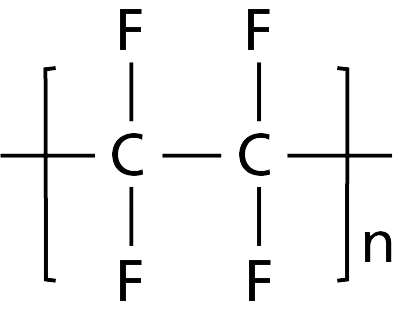
Structural Formula
Properties
NETZSCH Measurement
| Sample Mass | 12.80 mg |
| Heating Rates | 10 K/min |
| Crucible | Al, pierced lid |
| Atmosphere | N2 (40 ml/min) |
Evaluation
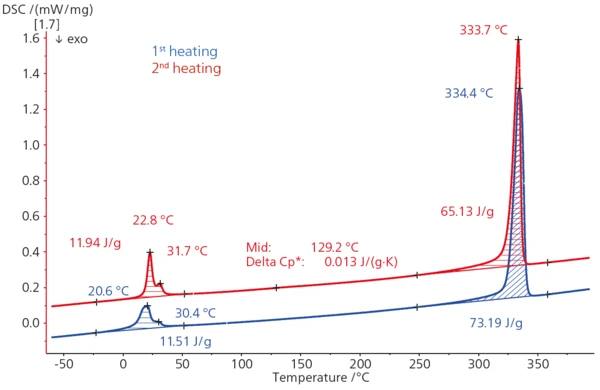
The DSC curve of the PTFE sample exhibits two overlapping peaks around 20°C. The peaks were sharper in the 2nd heating (red) than they were in the 1st heating (blue) with peak temperatures of 23°C and 32°C. A very weak Glass Transition TemperatureThe glass transition is one of the most important properties of amorphous and semi-crystalline materials, e.g., inorganic glasses, amorphous metals, polymers, pharmaceuticals and food ingredients, etc., and describes the temperature region where the mechanical properties of the materials change from hard and brittle to more soft, deformable or rubbery.glass transition at approx. 130°C was detected in the 2nd heating. The melting transitions peaked at 334°C in both heatings. The melting enthalpy with 65 J/g in the 2nd heating (red) is approx. 11% below the melting enthalpy in the 1st heating. This indicates a lower Crystallinity / Degree of CrystallinityCrystallinity refers to the degree of structural order of a solid. In a crystal, the arrangement of atoms or molecules is consistent and repetitive. Many materials such as glass ceramics and some polymers can be prepared in such a way as to produce a mixture of crystalline and amorphous regions.crystallinity in the 2nd heating and is consistent with the somewhat clearer Glass Transition TemperatureThe glass transition is one of the most important properties of amorphous and semi-crystalline materials, e.g., inorganic glasses, amorphous metals, polymers, pharmaceuticals and food ingredients, etc., and describes the temperature region where the mechanical properties of the materials change from hard and brittle to more soft, deformable or rubbery.glass transition step, which indicates an increase in amorphous content.