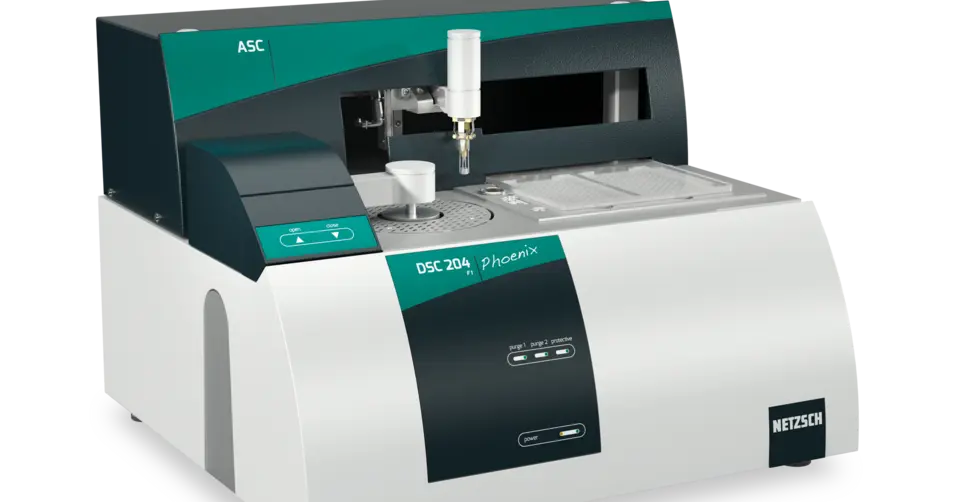
TG 209 F1 Libra®
The vacuum-tight thermo-microbalance for highest demands
Faster and more comprehensive characterization of materials
Based on over 50 years of experience in thermogravimetry, NETZSCH has developed the thermobalance TG 209 F1 Libra®. This instrument allows for analyses to be carried out even faster, more accurately, and across an extended temperature range.
Twice as fast by means of BeFlat®
In contrast with other thermobalances, no time-consuming baseline determinations need normally to be carried out with the TG 209 F1 Libra® prior to a measurement. The unique BeFlat® function of the Libra® automatically compensates for any external factors influencing the measurement. This cuts work hours by up to 50%, leaving more time available, for example, for further measurements.
20 times faster due to high heating rates
The heart of the TG 209 F1 Libra® is the micro furnace made of high-performance ceramics. It not only allows for a wider sample temperature range of up to 1100°C, but also for heating rates of up to 200 K/min. The user can thus receive the results of the analysis – even at highest temperature – within a few minutes, i.e. 20 times faster than for other thermobalances.
More comprehensive and faster characterization by patented c-DTA®
With the TG 209 F1 Libra®, the sample temperature is measured directly. Endo- and ExothermicA sample transition or a reaction is exothermic if heat is generated.exothermal reactions can now be detected and show, for example, the Melting Temperatures and EnthalpiesThe enthalpy of fusion of a substance, also known as latent heat, is a measure of the energy input, typically heat, which is necessary to convert a substance from solid to liquid state. The melting point of a substance is the temperature at which it changes state from solid (crystalline) to liquid (isotropic melt).melting point of the sample, in the evaluation. This yields considerably more information on the sample behavior without having to carry out further measurements.
High-performance ceramics for a long lifespan
The lifespan of the new, especially designed ceramic furnace – even when investigating materials containing corrosive components – is many times longer than that of conventional thermobalances. The analysis of fluorinated or chlorinated polymers is therefore no problem. The reaction and purge gases flow in the natural, vertical direction. Condensation on measure-relevant components (sample holders) can therefore be excluded. This not only is gentle on the material, but also prevents occurrence of the dreaded memory effect which can distort subsequent measurements in conventional systems.

Technical Data

Cooling time:
12 min (1100°C to 100°C)
Wide measuring range:
2000 mg
Resolution:
0.1 µg
Sample crucible volume:
up to 350 µl
Atmospheres:
inert, oxidizing, reducing, static, dynamic
Vacuum-tight assembly:
up to 10-2 mbar (1 Pa)

The TG 209 F1 Libra® runs under Proteus® software on Windows®. The Proteus® software includes everything you need to carry out a measurement and evaluate the resulting data. User-friendly menus combined with automated routines make Proteus® very easy to use while still providing sophisticated analysis. The Proteus® software is licensed with the instrument and can of course be installed on other computer systems.
TGA features:
- Mass changes in % or mg
- Automatic evaluation of mass changing steps
- Determination of mass-/ temperature pair of variates
- Determination of the residual mass
- Extrapolated onset and endset
- Peak temperatures of the 1st and 2nd derivate of the mass changing curve
- Automatic baseline- and buoyancy-correction
- c-DTA® for the calculated DTA signal for recognition of endo- and ExothermicA sample transition or a reaction is exothermic if heat is generated.exothermal reactions
- Super-Res for automatic rate controlled mass change and high resolution temperature programs (optional)
- Sectoral software solutions for conformity, e.g., to GLP and GMP
You can use the following software with this product
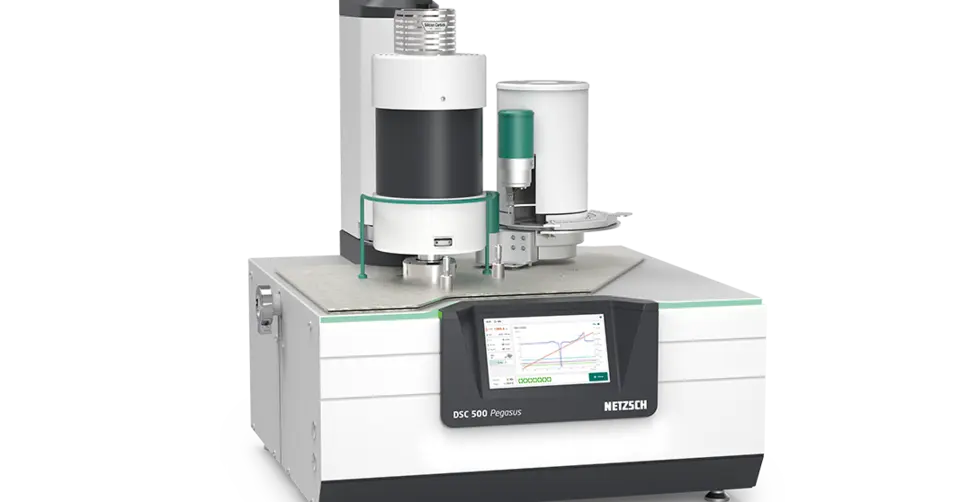
The TG 209 F1 Libra® is equipped with a cooling thermostat to guarantee highest long term stability, start measurements under room temperature and allow quick cooling of the micro furnace.
Automatic Sample Changer (ASC)
The TG system with an automatic sample changer can handle up to 192 crucibles/pans evenly distributed on two removable trays. Different types of crucibles/pans are allowed up to 8 mm Ø in and 8 mm in height. A four-needle gripper handles different crucibles by using the appropriate gripping pressure for the chosen pan. For calibration and correction purposes, a fixed strip with additional 12 crucible/pan positions is available. Crucible/pan recognition in flight is available. A crucible/pan and lid data base is linked to the ASC. The sample trays are covered by an automatically controlled cover. After closing the cover, the space above the sample pans is purged by branching gas channels integrated in the cover. The purge gas rate is adapted to opening and closing the cover. For this purpose, a further purge gas inlet is available only for the use with the ASC. A “remove lid” function is integrated to cover the sample while waiting its turn to be inserted into the TG cell. Alternatively, a piercing device is optionally available for piercing the lid prior to measurement. The TG system has a refuse bin for disposing lids and non-reusable pans. It is possible to archive the micro-plate trays (storage sample). For better identification, the plates have a serial number and 2D code. The tray identification feature is linked to a crucible/lid data base.
Vacuum Pumps
Different vacuum pumps in connection with the prepared automatic evacuating and filling system, AutoVac, make measurements at a reduced pressure or in a pure, oxygen-free atmosphere possible.
Sample Crucibles (Pans)
There are numbers of different crucibles (pans) of aluminum oxide, platinum, aluminum, graphite and fused silica available in different sizes up to 350 µl.
Piercing Device
For unstable samples or samples with volatile components, an automatic piercing device is available for the ASC which opens the sealed crucible (pan) just prior to the start of measurement.
Calibration Standards
Different calibration sets are available and cover the entire temperature range of 10°C to 1100°C. The calibration substances are prepared for measurement in accordance with ASTM and CEI-IEC standards.
Evolved Gas Analysis (analysis of evolved reaction gases)
The TG 209 F1 Libra® can be coupled to the Quadrupole Mass Spectrometer QMS 403 D Aëolos® and/or to an FT-IR Spectrometer or to a GC-MS. Gases released are conducted via a heated fused silica capillary or transfer line directly into the gas analyzer, where the volatile fragments can be detected down to the ppm-range during the Decomposition reactionA decomposition reaction is a thermally induced reaction of a chemical compound forming solid and/or gaseous products. decomposition of the sample.


Crucibles (Pans) for General Applications – TG 209 F1 Libra®
| Material (Purity) | Temperature Range | Consisting of | Dimension/ Volume | Remarks | Order Number |
| Al2O3 (99.7) | Max. 1700°C | Crucible | ø 6.8 mm / 85 μl | GB399972 | |
| Al2O3 (99.7) | Max. 1700°C | Lid | For GB399972 | GB399973 | |
| Quartz | Max. 1000°C | Crucible | ø 6.7 mm / 85 μl | GB399974 | |
| Quartz | Max. 1000°C | Lid | For GB399974 | GB399975 | |
| Pt/Rh (80/20) | Max. 1700°C | Crucible | ø 6.8 mm / 85 μl | GB399205 | |
| Pt/Rh (80/20) | Max. 1700°C | Lid | For GB399205 and NGB801556 | GB399860 | |
| Pt/Rh (80/20) | Max. 1700°C | Crucible | ø 6.8 mm / 190 μl | NGB801556 | |
| Al (99.5) | Max. 610°C | Cruciblel | ø 6.7 mm / 85 μl | Set of 100 pieces | NGB810405 |
| Al (99.5) | Max. 610°C | Lid | For NGB810405 | NGB810406 | |
| Gold (99.9) | Max. 900°C | Crucible + lid | ø 6.7 mm / 85 μl | 6.225.6-93.3.00 | |
| Silver | Max. 750°C | Crucible + lid | ø 6.7 mm / 85 μl | 6.225.6-93.4.00 | |
| ZrO2 | Max. 2000°C | Crucible | 85 μl | CaO-stabilized | GB397053 |
| ZrO2 | Max. 2000°C | Lid | For GB397053 | GB397052 | |
| Graphite | Max. 2200°C | Crucible | 85 μl | GB399956 | |
| Graphite | Max. 2200°C | Lid | For GB399956 | GB399957 | |
| Al2O3 (99.8) | Max. 1700°C | Crucible | ø 9 mm, height 7 mm, volume 350 μl | Sample holder for large samples required | NGB800453 |
| Al2O3 (99.8) | Max. 1700°C | Lid | NGB800454 | ||
| Al2O3 (99.7) | Max. 1700°C | Crucible | ø 8 mm, height 8 mm, volume 300 μl | Sample holder for large samples required, ASC-compatible | NGB803698 |
| Al2O3 (99.7) | Max. 1700°C | Lid | For crucible NGB803698 | NGB808209 |
The future is now!
Bring our devices into your laboratory with the click of a button.
Simply scan the QR code and get a 3D model of the instrument directly on your mobile phone or tablet. With the help of the latest AR Technology (Artificial Reality), the 3D model can easily be placed in your laboratory in its original life size. This function is browser-based and requires no app.
Find out and be amazed!


This instrument is LabV®️-primed
LabV®️ takes the data from your analytical instrument: It automatically imports all measurement data into a central and secure database solution, the LabV®️ software. This allows you to visualize the data in LabV®️ and to make them searchable. Your data will now be accessible from anywhere. Moreover you have the possibility to generate reports.
Application Literature

Our latest blog articles
- 25.06.2026
Tracking Down the Chemistry of PUR Powder Coatings with TGA-FT-IR and DSC

- 15.06.2026
Understanding Molten Salts for the Next Generation of Nuclear Reactors

- 08.06.2026
6 Reasons Why Pharmaceutical Laboratories Trust NETZSCH Thermal Analysis

- 05.05.2026
Thermogravimetry Meets Hydrogen (Part 3): Investigating Cu and CuO Redox Reactions under Hydrogen Atmospheres
- 17.03.2026
Moisture Matters: Understanding the Decomposition of Potassium Clavulanate Using TGA-FT-IR

- 11.03.2026
Thermogravimetry Meets Hydrogen (Part 2): Studying the Reduction of Fe₂O₃ under Different Hydrogen Concentrations