26.08.2025 von Dr. Chiara Baldini, Aileen Sammler
Boosting Thermoelectric Power with Nanoribbon Ceramics – A New Route to High-Performance Calcium Cobaltites
The search for new ways to use energy efficiently and advance sustainable technologies is a central topic of our time. Materials capable of converting heat directly into electrical energy – so-called thermoelectric materials – are therefore increasingly in the spotlight. Ceramic compounds based on calcium cobaltite are considered particularly promising, as they are robust, resistant to high temperatures, and efficient in their performance.
In the field of high-temperature thermoelectric materials, achieving anisotropic microstructures in polycrystalline ceramics is a key strategy for boosting electrical conductivity while suppressing thermal transport.
But how can these materials be further improved? A research team has now developed an entirely new approach to significantly enhance the properties of these compounds, thus taking an important step toward cleaner energy generation.
The recent study published in the Journal of the American Ceramic and titled “High‐performance thermoelectric calcium cobaltite nanoribbon ceramic via electrospinning and dual spark plasma texturing”, presents an innovative approach to this challenge.
From Nanoribbons to High-Performance Ceramics
Researchers from Leibniz University Hannover and the Technion – Israel Institute of Technology successfully combined electrospinning with sequential spark plasma sintering (SPS) and edge-free spark plasma texturing (SPT). This processing strategy was previously presented in a previous blog, where it was applied to CCO powder-based ceramics.
The key innovation of this project is the use of electrospun nanoribbons as starting material for creating highly textured calcium cobaltite (Ca₃Co₄O₉, CCO) ceramics.
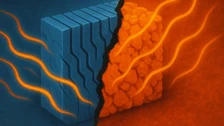
These one-dimensional precursors are inherently anisotropic and already exhibit aligned grain orientation. Once sintered and textured using the combined SPS + SPT approach, the resulting cobaltite has a densely packed, brick-wall-like microstructure, an enhanced alignment for efficient in-plane charge transport, and reduced thermal conductivity due to phonon scattering at textured grain boundaries.
At 1073 K, this promising thermoelectric material achieved a figure of merit ZT = 0.53, which is among the highest values reported for polycrystalline CCO.
NETZSCH Thermal Analyzers Enabling Accurate Thermoelectric Property Evaluation
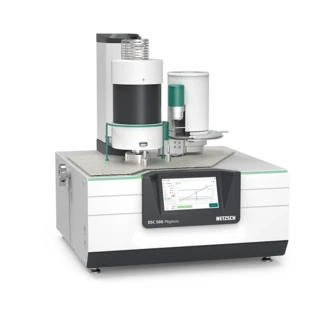
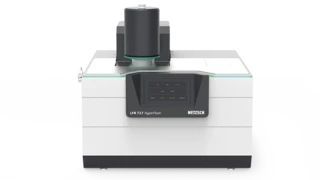
The NETZSCH Analyzing & Testing laboratory contributed essential measurements for this work by measuring thermal diffusivity, using the NETZSCH LFA 467 HT HyperFlash Laser Flash apparatus, and specific heat capacity (cp) with the NETZSCH DSC 404 F1 Pegasus® Differential Scanning Calorimeter.
Both data enabled accurate calculation of thermal conductivity (λ) and ZT values, providing direct insight into the effect of nanostructuring on thermal transport.
This study highlights how pre-structured, anisotropic ceramic building blocks can significantly enhance thermoelectric properties of oxide materials. The synergy between innovative synthesis and precise thermal characterization paves the way for new energy harvesting technologies based on stable, high-performance ceramics.
Acknowledgements
This work is the result of a collaborative effort between the Institute of Physical Chemistry and Electrochemistry at Leibniz University Hannover (Germany) and the Wolfson Department of Chemical Engineering, in cooperation with the Nancy & Stephan Grand Technion Energy Program (GTEP) at Technion–Israel Institute of Technology (Haifa, Israel), in corporation with NETZSCH Analyzing & Testing.
We are pleased to having contributed to this research by providing thermal analysis expertise and instrumentation for the precise characterization of thermophysical properties.
Open access funding for this publication was enabled and organized by Projekt DEAL.
Learn more about NETZSCH DSC and LFA Instruments for High-Temperature Applications