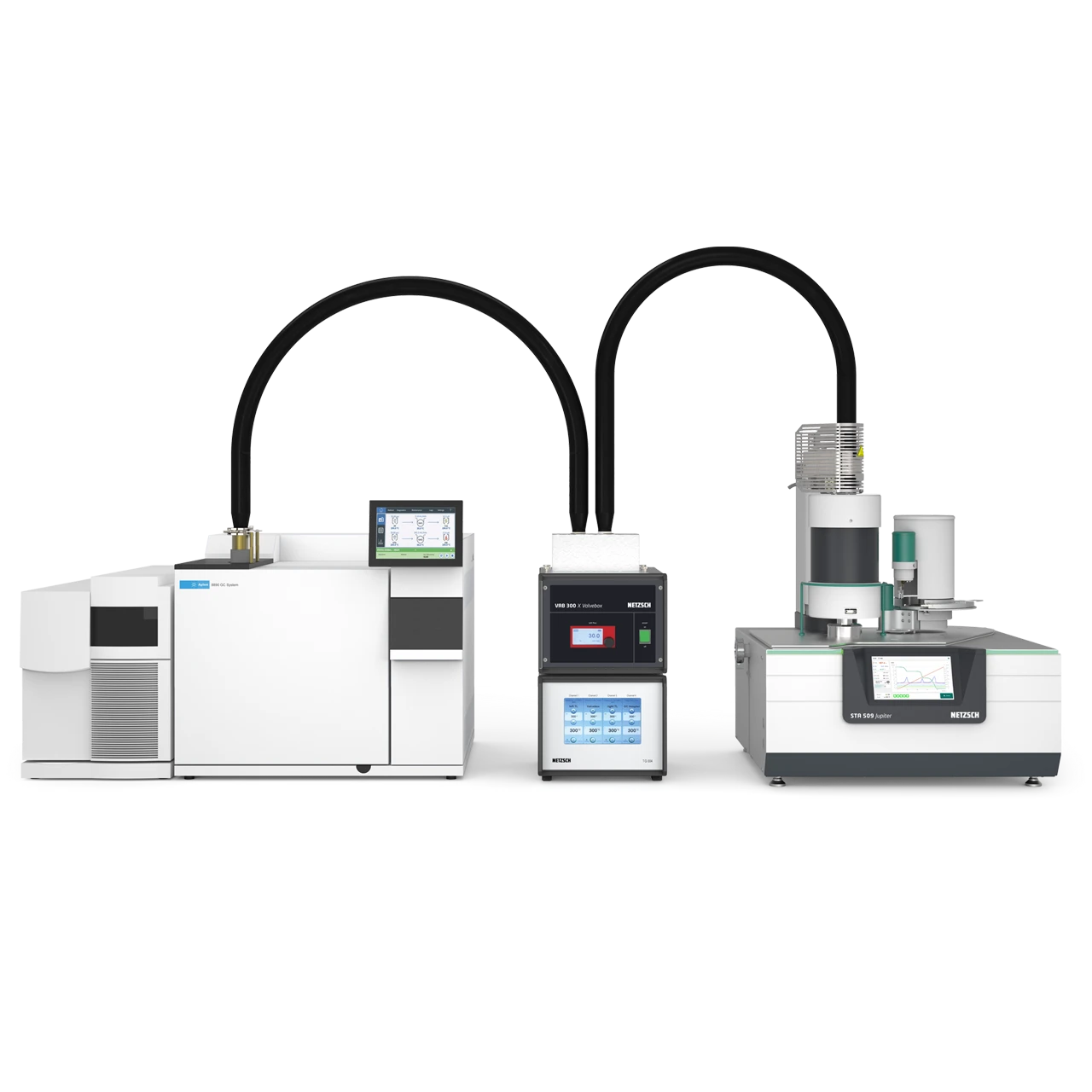
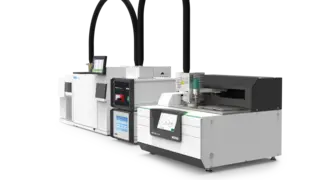
STA 509 Jupiter®, gekoppelt an GC-MS
Die ideale Schnittstelle für die erweiterte Gasanalytik
Highlights
Thermische Analyse in Verbindung mit GC-MS – Eindeutige Identifizierung bis zum letzten Molekül
Die GC-MS-Kopplung macht die STA 509 Jupiter® zu einem leistungsstarken Analysesystem für die hochselektive Analyse von freigesetzten Gasen. Die Kombination der simultanen thermischen Analyse (TG-DSC/DTA) mit Gaschromatographie und Massenspektrometrie ermöglicht nicht nur die effektive Trennung und zuverlässige Identifizierung komplexer Gasgemische, die bei der thermischen Zersetzung freigesetzt werden, sondern korreliert diese Gase über das DSC-Signal auch mit thermischen Übergängen und Reaktionsenthalpien. Während andere spektroskopische Methoden die Komponenten vor der Identifizierung nicht trennen können, ermöglicht die GC-MS – dank ihres vorangehenden chromatographischen Schritts – eine zuverlässige Unterscheidung selbst chemisch ähnlicher oder gleichzeitig freigesetzter Spezies anhand ihrer Retentionszeit und charakteristischer Ionenmuster.
Die kompakte, intelligente Schnittstelle gewährleistet eine effiziente Weiterleitung der entstehenden Gase vom STA-Ofen zum GC-MS. Beheizte Kapillaren und optimierte Strömungswege minimieren Memory-Effekte und verhindern Kondensation, was eine schnelle Ansprechzeit, scharfe chromatographische Peaks und eine zuverlässige Detektion flüchtiger, halbflüchtiger und reaktiver Spezies gewährleistet.
Die mit einem GC-MS gekoppelte STA 509 Jupiter® fügt sich nahtlos in Forschungs- und Industrieumgebungen ein und unterstützt die Qualitätssicherung, die Polymer- und Materialentwicklung, Formulierungsstudien, Zersetzungs- und Reaktionsanalysen sowie forensische Anwendungen. Bestehende STA 509 Jupiter®-Systeme können jederzeit mit der GC-MS-Kopplung nachgerüstet werden.

Durch die Kopplung einer NETZSCH-STA mit einem Gaschromatographie-Massenspektrometrie-System (GC-MS) lassen sich Massenänderungen gleichzeitig messen und die entstehenden Gase detailliert analysieren. Während die TG die Massenänderungen während thermischer Vorgänge aufzeichnet, trennt der Gaschromatograph (GC) zunächst die entstehenden Gase anhand ihrer Retentionszeit an der stationären Phase. Das Massenspektrometer (MS) analysiert anschließend die ionisierten Fragmente dieser getrennten Gase anhand ihres Masse-zu-Ladungs-Verhältnisses (m/z). Diese leistungsstarke Kombination liefert tiefe Einblicke in Zersetzungsprozesse, Reaktionswege und die Zusammensetzung komplexer Gasgemische.
Method
Gaschromatographie-Massenspektrometrie (GC-MS) in Verbindung mit thermischer Analyse
Die thermische Analyse erfasst Massenänderungen und thermische Vorgänge über breite Temperaturbereiche hinweg. Um die chemischen Reaktionen jedoch vollständig zu verstehen und die bei diesen Prozessen freigesetzten Verbindungen zu identifizieren, müssen die entstehenden Gase getrennt und analysiert werden. Die Kopplung von TG und GC-MS schließt diese Lücke: Die Gaschromatographie trennt überlappende Komponenten, während die Massenspektrometrie molekulare Fingerabdrücke für eine zuverlässige Identifizierung liefert. Die NETZSCH-Proteus®-Software steuert den gesamten Prozess, einschließlich Probenahme, Injektionszeitpunkt und Datensynchronisation, sodass die Ergebnisse der thermischen Analyse und der GC-MS automatisch miteinander verknüpft werden. Dadurch bleibt der vollständige Temperatur-Zeit-Zusammenhang zwischen TG-Kurven, Chromatogrammen und Massenspektren erhalten, was klare, korrelierte Erkenntnisse liefert, ohne dass eine externe Software erforderlich ist.
Intelligente Gaseinspritzung für eine effiziente GC-MS-Kopplung
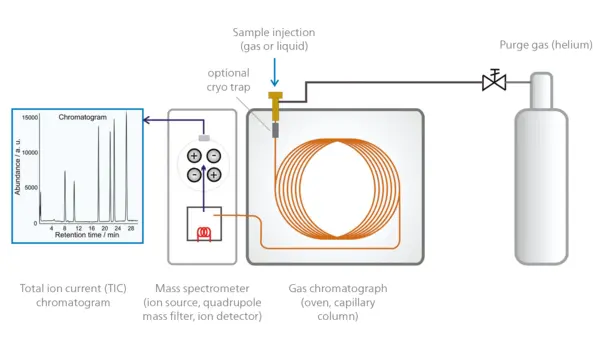
Da die GC-Trennung Zeit benötigt, die von den Proben- und Säulenbedingungen abhängt, ist eine kontinuierliche Online-Gaszufuhr für eine effektive Analyse nicht geeignet. NETZSCH löst dieses Problem durch eine quasi-kontinuierliche Kopplung über ein beheiztes Ventilsystem für die softwaregesteuerte Probenahme und die von Proteus® verwalteten Injektionen in kurzen Intervallen. Das injizierte (oder gespaltene) Gas durchströmt die GC-Säule und gelangt anschließend – nach einer Druckreduzierung – als Molekularstrahl in das Quadrupol-MS. Die Säule kann im quasi-kontinuierlichen Modus bei konstanter Temperatur oder mit einem Temperaturprogramm für ereignisgesteuerte Durchläufe betrieben werden. Das MS zeichnet ein TIC-Chromatogramm (Total Ion Current) in Abhängigkeit von der Retentionszeit auf, und jeder Peak wird analysiert, um die entsprechenden flüchtigen Verbindungen zu identifizieren.
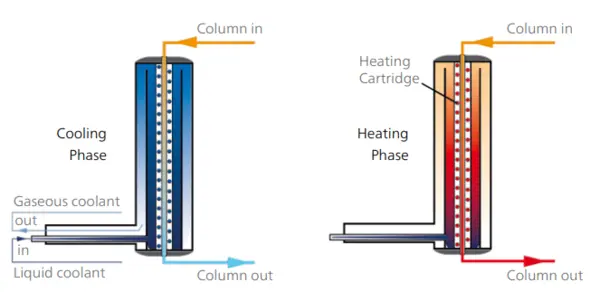
Multi-Injektions- und Kryofalle-Modus
Eine Kryofalle ist eine Vorrichtung, die in Gasanalysesystemen zum Kondensieren und Sammeln flüchtiger Verbindungen bei sehr niedrigen Temperaturen eingesetzt wird. Wie in der Abbildung links dargestellt, wird während einer TG- oder STA-Messung der Außenmantel der Kryofalle mit flüssigem Stickstoff gekühlt (Kühlphase), um flüchtige ausgasende Verbindungen zu kondensieren und zu konzentrieren. Sobald die Gassammlung abgeschlossen ist, wird die Falle mithilfe der eingebauten Heizpatrone schnell erhitzt (Heizphase), wodurch die konzentrierten Gase in einem scharfen Impuls freigesetzt werden, um in die GC-Säule injiziert zu werden.
Technische Daten
Gasprobenahme und
-einleitung
Beheizte Transferleitung
GC-MS-Detektion
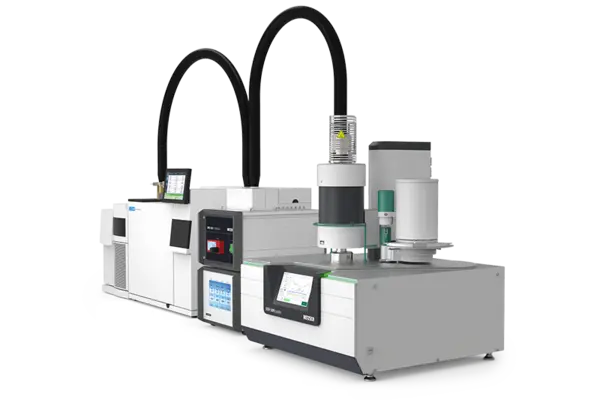
STA 509 Jupiter® in Verbindung mit GC-MS – optimierter Gastransfer
Die kopplung zwischen der STA 509 Jupiter® und dem GC-MS bietet einen vollständig beheizten Gasweg von der Thermowaage bis zum Ventilblock und zum GC-Injektor, wobei der Ofenadapter auf bis zu 400 °C und die emaillierte Stahl-Übertragungsleitung auf bis zu 350 °C beheizt werden. Ein integriertes Durchflussregelsystem gewährleistet einen erzwungenen Durchfluss durch die Probenahmeschleife und sorgt so für eine zuverlässige, verlustfreie Übertragung. Der ventilgesteuerte Doppelkreis-Injektor ermöglicht kurze Injektionsintervalle und ist vollständig in die Proteus®-Software integriert. Eine spezielle Wärmeisolierung (bis zu 350 °C) verhindert Kaltstellen im gesamten System. Die Anordnung lässt sich problemlos an jeden standardmäßigen GC-S/SL-Injektor anschließen und ermöglicht einen schnellen Wechsel zwischen der STA-Kopplung und herkömmlichen GC-Anwendungen wie der Flüssigkeitsprobenahme. Für maximale Flexibilität kann die Säule für eine direkte MS-Kopplung umgangen werden.
GC-MS-Plattform: Flexibel, schnell und im Einsatz bewährt
Das GC unterstützt Split-, Splitless- und Puls-Split-Injektionen, eine Ofentemperatur von bis zu 450 °C, optionale schnelle Säulenwechsel ohne Entlüftung des MS sowie eine Auswahl an anwendungsspezifischen Säulen. Das MS bietet einen Massenbereich von bis zu 10¹¹ u, Scanraten von bis zu 20.000 u/s, eine werkzeuglose Wartung (einschließlich vereinfachter Wartung der Ionenquelle) sowie mehrere Ionisationsmodi (EI, CI, PI). Es kann auch als eigenständiger Detektor betrieben werden. Für die GC-MS-Kopplung arbeitet NETZSCH mit weltweit renommierten Anbietern wie Agilent und JEOL zusammen und gewährleistet so erstklassige Hardware- und Servicequalität sowie eine optimierte Leistung für NETZSCH-Systeme.
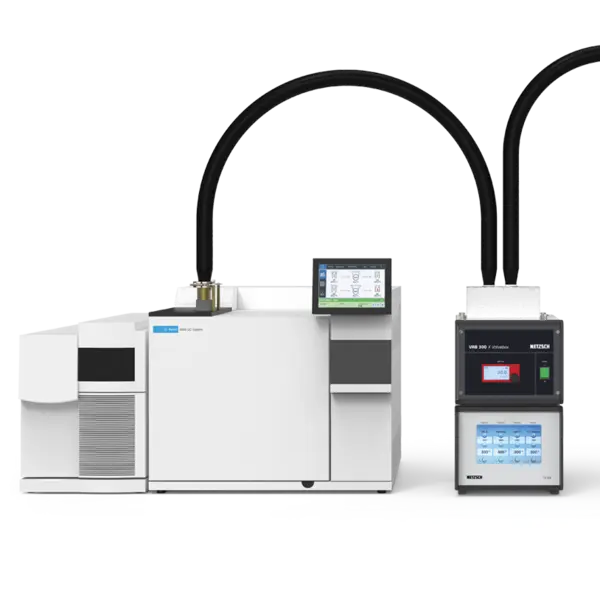



Proven Excellence im Service
NETZSCH Analysieren & Prüfen bietet Ihnen weltweit ein umfassendes Angebot an Services, um die optimale Leistung und Langlebigkeit Ihrer thermoanalytischen Geräte zu gewährleisten. Wir helfen Ihnen dabei, die Effektivität Ihrer Geräte zu maximieren, ihre Lebensdauer zu verlängern und Ausfallzeiten zu minimieren.
Schöpfen Sie das volle Potenzial Ihrer Geräte mit unseren maßgeschneiderten Lösungen aus, die auf jahrelanger Branchenerfahrung und Innovation beruhen.
Ähnliche Geräte

Beratung & Vertrieb
Haben Sie weitere Fragen zum Gerät oder zur Methode und möchten mit einem Vertriebsmitarbeiter sprechen?
Service & Support
Sie haben bereits ein Gerät und benötigen technische Unterstützung oder Ersatzteile?