29.09.2023 by Aileen Sammler
Low-Temperature Differential Scanning Calorimetry for Metals

Amidst the energy transition, lightweight construction is gaining increasing importance in areas such as the automotive sector, aviation and transportation. In the context of electric mobility, for example, by reducing the weight of a car by 100 kg, an energy saving of up to 0.64 kWh per 100 km can be achieved. [1] Due to their high specific strength, aluminum alloys are central materials in constructive lightweight construction. By replacing steel components with aluminum alloys, the weight can be reduced by up to 30%.[2]
AlMgSi alloys consist of aluminum with magnesium and silicon as main alloying elements. These alloys are precipitation-hardened and can, for instance after a forming process, be further strengthened by a specific heat treatment.
Low-temperature differential scanning calorimeters (LT-DSC) are usually employed for the analysis of low-melting substances, such as polymers, and particularly feature high heat-flow sensitivity. LT-DSCs are also valuable tools for studying phase transformations in metals, including precipitation formation in AlMgSi alloys. By analyzing the heat flow associated with these transformations, researchers gain insights into the microstructural evolution and its impact on the alloy's properties.
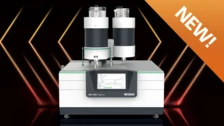
In this Application Note, we analyze and determine precipitation of AlMgSi alloys by means of differential scanning calorimetry (DSC). The NETZSCH low-temperature DSC features a highly precise measuring sensor (enthalpy precision < 1% for Indium) and allows for measurements up to 750°C, depending on the cooling system used (according to the model).
[1] Helms, H., & Kräck, J.: Energy savings by light-weighting-2016 Update. Heidelberg: Institute for Energy and Environmental Research 2016
[2] Schlosser, J. et al.: Materials and simulation modelling of a crash-beam performance. A comparison study showing the potential for weight saving using warm-formed ultra-high strength aluminium alloys. In: Journal of Physics: Conference Series (2017), S. 896
New e-book “Thermal Properties of Metals and Alloys”
Our new booklet presents an introduction into the broad applications spectrum of thermoanalytical methods and illustrates how these can be used in determining thermophysical properties of metals and alloys.
More Blog Articles about the Thermal Analysis of Metals & Alloys
- 16.07.2025
The Brand-New NETZSCH DIL 502 Expedis® Dilatometer: The Future of Low- and High-Temperature Dilatometry

- 08.07.2025
Unmatched Versatility: Introducing the NETZSCH TMA 512 Hyperion® for Thermomechanical Analysis
- 11.02.2025
The New NETZSCH DMA 503 Eplexor®: A Dynamic Mechanical Analyzer Revolutionized

- 08.01.2025
Introducing the New NETZSCH LFA 717: Precision Redefined in Thermal Conductivity Measurement

- 23.12.2024
Exploring the Versatile Furnaces of the NETZSCH STA 509 Jupiter® Instrument Series - Part 1

- 11.12.2024
Brand-new Differential Scanning Calorimeter for High-Temperature Applications: The NETZSCH DSC 500 Pegasus®