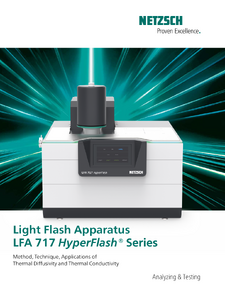
LFA 717 HyperFlash® HT
High-temperature Light Flash Apparatus
Highlights
How Fast Is Heat Transferred?
The LFA 717 HyperFlash® HT is a state-of-the-art instrument designed to accurately measure the Thermal DiffusivityThermal diffusivity (a with the unit mm2/s) is a material-specific property for characterizing unsteady heat conduction. This value describes how quickly a material reacts to a change in temperature.thermal diffusivity of various materials. With its advanced calculation models, it is at the forefront of scientific innovation, ensuring accurate results essential for materials analysis.
- Measurements up to 1250°C: The LFA 717 HyperFlash® HT is an advanced thermal analysis instrument that uses the latest xenon flash lamp technology to measure temperatures up to 1250°C. This innovative system eliminates the need for laser classification, making it easy to use and compliant with safety regulations.
- Broad sample range: The LFA 717 HyperFlash® can accommodate a wide range of sample materials, including both round and square shapes.
- Vacuum tight furnace for controlled atmosphere: The vacuum-tight furnace is designed to create controlled atmospheres that effectively prevent OxidationOxidation can describe different processes in the context of thermal analysis.oxidation during heating processes. The vacuum-tight furnace features an internal pump that automatically evacuates the chamber prior to each measurement, maintaining a defined atmosphere for accurate results. It also provides additional ports for external pumping equipment, increasing operational flexibility.
- Time-saving mini-tube furnaces: With the ability to support rapid heating rates of up to 50 K/min, the four alumina mini-tube furnaces provide exceptional sample throughput across the temperature range for unmatched test speed. Each of the four sample positions is equipped with its own thermocouple, resulting in fast stabilization times. With the ability to measure ten temperature steps from RT to 1250°C in just one hour, these furnaces are designed for efficiency and precision, making them ideal for demanding applications in laboratories and research facilities.
- Advanced corrections specifically for thin and highly conductive samples: The latest version of our analysis software introduces an enhanced analysis pulse correction feature designed for high-precision applications where exceptional time resolution is critical. This enhancement is particularly beneficial when analyzing thin and highly conductive samples, and in situations where the light pulse coincides with the thermal response of the sample.
The LFA 717 HyperFlash® HT is an essential tool for researchers and industries requiring precise thermal property measurements, making it an invaluable asset in the field of materials science.


The top cover of the instrument serves as a convenient area for sample preparation and storage. It has been thoughtfully designed with four visually distinct sections, each corresponding to specific sample locations within the furnace. This innovative layout simplifies sample identification and pre-assembly, minimizes instrument downtime, and is especially beneficial in multi-user environments.
Method
Efficient Determination of Thermophysical Properties with the Light Flash Method
The Light Flash (LFA) technique is a fast, absolute, non-destructive, and non-contact method for accurate measurement of Thermal DiffusivityThermal diffusivity (a with the unit mm2/s) is a material-specific property for characterizing unsteady heat conduction. This value describes how quickly a material reacts to a change in temperature.thermal diffusivity. This innovative approach not only determines Thermal DiffusivityThermal diffusivity (a with the unit mm2/s) is a material-specific property for characterizing unsteady heat conduction. This value describes how quickly a material reacts to a change in temperature.thermal diffusivity, but also characterizes the specific heat of materials when a reference sample is used.
In the LFA process, the front surface of a plane-parallel sample is heated by a short pulse of energy. An infrared (IR) detector measures the resulting temperature change on the back of the sample. From these data, both Thermal DiffusivityThermal diffusivity (a with the unit mm2/s) is a material-specific property for characterizing unsteady heat conduction. This value describes how quickly a material reacts to a change in temperature.thermal diffusivity and specific heat can be characterized.
To calculate the Thermal ConductivityThermal conductivity (λ with the unit W/(m•K)) describes the transport of energy – in the form of heat – through a body of mass as the result of a temperature gradient (see fig. 1). According to the second law of thermodynamics, heat always flows in the direction of the lower temperature.thermal conductivity, these thermophysical properties are combined with the DensityThe mass density is defined as the ratio between mass and volume. density using the formula:
λ(T)=a(T)⋅cp⋅ρ(T)
Where:
- λ = Thermal ConductivityThermal conductivity (λ with the unit W/(m•K)) describes the transport of energy – in the form of heat – through a body of mass as the result of a temperature gradient (see fig. 1). According to the second law of thermodynamics, heat always flows in the direction of the lower temperature.thermal conductivity [W/(m·K)]
- a = Thermal DiffusivityThermal diffusivity (a with the unit mm2/s) is a material-specific property for characterizing unsteady heat conduction. This value describes how quickly a material reacts to a change in temperature.thermal diffusivity [mm²/s]
- cp = specific heat [J/(g·K)]
- ρ = DensityThe mass density is defined as the ratio between mass and volume. density [g/cm³]
With its ability to analyze a wide range of materials at various temperatures, the LFA technique is essential for researchers and industries focused on understanding thermal properties in depth.

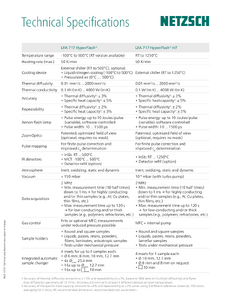
Specifications

Proven Excellence in Service
At NETZSCH Analyzing & Testing, we offer a comprehensive range of services globally to ensure the optimal performance and longevity of your thermoanalytical equipment. With a track record of proven excellence, our services are designed to maximize the effectiveness of your devices, extend their lifespan, and minimize downtime.
Unlock the full potential of your equipment with our tailored solutions, backed by years of industry expertise and innovation.
Software
Proteus® Software for LFA - Fast, efficient, and seamlessly integrated!

The Proteus® 64-bit software is designed to be licensed with each instrument, allowing users to simultaneously connect multiple instruments via USB or run the software on secondary installations on different computer systems. Integrated into the NETZSCH Assistant starting with version 9.5, this software suite links a wide range of NETZSCH instruments and various third-party applications into a cohesive management platform.
A significant enhancement specific to Laser Flash Analysis (LFA) is the transition from the previous database format to a new, faster SQL database format. This upgrade in data architecture results in improved modeling times and can deliver results up to 2.5 times faster while using less memory. As a result, users can now store an almost unlimited number of measurements in a single database. All standard database management functions, including import/export and data merging, are still fully supported.
The LFA 717 HyperFlash® HT measurement software is an essential tool for connecting and controlling instrument and hardware accessories, allowing users to effectively define, monitor, and optimize measurements. Designed to enhance automation, this software offers a high degree of customization, making it ideal for various industries.

In addition to measurement capabilities, the dedicated, stand alone Proteus® LFA analysis software provides robust data analysis based on analytical models. Key features include:
Comprehensive data analysis
Users can simultaneously analyze multiple measurements within a single plot, eliminating the need for post-processing. This streamlining saves time and improves accuracy.
Export detailed documentation
Proteus® LFA provides extensive export options to generate comprehensive documentation of results, critical for quality assurance and reporting.
Save analysis states
The ability to save analysis states allows convenient sequential analysis, making it easier to perform follow-up analyses without starting from scratch.

Unsurpassed integrated mathematical models for clear and precise evaluation. In addition to the standard model for opaque, homogeneous and isotropic samples, the so-called improved Cape-Lehman model, there are models for special application requirements and corrections.

For better fit and best results, all models come standard with light pulse correction and baseline correction. The user has the option to turn off these corrections. All previously mentioned models take heat loss into account, in addition the AdiabaticAdiabatic describes a system or measurement mode without any heat exchange with the surroundings. This mode can be realized using a calorimeter device according to the method of accelerating rate calorimetry (ARC). The main purpose of such a device is to study scenarios and thermal runaway reactions. A short description of the adiabatic mode is “no heat in – no heat out”.adiabatic (Parker) Model is also available.

In the latest version of our analysis software, we are pleased to introduce a refined and highly accurate pulse correction feature. This enhancement allows users to access samples that require exceptional time resolution, making it particularly beneficial for thin or highly conductive materials. It is especially useful when the light pulse overlaps with the thermal response of the sample.
Users can select from a variety of correction techniques within the calculation dialog:
- Equivalent Square
- Center of Gravity
- Double Exponential Pulse Correction
Impact on Model Function and Fit Quality
Implementing pulse correction significantly affects both the appearance of the model function and the associated goodness of fit. For example, shown below is a high diffusivity material with a thermal diffusivity (α) of 800 mm²/s where a 1 ms pulse signal is superimposed on the detector signal.
The difference in calculated thermal diffusivity can exceed 20% depending on whether the exponential pulse correction is applied or not. This highlights the critical importance of using pulse correction techniques to achieve accurate analysis results.


This instrument is LabV®️-ready.
Turn data into better products with LabV®—a centralized, AI-driven material intelligence platform that integrates data from this instrument and any other data sources. Designed for R&D and QC engineers, LabV® enables data-driven decision-making to drive innovation and ensure consistently high-quality results.
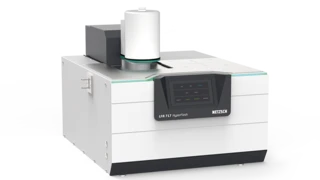
Related Devices
E-Learning
LFA 717 Hyperflash - Basic Courses



Downloads and Media
Videos
Innovations in Thermal ConductivityThermal conductivity (λ with the unit W/(m•K)) describes the transport of energy – in the form of heat – through a body of mass as the result of a temperature gradient (see fig. 1). According to the second law of thermodynamics, heat always flows in the direction of the lower temperature.Thermal Conductivity: The new NETZSCH LFA 717 HyperFlash®
This is an excerpt of our NETZSCH Tech Talk of December 2024.
Application Literature
Our latest blog articles
- 22.09.2026
NETZSCH Analysis Instruments in Use at South Korean Research Institutes
- 26.08.2025
Boosting Thermoelectric Power with Nanoribbon Ceramics – A New Route to High-Performance Calcium Cobaltites

- 06.08.2025
Unlocking Waste Heat Recovery: Calcium Cobaltites at the Forefront of Thermoelectric Innovation

- 29.04.2025
Turning Waste Heat into Power with Nanoribbon Tech - Enhancing Performance of Thermoelectrics