methods
Dielectric Analysis (DEA)
Dielectric Analysis (DEA), also known as Dielectric Thermal Analysis (DETA), is a technique for monitoring changes in viscosity and the cure state of thermosetting resins, adhesives, paints, composites and other kinds of polymers or organic substances by measuring variations in their dielectric properties.
DEA is the most powerful measurement technique for the critical, invisible in-mold Curing (Crosslinking Reactions)Literally translated, the term “crosslinking“ means “cross networking”. In the chemical context, it is used for reactions in which molecules are linked together by introducing covalent bonds and forming three-dimensional networks.curing that dictates the quality of a component.
- Degree of CureThe degree of curing describes the conversion achieved during crosslinking reactions (curing). Degree of Cure
- Gel-Point
- Flow Behavior
- Reactivity
- Cure Monitoring
- Diffusion Properties
- Glass Transition TemperatureThe glass transition is one of the most important properties of amorphous and semi-crystalline materials, e.g., inorganic glasses, amorphous metals, polymers, pharmaceuticals and food ingredients, etc., and describes the temperature region where the mechanical properties of the materials change from hard and brittle to more soft, deformable or rubbery.Glass Transition Temperature
- Process Monitoring and Optimization
- Aging
- Decomposition reactionA decomposition reaction is a thermally induced reaction of a chemical compound forming solid and/or gaseous products. Decomposition Effects
The functional principle is consistent with that of an impedance measurement. In a typical test, the sample is placed in contact with two electrodes (the dielectric sensor).
When a sinusoidal voltage is applied, the charge carriers inside the sample are forced to move: positively charged particles migrate to the negative pole and vice versa. This movement results in a sinusoidal current with a phase shift.
In the frequency range of theDEA 288 Ionic (up to 1 MHz), the charge carriers are mainly ions (often present as catalysts or impurities) and additionally dipole alignment takes place within the electrical field.
The response signals – current and phase shift – are a function of the ion and dipole mobility. This relationship makes dielectric (thermal) analysis an ideal method for monitoring a Curing (Crosslinking Reactions)Literally translated, the term “crosslinking“ means “cross networking”. In the chemical context, it is used for reactions in which molecules are linked together by introducing covalent bonds and forming three-dimensional networks.curing process, where the sample's viscosity is increasing dramatically. As a consequence, the mobility of the charge carriers decreases, causing a corresponding attenuation of the amplitude and an increased phase shift in the resulting signal.
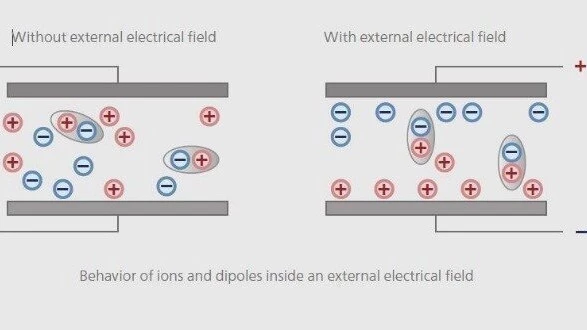
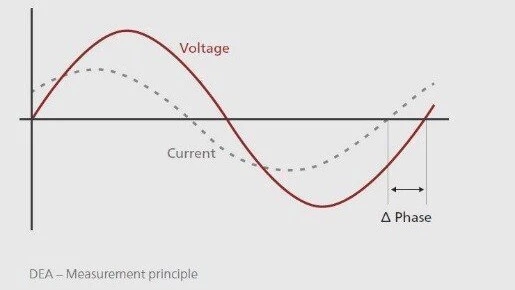
An external electric field generated by an excitation voltage is applied to the sample and the response, occurring as a current through the material, is measured.
Dipoles will be aligned and the ions will move towards the oppositely charged electrode, which can be seen in permittivity ε' and loss factor ε'', respectively. Based on the sample's characteristics, a time shift between the excitation and response signal is detected which, along with voltage and current, allows for calcu¬lation of the dielectric magnitudes.
In detail, this yields information about:
- Flow behavior
- Reactivity
- Cure progress
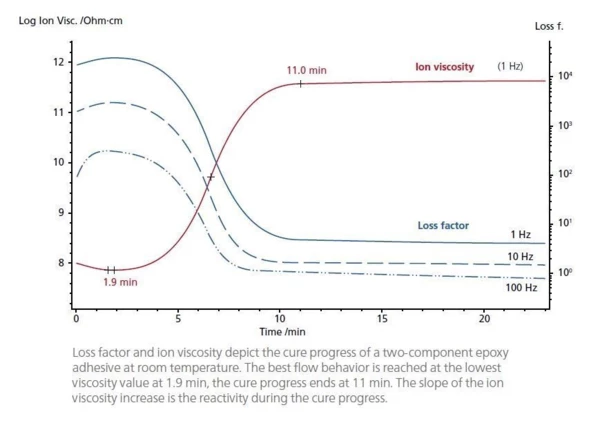
Loss factor and Ion ViscosityIon viscosity is the reciprocal value of the ion conductivity, which is calculated from the dielectric loss factor.ion viscosity depict the cure progress of a two-component epoxy adhesive at room temperature. The best flow behavior is reached at the lowest viscosity value at 1.9 min, the cure progress ends at 11 min. The slope of the Ion ViscosityIon viscosity is the reciprocal value of the ion conductivity, which is calculated from the dielectric loss factor.ion viscosity increase describes the reactivity during the cure progress.