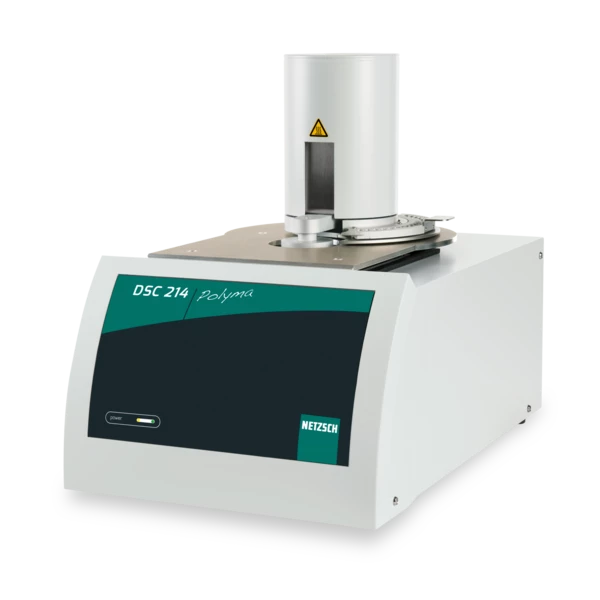
DSC 214 Polyma
The System Solution for Efficient Characterization of Polymers
The New All-Inclusive Product Package for DSC Measurements
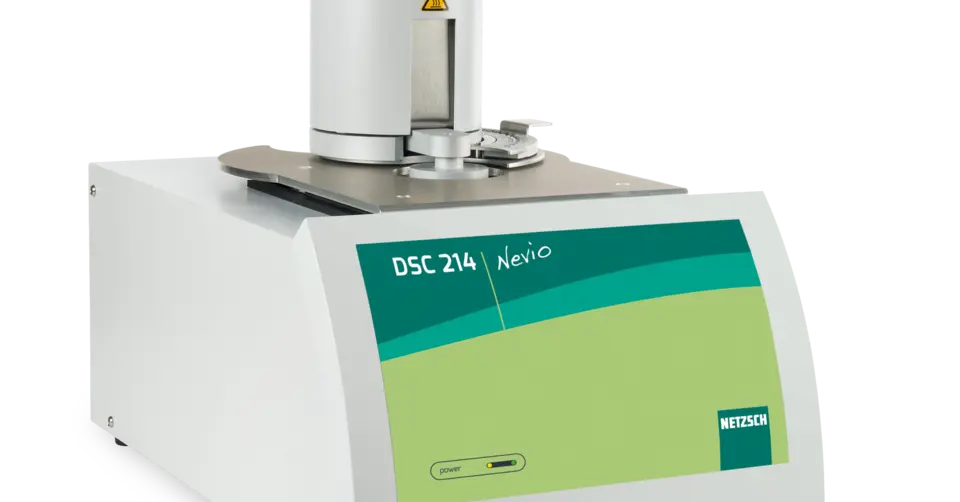
Easy-to-use, robust, precise, optimized for everyday use – these are the features of the innovative DSC 214 Polyma. The unique design of this instrument encompasses everything needed for successful DSC investigations – regardless of whether the user is a beginner or an experienced professional. Above all, it is the two new software developments that are setting new standards: AutoEvaluation and Identify. These have the potential to revolutionize DSC analysis.
- New all-inclusive 360° product package for the characterization of polymers
- Easier sample preparation than ever before
- Automated measurement and evaluation

The First Classic Heat-Flux DSC for Fast Cooling
Integrated in the DSC 214 Polyma is an oval furnace with a very low thermal mass (Arena® furnace), which allows for heating and cooling rates of up to 500 K/min – values previously unachievable with heat-flux DSCs. Temperature profiles can now be realized which are far closer to real processing conditions.
Groundbreaking Sensor Technology
The novel, patent-pending ring-shaped sensor is comprised of a core of nickel chromium and an outer ring of constantan. Both materials are diffusion-welded. This generates a defined, ring-shaped zone where the temperature under the crucible is recorded, resulting in a significantly higher reproducibility – especially in combination with the Concavus® crucibles.


By combining a very low thermal mass furnace (Arena®) with a robust, sensitive sensor (ring-shaped sensor) and optimized crucibles (Concavus®), the DSC 214 Polyma achieves impressive performance data.
Along with fast heating and cooling rates – which also allow for IsothermalTests at controlled and constant temperature are called isothermal.isothermal CrystallizationCrystallization is the physical process of hardening during the formation and growth of crystals. During this process, heat of crystallization is released.crystallization experiments – this is expressed particularly by the Indium Response Ratio, which is the achievable height-to-width-ratio of the melting peak of indium.
A high value for the Indium Response Ratio describes a peak that is not only tall (high sensitivity), but also narrow. This allows for the detection of weak effects and, at the same time, for the reliable separation of peaks occurring in close succession.
The DSC 214 Polyma features a high Indium Response Ratio of over 100 mW/K – a value which is not only far greater than average, but actually one of the highest ever published for a DSC instrument.

Technical Data

Enthalpy precision:
±0.1% for indium and ±0.05% to ± 0.2% for most samples
Specific heat determination: Optional
Temperature modulation: Optional
Gas atmospheres:
Inert, oxidizing, static and dynamic operation
Cooling device options:
Compressed air cooling (RT to 600°C)
IC40 (-40°C to 600°C)
IC70 (-70°C to 600°C)
LN2 (-170°C to 600°C)
Indium Response Ratio:
> 100 mW/K
(Related to indium as standard material under measurement conditions typically used for polymer investigation)
Heating/Cooling rate:
0.001 K/min to 500 K/min
(Maximum rates depend upon the temperature)
When we tested the curing degree by DSC the same way we did for the previous two bike rims, we realized that the kinetics-optimized Curing (Crosslinking Reactions)Literally translated, the term “crosslinking“ means “cross networking”. In the chemical context, it is used for reactions in which molecules are linked together by introducing covalent bonds and forming three-dimensional networks.curing cycle not only allowed us to almost halve the production time, but also to further improve the Curing (Crosslinking Reactions)Literally translated, the term “crosslinking“ means “cross networking”. In the chemical context, it is used for reactions in which molecules are linked together by introducing covalent bonds and forming three-dimensional networks.curing degree. A real happy ending.
Software
Proteus® 8.0: Software That Frees Time for Other Tasks
A simplified user interface for setting up measurement programs (SmartMode), automatic curve evaluation at the push of a button (AutoEvaluation), and a program for identifying unknown polymer curves (Identify) are the software’s keys to freeing up time for other tasks. Even inexperienced users are able to obtain fast, safe and meaningful results.
DSC specialists can make use of ExpertMode at any time to access the full scope of Proteus® software functionality. Results generated by means of AutoEvaluation can be manually post-processed and newly calculated so that the experienced user maintains full control of the evaluation process.
The Proteus® software version 8 – especially tailored to the DSC 214 Polyma – runs on Windows 7, Windows 8.1 or Windows 10. It is licensed with the instrument and can of course also be installed on other computer systems.
AutoEvaluation is a completely novel software development allowing for the evaluation – automatically or at the push of a button – of unknown curves for thermoplastic polymers, rubbers and resins. AutoEvaluation analyzes DSC curves by first recognizing any key effects such as Glass Transition TemperatureThe glass transition is one of the most important properties of amorphous and semi-crystalline materials, e.g., inorganic glasses, amorphous metals, polymers, pharmaceuticals and food ingredients, etc., and describes the temperature region where the mechanical properties of the materials change from hard and brittle to more soft, deformable or rubbery.glass transitions or melting peaks, and then properly interpreting side effects such as recrystallization effects in logical steps. For the first time, users now have access to expert applications knowledge in the form of an intelligent software algorithm.

Identify is a unique tool for automatic identification and interpretation of curves with only a single click. This part of the software is designed for material identification and quality assurance. The analyzed properties of the DSC curve for a given material being investigated are compared with the integrated database, allowing for the automatic identification of plastic types. Such a database comparison is unique in the area of DSC technology. The Identify database contains a NETZSCH library for typical polymers and can also be extended by adding the user’s own materials. User-specific quality criteria can additionally be applied in order to define categories. For the first time, individual batches can be objectively compared with one another – an ability which is particularly relevant in the fields of quality assurance and failure analysis.

With the launch of the DSC 214 Polyma, the new SmartMode software interface was born.It features a clear structure, uniform navigation and user friendliness. Even less-experienced users will quickly find their way thanks to its intuitive interface. Under the Wizards menu item, a set of common pre-defined measurement methods can be found; these only require a few inputs and then lead directly to measurement at the touch of a button. They can also be combined with each other. Predefined Methods include all of the materials on the NETZSCH “Thermal Properties of Polymers” poster with the corresponding methods to immediately start a measurement experiment. The User Methods menu item allows users to save methods which they have already carried out so that those measurement parameters are available as a template for subsequent measurements and do not have to be newly defined.

Calibration of the DSC instrument is a prerequisite for correct DSC measurements. It ensures that the instrument always measures within pre-defined parameters. The calibration process itself, however, should be simple, fast and – ideally – carried out right along with the process. The solution for this is AutoCalibration. This special software feature begins by offering pre-defined calibration methods for common standards, and then not only starts the calibration measurements but also – fully automatically – analyzes melting peaks, calculates calibration curves and even checks their validity. AutoCalibration thereby simplifies a routine task which can otherwise be very time-consuming.

You can use the following software with this product
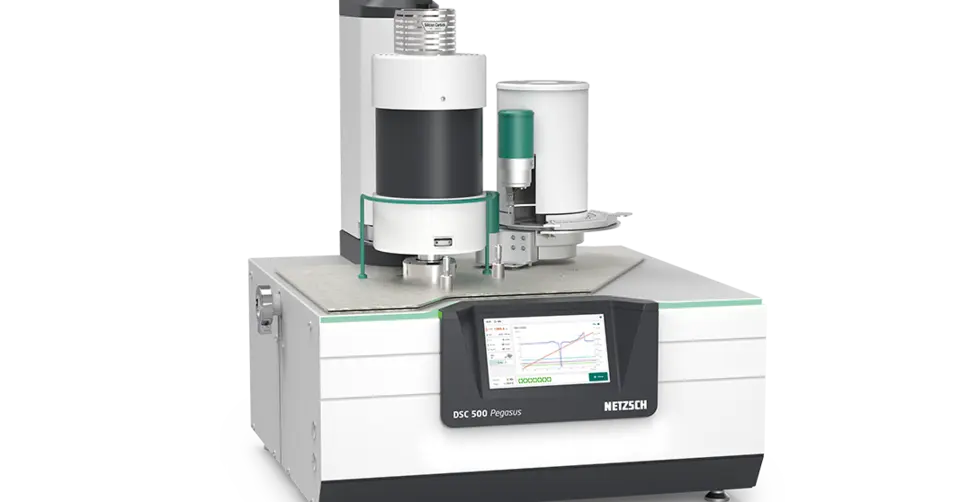
The DSC 214 Polyma can be equipped with various accessories and extensions for optimum adjustment of the system to your requirements.
Various cooling systems can be applied to cool the furnace, either back to room temperature via compressed air or down to -170°C by using liquid nitrogen cooling. The cost-efficient intracoolers offer an alternative to liquid nitrogen cooling and make it possible to run measurements between -40 to 600°C (IC40) or -70°C to 600°C (IC70).
For investigation of the oxidative stability (e.g., Oxidative-Induction Time (OIT) and Oxidative-Onset Temperature (OOT)Oxidative Induction Time (isothermal OIT) is a relative measure of the resistance of a (stabilized) material to oxidative decomposition. Oxidative-Induction Temperature (dynamic OIT) or Oxidative-Onset Temperature (OOT) is a relative measure of the resistance of a (stabilized) material to oxidative decomposition.oxidative-induction time, Oxidative-Induction Time (OIT) and Oxidative-Onset Temperature (OOT)Oxidative Induction Time (isothermal OIT) is a relative measure of the resistance of a (stabilized) material to oxidative decomposition. Oxidative-Induction Temperature (dynamic OIT) or Oxidative-Onset Temperature (OOT) is a relative measure of the resistance of a (stabilized) material to oxidative decomposition.OIT), a software-controlled MFC gas flow control system for three gases is recommended.
A wide range of crucibles/pans (aluminum, copper, silver, platinum, stainless steel for pressure applications, etc.) is available for nearly all possible applications and materials. For all cold-weldable aluminum pans and the medium-pressure stainless steel crucibles, exchangeable toolkits for the sealing press are existing.
The 3in1 Box comes exclusively with the Concavus® pan by NETZSCH. It offers comprehensive protection during transport and storage, allows for easy withdrawal and features a unique archiving system for the pans following measurement.
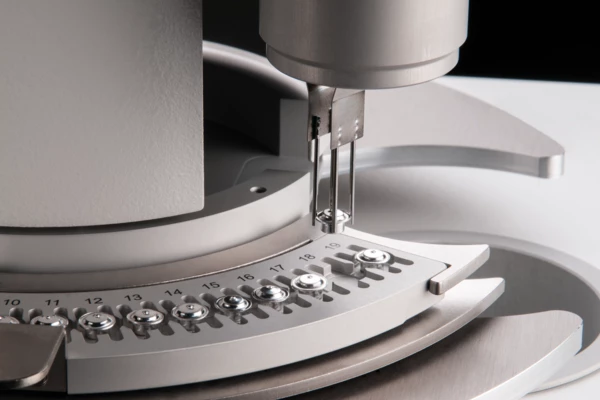
Routine applications are facilitated conveniently with an automatic sample changer (ASC) for up to 20 samples and reference materials, also for different crucible/pan types.


Standard Crucibles (Pans) Made of Aluminum for the DSC 214 Polyma
| Material (Purity) | Temperature Range | Consisting of | Dimension/ Volume | Remarks | Order Number |
| Al (99.5) | Max. 600°C | Concavus® pan + lid | ø 5 mm, 30/40 μl | Set of 96 Concavus® pans and lids incl. 3in1 Box, cold weldable** | DSC21400A66.010-00 |
| Al (99.5) | Max. 600°C | Concavus®pan | ø 5 mm, 30/40 μl | Set of 96 Concavus® pans incl. 3in1 Box | NGB814672 |
| Al (99.5) | Max. 600°C | Concavus® pan | Set of 96 Concavus®lids | NGB814673 | |
| Al (99.5) | Max. 600°C | Crucible + lid | ø 6 mm; 25/40 μl* | Set of 100, cold weldable** | 6.239.2-64.5.00 |
| Al (99.5) | Max. 600°C | Crucible + lid | ø 6 mm; 25/40 μl* | Set of 500, cold weldable** | 6.239.2-64.51.00 |
| Al (99.5) | Max. 600°C | Crucible + lid with laser-cut hole (50 μm) | ø 6 mm; 40 μl | Set of 100, cold weldable** | 6.239.2-64.8.00 |
| Al (99.5) | Max. 600°C | Crucible + lid with laser-cut hole (50 μm) | ø 6 mm; 40 μl | Set of 500, cold weldable** | 6.239.2-64.81.00 |
| Al (99.5) | Max. 600°C | Crucible | ø 6.7mm; 85 μl | Set of 100 pieces | NGB810405 |
| Al (99.5) | Max. 600°C | Lid | 100 pieces, for NGB810405 | NGB810406 |
* Crucible (pan) volumes of either 25 μl or 40 μl can be achieved by simply reversing the lid.
** One and the same sealing press is capable of sealing all standard Al crucibles (pans); order no. 6.240.10-80.0.00A.

This instrument is LabV®️-primed
LabV®️ takes the data from your analytical instrument: It automatically imports all measurement data into a central and secure database solution, the LabV®️ software. This allows you to visualize the data in LabV®️ and to make them searchable. Your data will now be accessible from anywhere. Moreover you have the possibility to generate reports.
Application Literature

Our latest blog articles
- 03.07.2025
Thermal Analysis of UF Adhesives: From Curing Behavior to Stability with NETZSCH DSC and TGA

- 20.05.2025
Oxidative Liquefaction of Wind Turbine Blades: A New Dimension in Composite Recycling

- 30.04.2024
How to Enhance the Mechanical Properties of Polyacrylonitrile Nanofiber Mats

- 13.03.2024
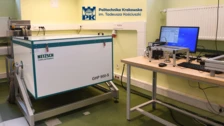
Cracow University of Technology Relies on NETZSCH Analysis Instruments
- 04.10.2023
Optimization of Extrusion, Injection Molding and 3D Printing Manufacturing Processes for the Automotive Industry

- 15.09.2023
From Drug Delivery to Cosmetics: A Deep Dive into Thermal Analysis of Electrospun Polymeric Nanofibers