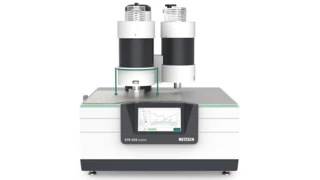
SBA 458 Nemesis®
Simultaneous Determination of the Seebeck CoefficientThe Seebeck coefficient is the ratio of the induced thermoelectric voltage to the temperature difference between two points at an electrical conductor.Seebeck Coefficient and Electrical Conductivity
Highlights
Method and Technique for the Characterization of Thermoelectric Materials
The Electrical Conductivity (SBA)Electrical conductivity is a physical property indicating a material's ability to allow the transport of an electric charge.SBA 458 Nemesis® offers a versatile measurement setup that accommodates a wider range of sample geometries than is typically possible with this technique. This system enables measurements of Electrical Conductivity (SBA)Electrical conductivity is a physical property indicating a material's ability to allow the transport of an electric charge.electrical conductivity—a physical property indicating a material's ability to transport electric charge—at temperatures up to 1100°C.
One of the standout features of the Electrical Conductivity (SBA)Electrical conductivity is a physical property indicating a material's ability to allow the transport of an electric charge.SBA 458 Nemesis® is its quick and convenient sample change process. Samples can be swapped out swiftly and effortlessly by hand, without the need for any tools. The use of sheathed thermocouples in the setup prevents the samples from sticking to the electrodes, ensuring smooth transitions between measurements.
The system also integrates a quality check mechanism through its innovative two-heater design. These heaters operate alternately at each temperature step, allowing for the immediate detection of deviations from linearity or hysteresis, which could indicate inaccurate measurements. This proactive monitoring enhances the reliability of the results.
Additionally, the fixed positions of the thermocouples mean that the often cumbersome process of determining their distance before each measurement is no longer necessary. This removal of a potential error source significantly enhances the precision and reproducibility of Electrical Conductivity (SBA)Electrical conductivity is a physical property indicating a material's ability to allow the transport of an electric charge.electrical conductivity measurements.

The unique design of the Electrical Conductivity (SBA)Electrical conductivity is a physical property indicating a material's ability to allow the transport of an electric charge.SBA 458 Nemesis® allows for a quality check of both the Seebeck coefficient and Electrical Conductivity (SBA)Electrical conductivity is a physical property indicating a material's ability to allow the transport of an electric charge.electrical conductivity. Even before a time-consuming temperature program is started, this quality check indicates whether a measurement can be performed without any errors. In addition, the quality check is performed at each temperature step, monitoring the correctness of the measurement results for the Seebeck coefficient and the Electrical Conductivity (SBA)Electrical conductivity is a physical property indicating a material's ability to allow the transport of an electric charge.electrical conductivity
Method
Electrical Conductivity (SBA)Electrical conductivity is a physical property indicating a material's ability to allow the transport of an electric charge.SBA 458 Nemesis® - A new method with innovative design
The Electrical Conductivity (SBA)Electrical conductivity is a physical property indicating a material's ability to allow the transport of an electric charge.SBA 458 Nemesis® is a truly new method for determination of the Seebeck coefficient (S) and Electrical Conductivity (SBA)Electrical conductivity is a physical property indicating a material's ability to allow the transport of an electric charge.electrical conductivity (σ). Its novel setup and clever, practical design offer numerous unparalleled advantages. Perhaps the most significant of these is elimination of the disadvantages inherent in conventional methods – thus allowing for the reliable and precise determination of the two thermophysical properties S and σ.
Using current pins and thermocouples on the sample’s lower surface, the Electrical Conductivity (SBA)Electrical conductivity is a physical property indicating a material's ability to allow the transport of an electric charge.electrical conductivity is determined by the 4-point method. Micro heaters are placed below the two sample edges, creating temperature gradients in both sample directions. The resulting voltage is measured by the thermocouple wires and then used for calculation of the Seebeck coefficient.
Using the Electrical Conductivity (SBA)Electrical conductivity is a physical property indicating a material's ability to allow the transport of an electric charge.SBA 458 Nemesis® along with our Laser/Light Flash Analyzer, Differential Scanning Calorimeter and Dilatometer systems, it is now possible to determine a complete set of thermophysical properties directly related to the efficiency of thermoelectric materials, including:
- Seebeck coefficient (S)
- Electrical conductivity (σ)
- Thermal conductivity (λ)/Thermal DiffusivityThermal diffusivity (a with the unit mm2/s) is a material-specific property for characterizing unsteady heat conduction. This value describes how quickly a material reacts to a change in temperature.thermal diffusivity (a)
- DensityThe mass density is defined as the ratio between mass and volume. Density (ρ)
- Specific Heat Capacity (cp)Heat capacity is a material-specific physical quantity, determined by the amount of heat supplied to specimen, divided by the resulting temperature increase. The specific heat capacity is related to a unit mass of the specimen.Specific heat capacity (Specific Heat Capacity (cp)Heat capacity is a material-specific physical quantity, determined by the amount of heat supplied to specimen, divided by the resulting temperature increase. The specific heat capacity is related to a unit mass of the specimen.cp)


Seebeck Coefficient
A temperature gradient is generated in both sample directions by two micro heaters operating in alternation. While the cyclic heating is in progress, the resulting voltages (UA,UB) are measured.UA andUB are the voltages between the two positive and two negative thermocouple wires which are plotted against the temperature difference (ΔT; for both directions). ΔT is determined by two thermocouples (plot A).
The resulting large number of measuring points is the basis for calculation of a regression line. From the slope of the regression line, the Seebeck coefficient can be precisely determined:
- All measurement points lie on a straight line → well-performed measurement (see plot A)
- Deviation of the measurement points from the straight line, e.g., hysteresis → poor measurement
Electrical Conductivity
At each testing temperature, different current values will be applied to the sample several times by current pins. These values will be applied in both sample directions and the resulting voltages (UA,UB) will be measured (plot B).
This process yields a large number of measurement points, allowing for a quality check prior to and during the measurement of all temperature steps:
- All measurement points lie on a straight line and the two curves are superimposed → well-performed measurement (see plot B)
- Deviation of the measurement points from the straight line or the two curves are not congruent with each other → poor measurement

Specifications
| Electrical Conductivity (SBA)Electrical conductivity is a physical property indicating a material's ability to allow the transport of an electric charge.SBA 458 Nemesis® | |
|---|---|
| Design | Two-heater system, quality check, horizontal sample arrangement |
| Temperature ranges of the exchangeable furnaces |
|
| Temperature setting range | Unlimited number of temperature steps |
| Thermocouples |
|
| Sample dimensions |
|
| Sample geometries | Square, round, rectangular, strips |
| Seebeck coefficient range |
|
| Electrical conductivity range |
|
| Quality check for Electrical Conductivity (SBA)Electrical conductivity is a physical property indicating a material's ability to allow the transport of an electric charge.electrical conductivity | Prior to and during measurement |
| Quality check for Seebeck measurement | Prior to and during measurement |
| Number of readings automatically averaged | ≥ 100 |
| Atmosphere | Inert, oxidizing, reducing (max. 2%H2) |
| Vacuum-tightness | 10-2 mbar |
| Software | Based on Windows 7, 32-/64-bit |
Find out even more:
The new plug-and-measure feature offers convenient sample change. The operator may now use various sample geometries in different dimensions. Since distance determination between the thermocouples is no longer required, a quick start to the measurement can be realized.
In every respect, the robust design of the Electrical Conductivity (SBA)Electrical conductivity is a physical property indicating a material's ability to allow the transport of an electric charge.SBA 458 Nemesis® allows for unfettered, easy handling. The thermocouples are exceptionally well protected against damage by virtue of Inconel sheathing, and are additionally mechanically fixated in order to yield high precision and reproducibility of the measurement results. Nevertheless, thermocouples and current pins can still be easily replaced by the operator.
The system comes with two micro heaters which operate in alternation. The cyclic heating process is used to perform a quality check for the Seebeck coefficient. A quality check for measurement of Electrical Conductivity (SBA)Electrical conductivity is a physical property indicating a material's ability to allow the transport of an electric charge.electrical conductivity can also be carried out. The user obtains information about the measurement’s performance already while it is still in progress.
Distance determination between fixed thermocouple positions is a cumbersome process which is usually necessary, but this instrument eliminates the need for any operator handling in this regard. By excluding this potential source of error from the determination process for Electrical Conductivity (SBA)Electrical conductivity is a physical property indicating a material's ability to allow the transport of an electric charge.electrical conductivity, the precision and reproducibility of the results are increased.
The hallmark of the SBA 458 Nemesis® is its one-of-a-kind measurement setup which allows more sample geometries than usual for this technique. Depending on the sensor, measurements can be carried out between room temperature and 800°C or room temperature and 1100°C.
With the SBA 458 Nemesis®, it is no longer necessary to use tools to insert and remove the sample. This makes changing the sample fast and easy while preventing any sample damage which might have resulted from sticking to the electrodes.
Brochures and Data Sheets:
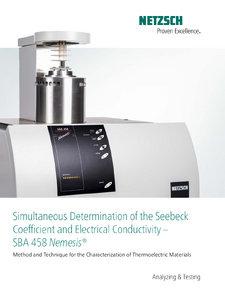
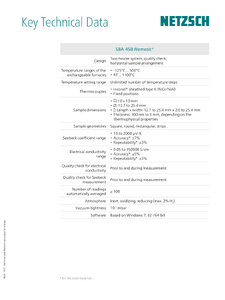

Proven Excellence in Service
At NETZSCH Analyzing & Testing, we offer a comprehensive range of services globally to ensure the optimal performance and longevity of your thermoanalytical equipment. With a track record of proven excellence, our services are designed to maximize the effectiveness of your devices, extend their lifespan, and minimize downtime.
Unlock the full potential of your equipment with our tailored solutions, backed by years of industry expertise and innovation.
Software
All software features at a glance

The software is based on Windows 7, 64 bit. It fully controls the measurements, which are performed at each specified temperature interval. The software allows for easy operation and control of the data.
The resistance (U-I plot) and quality check (Seebeck) functions are integrated. The measurement data can be easily exported.

Downloads and Media
Application Literature
Our latest blog articles
- 07.10.2026
From the Green Body to a Dense Ceramic – How NETZSCH Termica Neo Makes Sintering Transparent
- 03.10.2026
What DSC Can Reveal About Aging in Polypropylene

- 22.09.2026
NETZSCH Analysis Instruments in Use at South Korean Research Institutes
- 09.09.2026
Introduction to the Rheology of Dispersions – Fundamentals, Influencing Factors and Measurement Methods