Introduction
High-pressure capillary rheometers are the go-to solution for understanding material behavior under real processing conditions. It is also well known that temperature has a major impact on polymer viscosity. Therefore, NETZSCH rheometers measure the rheological properties which are sensitive to temperatures which are linked to transition temperatures and degradation temperature and kinetics determined by DSC and TGA. However, capillary rheometers apply both temperature and shear to the sample, allowing to study degradation under complete process conditions and to prevent issues.
Experimental
The viscosity of a PHBH sample was measured at 170°C by applying shear rates between 100,000 s-1 and 100 s-1. Immediately after this initial analysis, the viscosity was measured from low to high shear rates without changing the sample. Then, a new measurement was performed on a newly loaded sample. The viscosity of a PHBV sample was measured twice at 200°C on two loadings.
PHBV vs. PHBH
PHBV and PHBH are biodegradable biopolymers. The different comonomers give them different flexibility, Crystallinity / Degree of CrystallinityCrystallinity refers to the degree of structural order of a solid. In a crystal, the arrangement of atoms or molecules is consistent and repetitive. Many materials such as glass ceramics and some polymers can be prepared in such a way as to produce a mixture of crystalline and amorphous regions.crystallinity, and processing behavior.
PHBV = poly(3-hydroxybutyrate-co-3-hydroxyvalerate)
PHBH = poly(3-hydroxybutyrate-co-3-hydroxyhexanoate)
Results
The shear viscosity values are lower in the second part of the measurement (increasing shear rates) of the first APPLICATIONNOTE Biopolymers – Capillary Rheometer PHBH loading (Figure 1). This is most probably due to the thermal Decomposition reactionA decomposition reaction is a thermally induced reaction of a chemical compound forming solid and/or gaseous products. decomposition of the biopolymer. Additionally, it was observed that the further the measurement advances, the darker colored the extrudate becomes. This is also an indication for degradation. The second measurement carried out on a second loading (blue curve) shows the good repeatability of the results as long as the same procedure is used for the sample preparation in order to achieve similar retention times in the capillary rheometer at 170°C.
The raw data (i.e. pressure curves) did not show any instability during the measurement (Figure 1).

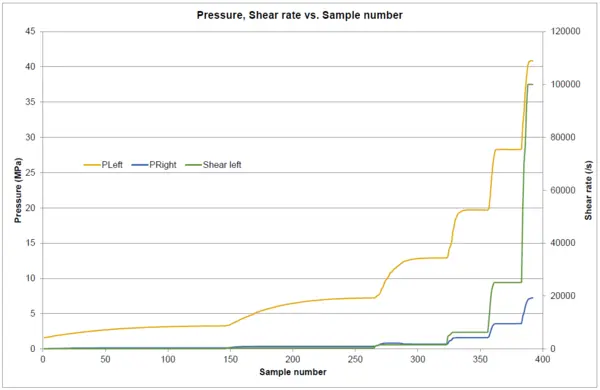
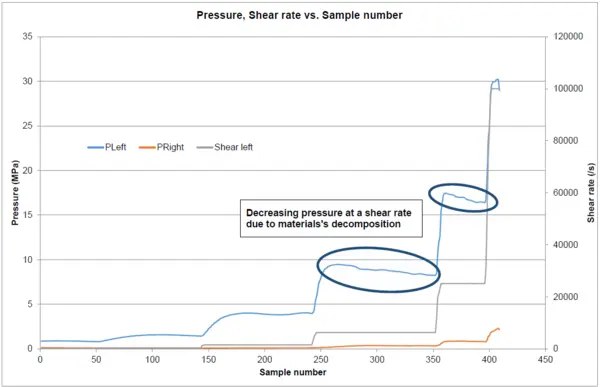
The results for PHBV seem to be repeatable (Figure 3). However, the pressure curves show that Decomposition reactionA decomposition reaction is a thermally induced reaction of a chemical compound forming solid and/or gaseous products. decomposition occurs during the measurement: At a specified shear rate, the pressure decreases instead of reaching a plateau (Figure 4). The higher the shear rate, the more important this effect becomes. This is because of shear heating, which is more pronounced with higher shear rates. This leads to a temperature increase and consequently to a faster Decomposition reactionA decomposition reaction is a thermally induced reaction of a chemical compound forming solid and/or gaseous products. decomposition.

Conclusion
The PHBH sample undergoes degradation at 170°C which is dependent on the duration of exposure to high temperatures whereas PHBV at 200°C is additionally sensitive to the shear level which leads to self-heating if the shear level is high.
Only capillary rheometers are capable of analyzing the influence of high shears rate at processing temperature on polymer samples.
Acknowledgement
We would like to thank the Lycée Jean Zay at Thiers, France, for supplying the samples and GBCC (Green Business & Consulting Company) for their comments on the results.