03.09.2025 by Aileen Sammler
Improving Lithium-Ion Battery Safety: Thermal and Kinetic Analysis of LiPF₆ Electrolytes with the NETZSCH DSC & Kinetics Neo
Discover how Differential Scanning Calorimetry (DSC) and the Kinetics Neo software by NETZSCH improve lithium-ion battery safety by analyzing the thermal and kinetic stability of LiPF₆-based electrolytes and prevent Thermal runawayA thermal runaway is the situation where a chemical reactor is out of control with respect to temperature and/or pressure production caused by the chemical reaction itself. Simulation of a thermal runaway is usually carried out using a calorimeter device according to accelerated rate calorimetry (ARC).thermal runaway and optimize performance.
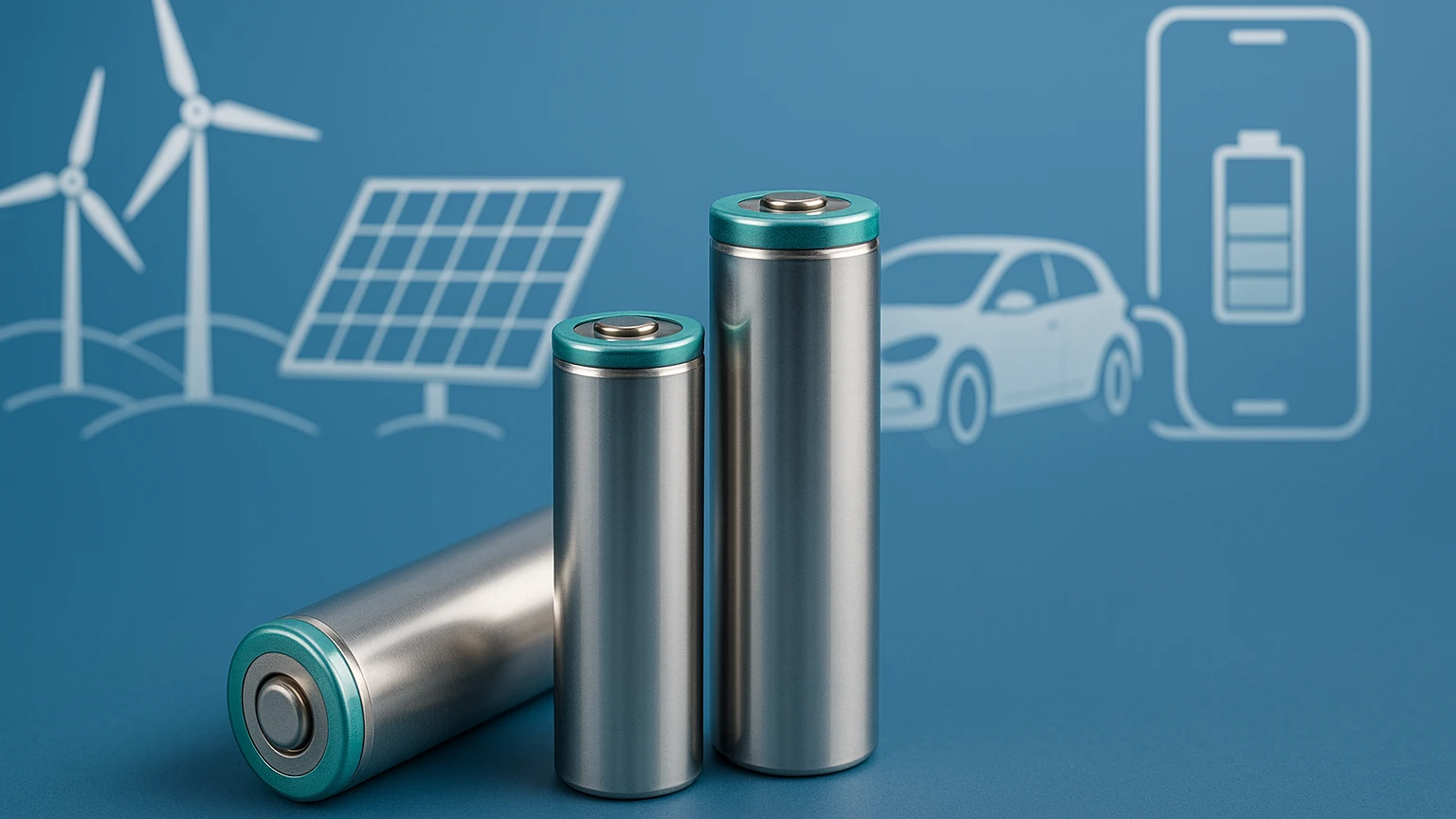
Lithium-ion batteries (LIBs) power our smartphones, electric vehicles, and renewable energy storage systems. As the global demand increases rapidly, safety and reliability have become top priorities. Regulatory frameworks such as the EU Battery Regulation 2023 and international standards now impose strict requirements on battery thermal safety testing.
At the heart of every LIB is the electrolyte, and one of the most widely used salts in carbonate solvents is LiPF₆. Although LiPF₆ features excellent Ionic conductivity and compatibility with graphite anodes, it is thermally and chemically instable. This instability can trigger Thermal runawayA thermal runaway is the situation where a chemical reactor is out of control with respect to temperature and/or pressure production caused by the chemical reaction itself. Simulation of a thermal runaway is usually carried out using a calorimeter device according to accelerated rate calorimetry (ARC).thermal runaway, a major safety concern in electric mobility and stationary storage.
To address these challenges, researchers and manufacturers rely on advanced material characterization. In this new application note, a NETZSCH DSC combined with the Kinetics Neo software was used to analyze the Thermal StabilityA material is thermally stable if it does not decompose under the influence of temperature. One way to determine the thermal stability of a substance is to use a TGA (thermogravimetric analyzer). thermal stability and Decomposition reactionA decomposition reaction is a thermally induced reaction of a chemical compound forming solid and/or gaseous products. decomposition kinetics of LiPF₆-based electrolytes.
Key Results from the Study
Thermal Events Identified by DSC
A NETZSCH DSC was used to analyze LiPF₆ in a mixed carbonate solvent system (EMC+DMC+EC, 1:1:1). The following thermal effects were detected above 190°C:
- Endothermal peak (≈230°C) → Decomposition reactionA decomposition reaction is a thermally induced reaction of a chemical compound forming solid and/or gaseous products. decomposition of LiPF₆ and solvent-specific interactions
- Exothermal peak (≈250°C) → interaction of LiPF₆ with EC, ring cleavage reactions
- Broad ExothermicA sample transition or a reaction is exothermic if heat is generated.exothermal peak (≈290°C) → polymerization reactions, PEO-like products, CO₂ release
Kinetic Analysis with Kinetics Neo Software
- Kinetic evaluation confirmed a three-step reaction model with activation energies of 146.3, 137.2, and 118.6 kJ/mol.
- The correlation between the measured and calculated data reached R² = 0.997, indicating an excellent agreement between experimental and simulated data
Predictions for Real-Life Scenarios
- IsothermalTests at controlled and constant temperature are called isothermal.Isothermal prediction: Decomposition reactionA decomposition reaction is a thermally induced reaction of a chemical compound forming solid and/or gaseous products. Decomposition started after ≈1 day at 150°C, after ≈9 days at 130°C, and after ≈24 days at 120°C.
- AdiabaticAdiabatic describes a system or measurement mode without any heat exchange with the surroundings. This mode can be realized using a calorimeter device according to the method of accelerating rate calorimetry (ARC). The main purpose of such a device is to study scenarios and thermal runaway reactions. A short description of the adiabatic mode is “no heat in – no heat out”.Adiabatic prediction: Under AdiabaticAdiabatic describes a system or measurement mode without any heat exchange with the surroundings. This mode can be realized using a calorimeter device according to the method of accelerating rate calorimetry (ARC). The main purpose of such a device is to study scenarios and thermal runaway reactions. A short description of the adiabatic mode is “no heat in – no heat out”.adiabatic conditions, Thermal runawayA thermal runaway is the situation where a chemical reactor is out of control with respect to temperature and/or pressure production caused by the chemical reaction itself. Simulation of a thermal runaway is usually carried out using a calorimeter device according to accelerated rate calorimetry (ARC).thermal runaway occurred after ≈5 days at 150°C.
Why It Matters for Today’s Battery Industry
- Battery safety is a critical challenge in EVs and grid storage.
- Regulatory compliance requires in-depth Thermal StabilityA material is thermally stable if it does not decompose under the influence of temperature. One way to determine the thermal stability of a substance is to use a TGA (thermogravimetric analyzer). thermal stability analysis of electrolytes.
- Material developers can optimize formulations to minimize risk and extend battery life.
By combining Differential Scanning Calorimetry (DSC) and Kinetics Neo, NETZSCH provides a powerful toolkit for predicting electrolyte behavior under real operating and abuse conditions.
Benefits of the NETZSCH DSC for Battery Research
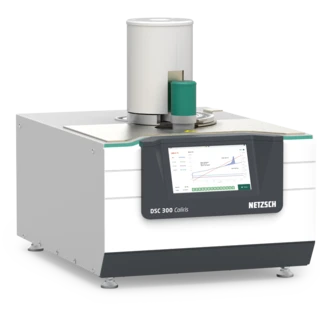
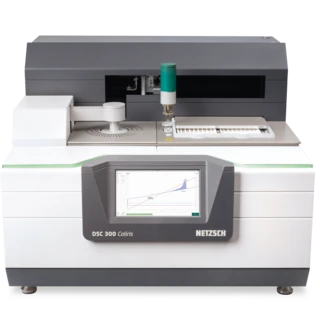
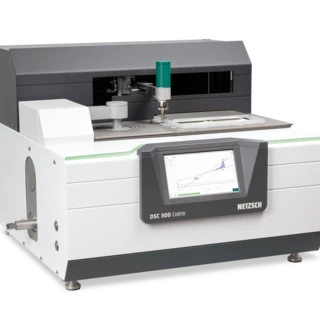
The NETZSCH DSC 300 Caliris® analysis instrument features exceptional sensitivity and flexibility, making it the ideal tool for analyzing battery electrolytes and materials.
In the context of lithium-ion battery safety, DSC enables researchers to precisely determine Phase TransitionsThe term phase transition (or phase change) is most commonly used to describe transitions between the solid, liquid and gaseous states.phase transitions, Decomposition reactionA decomposition reaction is a thermally induced reaction of a chemical compound forming solid and/or gaseous products. decomposition temperatures, and heat-flow events that are critical for identifying the onset of Thermal runawayA thermal runaway is the situation where a chemical reactor is out of control with respect to temperature and/or pressure production caused by the chemical reaction itself. Simulation of a thermal runaway is usually carried out using a calorimeter device according to accelerated rate calorimetry (ARC).thermal runaway. With its modular design and high-pressure crucibles, the DSC Caliris® allows for reliable results, even for volatile electrolyte systems.

Benefits of Kinetics Neo in Battery Safety Analysis
The Kinetics Neo software extends DSC measurements by enabling predictive simulations under real-life conditions. For battery developers, this means that data from a set of three DSC heating experiments can be used to model IsothermalTests at controlled and constant temperature are called isothermal.isothermal storage stability, AdiabaticAdiabatic describes a system or measurement mode without any heat exchange with the surroundings. This mode can be realized using a calorimeter device according to the method of accelerating rate calorimetry (ARC). The main purpose of such a device is to study scenarios and thermal runaway reactions. A short description of the adiabatic mode is “no heat in – no heat out”.adiabatic conditions, and different temperature profiles.
This allows for accurate predictions of the electrolyte behavior during operation, transport, or abuse scenarios – supporting the design of safer, longer-lasting battery systems.
Conclusion
The combination of NETZSCH DSC and Kinetics Neo software delivers essential insights into the thermal and kinetic stability of LiPF₆-based electrolytes. These results directly support battery developers in preventing Thermal runawayA thermal runaway is the situation where a chemical reactor is out of control with respect to temperature and/or pressure production caused by the chemical reaction itself. Simulation of a thermal runaway is usually carried out using a calorimeter device according to accelerated rate calorimetry (ARC).thermal runaway, ensuring compliance with safety standards, and driving the transition towards safe and sustainable e-mobility and energy storage systems.
? Read the full Application Note here:
Learn more about NETZSCH DSC Instruments and Kinetics Neo Software