07.10.2026 by Aileen Sammler
From the Green Body to a Dense Ceramic – How NETZSCH Termica Neo Makes Sintering Transparent
This is blog 5 of the series: “The New Dimension of Thermal Analysis with NETZSCH Termica Neo: The Software for Thermal Simulation of Chemical Reactions on an Industrial Scale.”

What happens inside a ceramic during SinteringSintering is a production process for forming a mechanically strong body out of a ceramic or metallic powder. sintering?
Temperature gradients, DensityThe mass density is defined as the ratio between mass and volume. density variations, and heat-flow changes all shape the final microstructure.
Until now, these dynamics were hidden — estimated only from shrinkage curves or DensityThe mass density is defined as the ratio between mass and volume. density measurements.
NETZSCH Termica Neo changes that. It transforms SinteringSintering is a production process for forming a mechanically strong body out of a ceramic or metallic powder. sintering kinetics into 3D maps of temperature, densification rate, and heat transfer, showing you how your material consolidates layer by layer.
The Challenge of SinteringSintering is a production process for forming a mechanically strong body out of a ceramic or metallic powder. Sintering Simulation
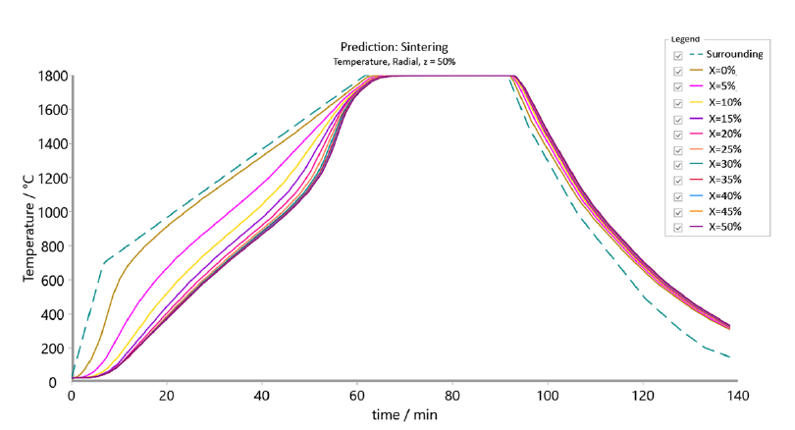
SinteringSintering is a production process for forming a mechanically strong body out of a ceramic or metallic powder. Sintering is more than just heating up. It couples diffusion, porosity, and Thermal ConductivityThermal conductivity (λ with the unit W/(m•K)) describes the transport of energy – in the form of heat – through a body of mass as the result of a temperature gradient (see fig. 1). According to the second law of thermodynamics, heat always flows in the direction of the lower temperature.thermal conductivity, each changing with temperature and DensityThe mass density is defined as the ratio between mass and volume. density.
A uniform furnace temperature doesn’t mean uniform densification. The core can lag or overheat depending on geometry and heat transfer.
The NETZSCH software Termica Neo dynamically links these phenomena:
- Imports Kinetics Neo models for SinteringSintering is a production process for forming a mechanically strong body out of a ceramic or metallic powder. sintering rate vs. temperature.
- Accounts for DensityThe mass density is defined as the ratio between mass and volume. density-dependent Thermal ConductivityThermal conductivity (λ with the unit W/(m•K)) describes the transport of energy – in the form of heat – through a body of mass as the result of a temperature gradient (see fig. 1). According to the second law of thermodynamics, heat always flows in the direction of the lower temperature.thermal conductivity.
- Simulates temperature, SinteringSintering is a production process for forming a mechanically strong body out of a ceramic or metallic powder. sintering rate, and degree of SinteringSintering is a production process for forming a mechanically strong body out of a ceramic or metallic powder. sintering (α) in 2D or 3D space.
Case Study: Silicon Nitride (Si₃N₄)
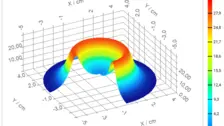
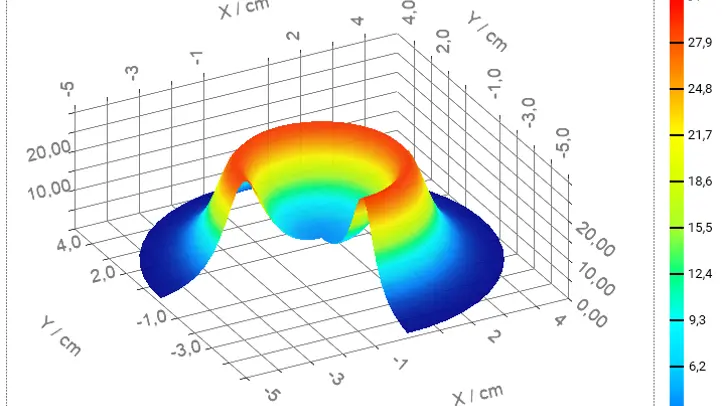
Termica Neo simulations show a dramatic increase in Thermal ConductivityThermal conductivity (λ with the unit W/(m•K)) describes the transport of energy – in the form of heat – through a body of mass as the result of a temperature gradient (see fig. 1). According to the second law of thermodynamics, heat always flows in the direction of the lower temperature.thermal conductivity — around 25 times higher from green to fully sintered material. This shift changes the internal heat flow and accelerates densification at the surface. The model predicts:
- ~17% length shrinkage,
- 40% DensityThe mass density is defined as the ratio between mass and volume. density gain,
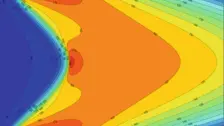
- temperature and densification fronts moving inward.
The insight: control heating rates and holds to achieve homogeneity without microcracks, not just total densification.
Case Study: Zirconia Optimization
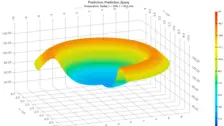
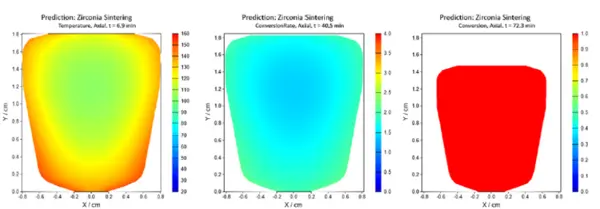
Termica Neo tested multiple heating profiles for zirconia. An optimized 72-minute SinteringSintering is a production process for forming a mechanically strong body out of a ceramic or metallic powder. sintering program produced uniform temperature and densification fields with minimal StressStress is defined as a level of force applied on a sample with a well-defined cross section. (Stress = force/area). Samples having a circular or rectangular cross section can be compressed or stretched. Elastic materials like rubber can be stretched up to 5 to 10 times their original length.stress.
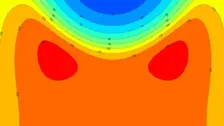
Uneven profiles revealed cooler cores and delayed SinteringSintering is a production process for forming a mechanically strong body out of a ceramic or metallic powder. sintering fronts. These are key indicators for adjusting the process.
See all case studies in detail in our new brochure:
Why It Matters
SinteringSintering is a production process for forming a mechanically strong body out of a ceramic or metallic powder. Sintering defines the final performance. Termica Neo helps you:
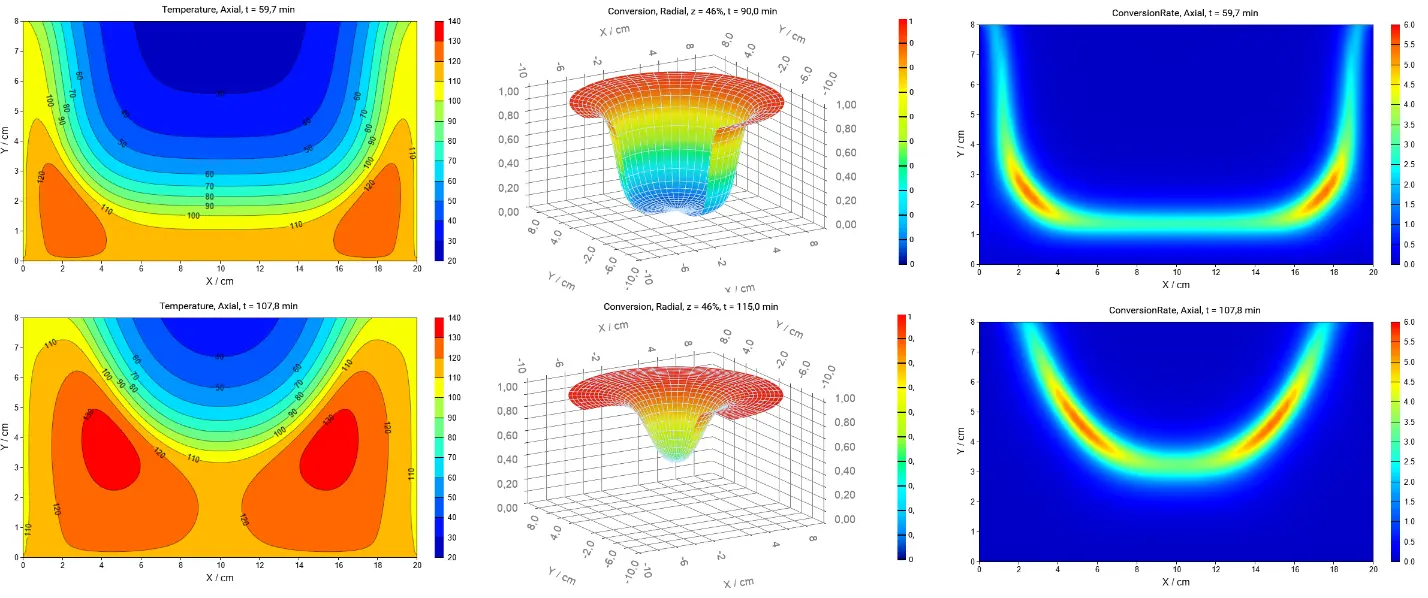
- Visualize temperature and densification gradients in real time.
- Optimize heating rates, holds, and cooling for uniform DensityThe mass density is defined as the ratio between mass and volume. density.
- Predict shrinkage behavior and thermal StressStress is defined as a level of force applied on a sample with a well-defined cross section. (Stress = force/area). Samples having a circular or rectangular cross section can be compressed or stretched. Elastic materials like rubber can be stretched up to 5 to 10 times their original length.stress zones.
- Shorten development loops and reduce costly trial batches.
It’s the clearest view ever into what really happens inside your ceramic part.
Benefits of Termica Neo
- Direct kinetic import from Kinetics Neo Software
- 2D/3D visualization of temperature, densification, and sintering rate
- DensityThe mass density is defined as the ratio between mass and volume. Density-dependent Thermal ConductivityThermal conductivity (λ with the unit W/(m•K)) describes the transport of energy – in the form of heat – through a body of mass as the result of a temperature gradient (see fig. 1). According to the second law of thermodynamics, heat always flows in the direction of the lower temperature.thermal conductivity modeling
- Realistic optimization of heat-treatment cycles
- Fewer furnace trials | Higher yield | Predictable performance
About This Blog Series
This post concludes the NETZSCH blog series “The New Dimension of Thermal Analysis with Termica Neo.” See here the full series at a glance:
- From Kinetic Model to Real-World Application — turning 1-D data into 3-D insight.
- Scale-up & Safety — predicting runaways before they happen.
- Polymer Curing — How Termica Neo Makes Curing Visible
- Thermoplastic Crystallization– Understanding PA12 During Cooling
- Ceramic Sintering – achieving uniform densification
--------------------------
Useful Links:
Get your free demo version:Request Demo Version of Temica Form - NETZSCH Termica Neo
Download the new brochure to learn more:Termica Neo Brochure
Direct contact:Feature Request - NETZSCH Kinetics Neo
Learn even more:Termica Neo - NETZSCH Termica Neo