Introduction
DensityThe mass density is defined as the ratio between mass and volume. Density tests on pasty materials like thermally conductive pastes, polymer melts, battery slurries and so on are usually quite difficult. They cannot be carried out through the conventional Archimedean method because these materials may absorb water during immersing or need to be investigated under high temperatures, as polymer melts do. However, many tests require the DensityThe mass density is defined as the ratio between mass and volume. density value as an index for further analyses. Examples include applying the DensityThe mass density is defined as the ratio between mass and volume. density to calculate the Thermal ConductivityThermal conductivity (λ with the unit W/(m•K)) describes the transport of energy – in the form of heat – through a body of mass as the result of a temperature gradient (see fig. 1). According to the second law of thermodynamics, heat always flows in the direction of the lower temperature.thermal conductivity of thermal paste through laser flash analysis (LFA); using the initial DensityThe mass density is defined as the ratio between mass and volume. density of the sample as a reference to analyze the thermal expansion in dilatometry (DIL); and, of course, applying the DensityThe mass density is defined as the ratio between mass and volume. density of the sample in rheological tests, where it is also required for squeeze flow. Therefore, a fast and accurate method for measuring the DensityThe mass density is defined as the ratio between mass and volume. density is very important. By using the parallel plate of the rotational rheometer, the DensityThe mass density is defined as the ratio between mass and volume. density value of pasty materials can be quickly and accurately measured.
Measurement Conditions and Sample Preparation
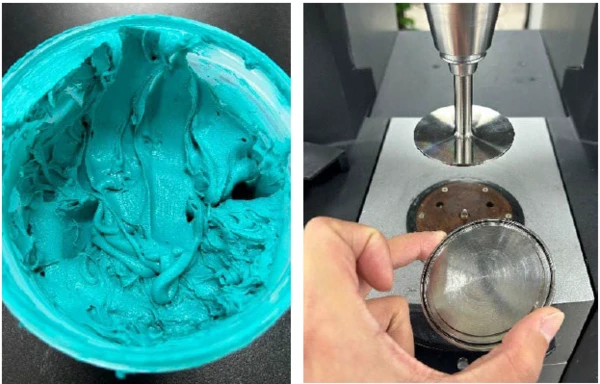
The measurement conditions are detailed in table 1. Figure 1 shows a thermal grease with a very high solid content, exhibiting a non-flowable quasi-solid state. To determine the DensityThe mass density is defined as the ratio between mass and volume. density of this paste, a plate of larger diameter is used, such as the 60-mm plate shown in this example. In addition, quick detachment of the lower plate is necessary, because we need to place the lower plate on the balance and weigh the sample.
Table 1: Measurement conditions
| Sample | Thermal grease |
|---|---|
| Temperature | 25°C |
| Geometry | Parallel plate (60 mm) |
| Test mode | Manual gap |
Conduction of the Measurements
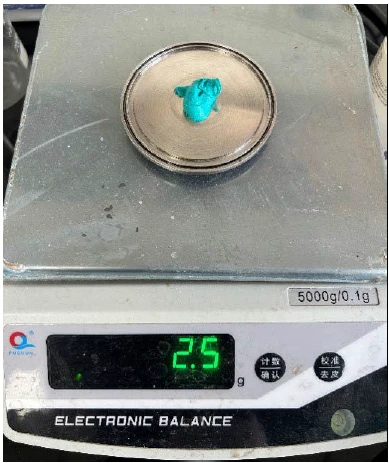
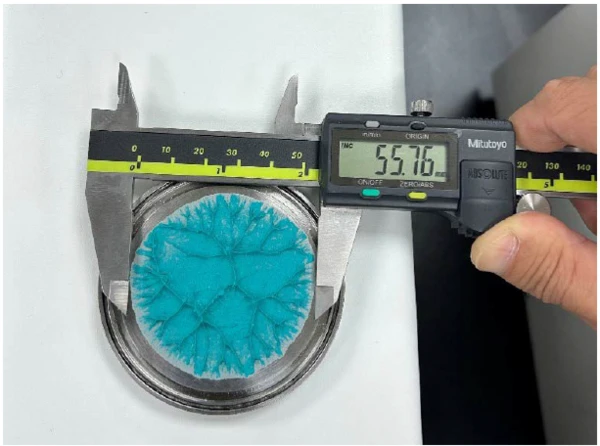
After zeroing the gap, based on the quickly detachable lower plate of the NETZSCH Kinexus rotational rheometer, the lower plate was removed and placed on the balance. The mass of the sample was weighed (figure 2). After that, the lower plate was installed back into the cartridge. A specific gap value was set. This gap was held to fully release the internal StressStress is defined as a level of force applied on a sample with a well-defined cross section. (Stress = force/area). Samples having a circular or rectangular cross section can be compressed or stretched. Elastic materials like rubber can be stretched up to 5 to 10 times their original length.stress of the sample. The upper plate was lifted upwards, so that a clear circular imprint appeared on the material. Due to the surface tension of this kind of flowable paste material, it can form a standard circle after undergoing such significant compression. Then, we can use a vernier caliper to measure the diameter of the circular imprint as shown in figure 3, and the volume of the sample can be accurately calculated by the following formula:
V = πr2h
V: volume [mm3], r: radius of the circular imprint [mm]
h: gap [mm]
The DensityThe mass density is defined as the ratio between mass and volume. density can also be obtained as:
ρ = m/V
ρ: DensityThe mass density is defined as the ratio between mass and volume. density [g·mm-3], m: mass [g], V: volume [mm3]
Measurement Results
The thermal paste had a mass of 2.5 g, the setting gap was 0.5 mm, the circular imprint diameter was 55.76 mm, and lastly, the final calculated DensityThe mass density is defined as the ratio between mass and volume. density was 2.048g/cm³ (see table 2).
Table 2: Measurement results
| Mass / g | Gap / mm | Diameter / mm | Volume / mm³ | DensityThe mass density is defined as the ratio between mass and volume. Density / g/cm³ |
|---|---|---|---|---|
| 2.5 | 0.5 | 55.76 | 1220.97 | 2.048 |
Conclusion
When we encounter non-solid samples, such as pasty materials that are prone to water absorption or polymer melts requiring high testing temperatures, it is not possible to use the Archimedean method for density testing. We can conduct fast and accurate density testing using a rotational rheometer with a quickly detachable parallel plate.