
nUCLEAR
STA, TGA and EGA in Nuclear
Understanding Thermal StabilityA material is thermally stable if it does not decompose under the influence of temperature. One way to determine the thermal stability of a substance is to use a TGA (thermogravimetric analyzer). Thermal Stability, Decomposition reactionA decomposition reaction is a thermally induced reaction of a chemical compound forming solid and/or gaseous products. Decomposition and Gas Evolution
In nuclear research and technology, materials are exposed to extreme temperatures, reactive atmospheres and long service lifetimes. It is essential to understand how these materials behave thermally, chemically and structurally to ensure safety, performance and regulatory compliance.
NETZSCH offers a comprehensive portfolio of Simultaneous Thermal Analysis (STA), Thermogravimetric Analysis (TGA) and Evolved Gas Analysis (EGA) solutions tailored to the specific requirements of nuclear applications. The ability to operate under controlled atmospheres, deliver reproducible data and identify evolved gases supports:
- material selection and qualification
- safety-related material assessments
- lifetime and stability evaluations
- research in fuel, structural and waste materials
With our decades of experience in high-temperature measurement, atmosphere control and advanced safety concepts, we support nuclear applications ranging from fundamental materials research to applied engineering and regulatory testing.

TGA
Thermogravimetric Analysis (TGA) focuses on the precise measurement of mass changes as a function of temperature and time. This method is fundamental to investigating material stability and chemical reactions in nuclear research.
Typical nuclear-related applications include:
- analysis of OxidationOxidation can describe different processes in the context of thermal analysis.oxidation and corrosion behavior
- investigation of thermal Decomposition reactionA decomposition reaction is a thermally induced reaction of a chemical compound forming solid and/or gaseous products. decomposition processes
- assessment of reaction kinetics and material degradation
- evaluation of fuel, waste and containment materials
High sensitivity and stable baseline performance enable reliable measurements even for small mass changes, which is particularly important for nuclear-relevant materials and safety assessments.
STA
STA combines thermogravimetric analysis with DSC in a single experiment, enabling simultaneous measurement of mass changes and thermal effects.
In nuclear applications, STA is widely used for the characterization of:
- nuclear fuels and fuel precursors
- cladding and structural materials
- ceramics, oxides and graphite
- advanced materials for reactor and waste-management systems
STA provides essential information on Thermal StabilityA material is thermally stable if it does not decompose under the influence of temperature. One way to determine the thermal stability of a substance is to use a TGA (thermogravimetric analyzer). thermal stability, Decomposition reactionA decomposition reaction is a thermally induced reaction of a chemical compound forming solid and/or gaseous products. decomposition behavior, OxidationOxidation can describe different processes in the context of thermal analysis.oxidation and reduction reactions, supporting material qualification across the nuclear fuel cycle. Measurements can be performed under controlled atmospheres, including inert and reactive gases, allowing simulation of application-relevant environments.

EGA
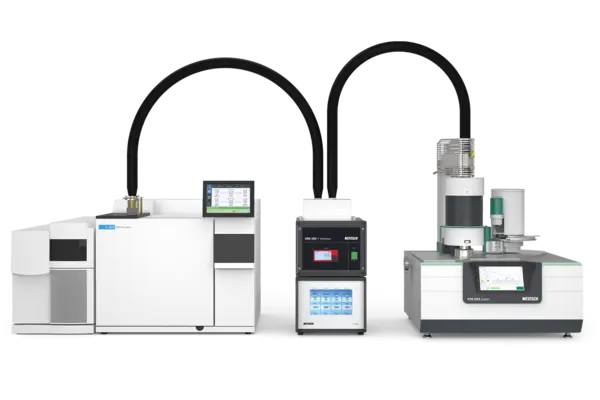
When coupled with EGA, for example via FT-IR or mass spectrometry, STA becomes a powerful tool for identifying and quantifying gases released during heating. This is essential for:
- analyzing Decomposition reactionA decomposition reaction is a thermally induced reaction of a chemical compound forming solid and/or gaseous products. decomposition products,
- monitoring corrosion and OxidationOxidation can describe different processes in the context of thermal analysis.oxidation reactions,
- evaluating fuel and waste material behavior,
- supporting safety and containment studies.
NETZSCH coupling solutions allow simultaneous measurement of mass change and gas composition, providing a deeper understanding of thermal processes relevant to nuclear environments.
Specific Heat and Transition Energetics
The capacity of a material to store energy is partly governed, by its specific heat (sensible heat). This is made up of lattice, electronic and defect components, depending on the material. This property is required for the design of any transient heat transfer process. It is also used to quantify surface OxidationOxidation can describe different processes in the context of thermal analysis.oxidation/reduction and the O/M ratio (defects) of fuels during processing. In some cases, the specific heat can be used as an indicator of the extent of damage in post-irradiation examination (PIE), e.g., stored energy. It is also required for calculating Thermal ConductivityThermal conductivity (λ with the unit W/(m•K)) describes the transport of energy – in the form of heat – through a body of mass as the result of a temperature gradient (see fig. 1). According to the second law of thermodynamics, heat always flows in the direction of the lower temperature.thermal conductivity from Thermal DiffusivityThermal diffusivity (a with the unit mm2/s) is a material-specific property for characterizing unsteady heat conduction. This value describes how quickly a material reacts to a change in temperature.thermal diffusivity data.
Transition energetics (latent heat) are required to characterize solid-solid transitions, melting/solidification and Decomposition reactionA decomposition reaction is a thermally induced reaction of a chemical compound forming solid and/or gaseous products. decomposition. Both the specific heat and transition energetics are most accurately and efficiently measured by differential scanning calorimetry (DSC).
The specific heat can also be measured using the laser flash technique, albeit with reduced accuracy and only with a reduced number of data points. (With DSC, the generation of a quasi-continuous set of temperature-dependent specific heat data is standard.) With the required expertise, DSCs can readily be adapted for hot work.
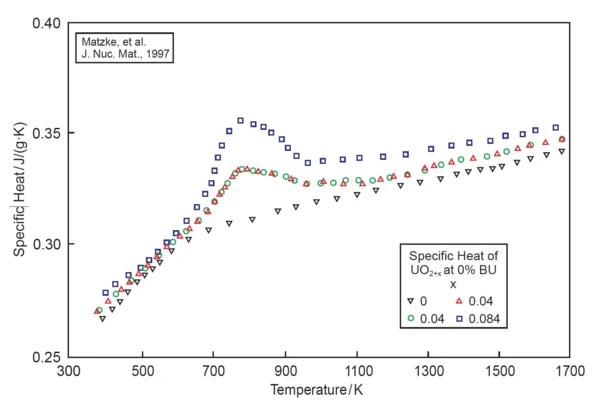
Temperature-dependent specific heat (Cp)
Stoichiometric UO2 follows the classical temperature-dependent specific heat trend, while that for UO2.04 and UO2.084 display an EndothermicA sample transition or a reaction is endothermic if heat is needed for the conversion.endothermic peak between approximately 600 and 950K. This is due to the energy required to dissolve the U4O9 phase. Note that the peak area for UO2.084 is larger than that for UO2.04 because of the greater quantity of the U4O9 phase.
Mass Change and Evolved Gases
Temperature-dependent mass change coupled with evolved gas analysis provides valuable information to help quantify the O/M ratio, out-gassing during fuel processing, corrosion, reduction, volatile fission products/actinides during vitrification, impurities remaining from the separation process, etc. Thermogravimetric analyzers (TGA) or simultaneous TGA-DSC (STA) instruments, coupled to a quadrupole mass spectrometer (QMS) either directly or by a heated transfer line, or a TGA or STA, coupled to an FT-IR via a heated transfer line, are widely employed for these types of analysis. As with the other techniques previously discussed, these instruments can easily be modified for hot work.

Solidus and Liquidus Temperatures
Solidus and liquidus temperature as well as Melting Temperatures and EnthalpiesThe enthalpy of fusion of a substance, also known as latent heat, is a measure of the energy input, typically heat, which is necessary to convert a substance from solid to liquid state. The melting point of a substance is the temperature at which it changes state from solid (crystalline) to liquid (isotropic melt).melting temperature data are necessary to establish safe reactor operating conditions and to model accident scenarios such as coolant losses. These temperatures are greatly affected by impurities, radiation damage, O/M ratios, burnup and, of course, composition.
Surprisingly, solidus/liquidus temperatures are notoriously difficult to be accurately measured. DSC is the technique most often employed for these measurements, but care must be taken to avoid undercooling during solidification (especially critical for metal alloys). Sample time constants and temperature ramp rates must be carefully considered. Solidus/liquidus temperatures of most metal alloys can also be measured by the laser flash technique (via Thermal ConductivityThermal conductivity (λ with the unit W/(m•K)) describes the transport of energy – in the form of heat – through a body of mass as the result of a temperature gradient (see fig. 1). According to the second law of thermodynamics, heat always flows in the direction of the lower temperature.thermal conductivity/Thermal DiffusivityThermal diffusivity (a with the unit mm2/s) is a material-specific property for characterizing unsteady heat conduction. This value describes how quickly a material reacts to a change in temperature.thermal diffusivity data), and dilatometry can be used for conductors and insulators alike. For materials that melt at ultra-high temperatures, thermal arrest is sometimes employed using optical pyrometers for temperature measurement. All things considered, DSC is the most versatile and accurate method.

O/M Ratio
This figure shows the O/M ratio during heating. These values were calculated from TGA data measured under multiple partial pressures of oxygen (PO2). During heating, the O/M starts to decrease at ≈1000°C and there are clearly different reduction rates resulting from the variable PO2 over the sample.
Nuclear Safety, Performance and Materials Research
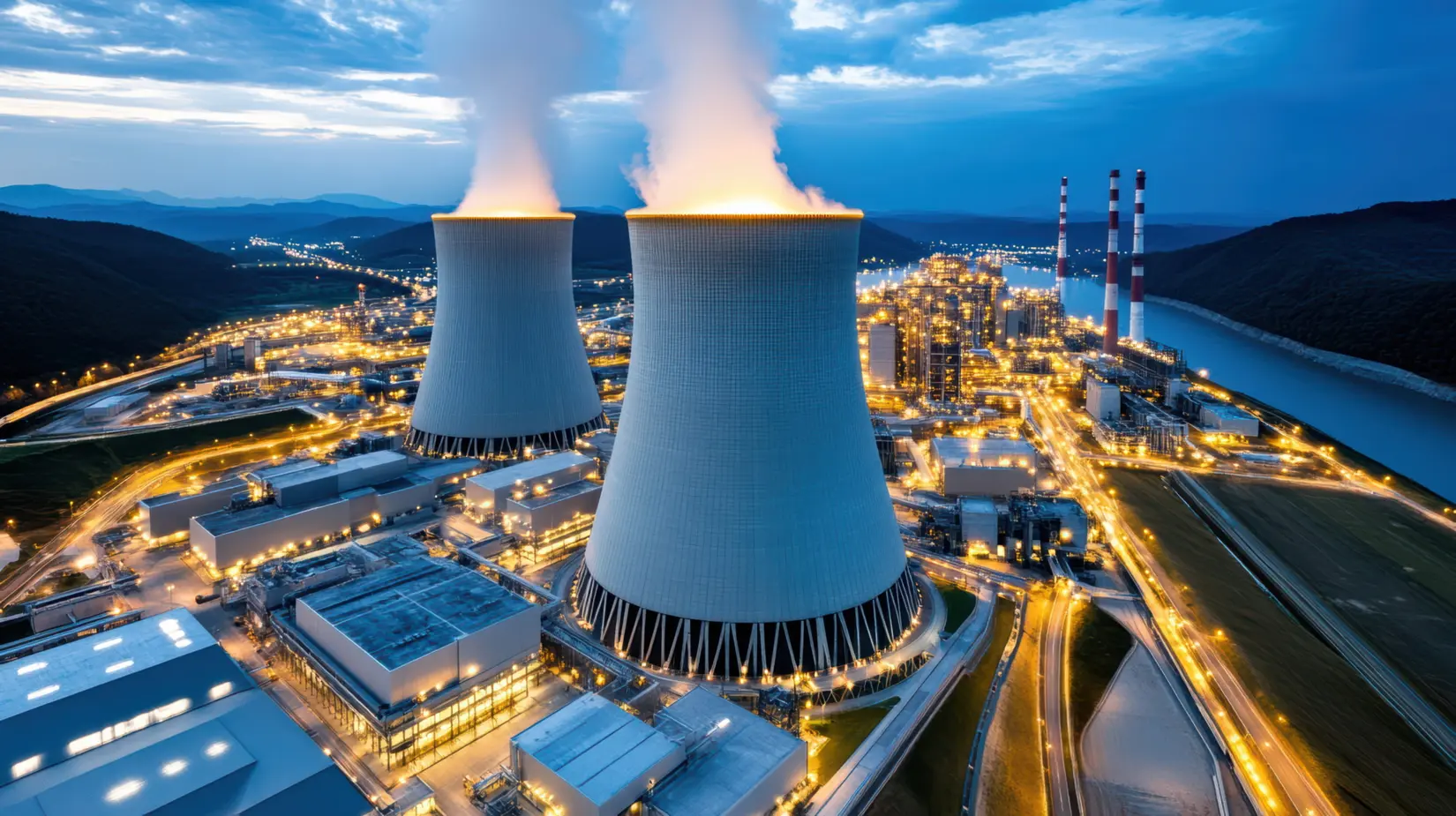
NETZSCH Analyzing & Testing provides proven thermal analysis solutions that support nuclear research, fuel development, safety assessment and materials qualification. Our instruments are used worldwide in research institutes, industry and government laboratories to investigate the thermal behavior, stability and thermophysical properties of nuclear materials under controlled and reproducible conditions.
Downloads and Media
Brochures


Related Devices
Application Literature




Consultancy & Sales
Do you have further questions about the instrument, the method and would you like to speak to a sales representative?
Service & Support
Do you already have an instrument and need technical support or spare parts?