Ask the AI Assistant
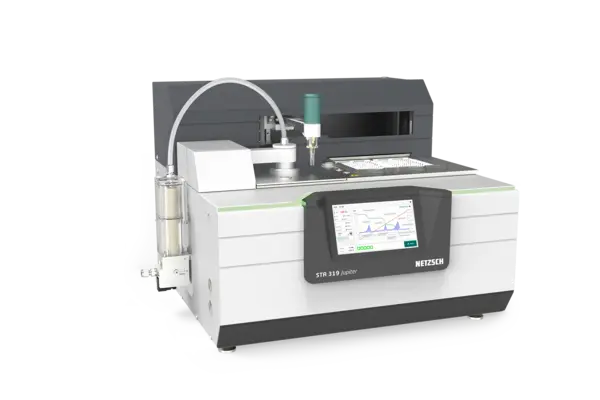
Faster insights. Greater control. Reliable performance.
The New STA 319 Jupiter® — Your Gateway to DSC/TGA Analysis
Discover the next generation of simultaneous thermal analysis with the STA 319 Jupiter®, the latest innovation in the renowned NETZSCH Jupiter® series. Designed for measurements on polymers, life sciences, and inorganic materials, it delivers superior accuracy, efficiency, and ease of use.
- High performance across applications: Achieve precise DSC/TGA results for a wide range of materials — from research to quality control.
- Fast, efficient furnace design: Robust, water-cooled ceramic furnace reaches temperatures of up to 1100°C. It also enables rapid heating and cooling, maximizing productivity.
- Exceptional measurement precision: The advanced top-loading microbalance provides extraordinary resolution and reliability for long-term stability.
- Simplified sample handling: The innovative ring sample holder eliminates the need for a reference crucible, ensuring faster setup and fewer handling errors.
- Smart, user-friendly operation: Engineered for seamless workflows and intuitive control — making high-quality thermal analysis easier than ever.
The STA 319 Jupiter® combines power, precision, and simplicity, setting a new benchmark for modern DSC/TGA analysis.

Save the date for two days of expertise, technology, and international exchange!
Register now for the third edition of our In-House Exhibition!
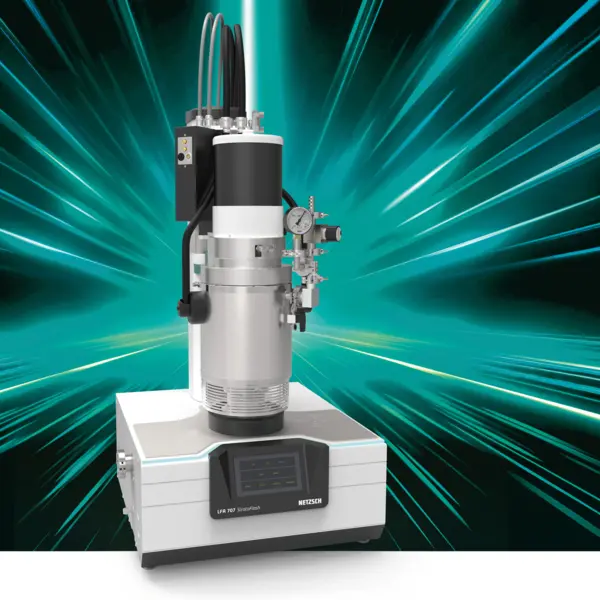
Powerful Laser Flash Analysis
LFA 707 StratoFlash® Classic — High-Precision Thermal Diffusivity Measurements up to 1600°C
Set a new standard in Thermal DiffusivityThermal diffusivity (a with the unit mm2/s) is a material-specific property for characterizing unsteady heat conduction. This value describes how quickly a material reacts to a change in temperature.thermal diffusivity analysis with a system designed ideal for the metal, glass, and ceramics industries.
Measure up to 1600°C with confidence: Achieve fast, precise Thermal DiffusivityThermal diffusivity (a with the unit mm2/s) is a material-specific property for characterizing unsteady heat conduction. This value describes how quickly a material reacts to a change in temperature.thermal diffusivity results even under extreme conditions.
Increase throughput with automation: Analyze up to five samples automatically under identical conditions for consistent, time-saving workflows.
Adapt to any sample type: Flexible holders support solids, liquids, powders, and complex composites for ultimate application versatility.
Simplify your data analysis: Advanced calculation models provide perfect curve fitting and intuitive, reliable evaluation.
Designed for high-performance thermal analysis, the LFA 707 StratoFlash® Classic combines precision, efficiency, and flexibility — making it the ideal solution for modern research and quality control.
Understanding the Complete Fire Risk
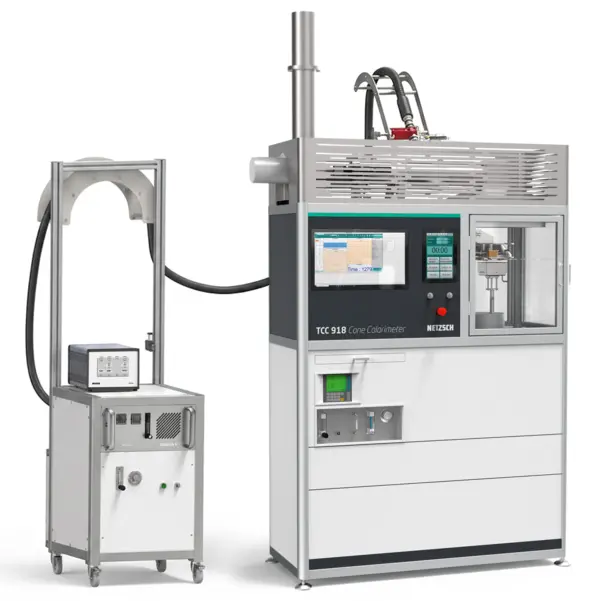
From Fire Behavior to Gas Composition —The TCC 918 Cone Calorimeter
Smoke DensityThe mass density is defined as the ratio between mass and volume. density and heat release only tell part of the story. Combining cone calorimetry with advanced FT-IR gas analysis provides a comprehensive understanding of fire behavior.
- Combines energy release data with the identification and quantification of toxic combustion gases.
- Provides deeper insights into combustion chemistry.
- Improves fire hazard assessment.
- Supplies the necessary data for safer materials and better-informed decisions.
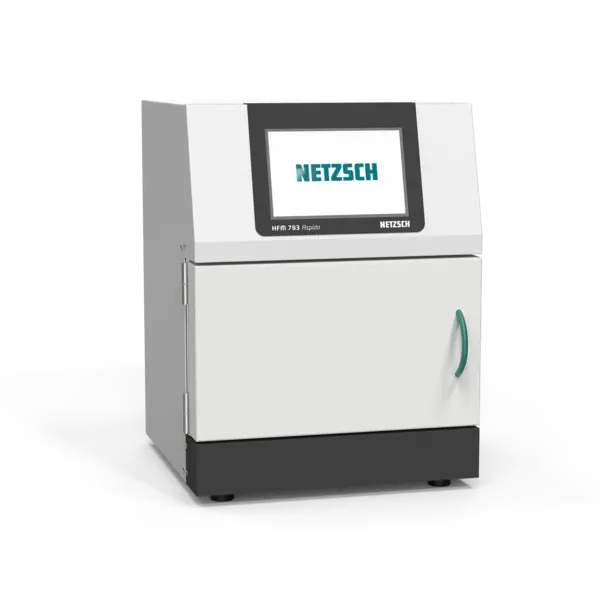
Efficient characterization of insulation materials — Heat Flow Meter HFM 783 Aspida
Every material has unique insulation and Thermal ConductivityThermal conductivity (λ with the unit W/(m•K)) describes the transport of energy – in the form of heat – through a body of mass as the result of a temperature gradient (see fig. 1). According to the second law of thermodynamics, heat always flows in the direction of the lower temperature.thermal conductivity properties. With the NETZSCH HFM 783 Aspida, you can obtain meaningful data on the thermal properties of your insulation materials. Designed for quality assurance and research, the HFM 783 Aspida lays the foundation for developing more efficient insulation materials. This helps minimize energy consumption and create sustainable solutions for industry.
- Cost-effective solution to use the HFM measurement technology
- Fast results: Measurements take as little as 15 minutes, depending on the application
- Precise and reliable data for materials with low Thermal ConductivityThermal conductivity (λ with the unit W/(m•K)) describes the transport of energy – in the form of heat – through a body of mass as the result of a temperature gradient (see fig. 1). According to the second law of thermodynamics, heat always flows in the direction of the lower temperature.thermal conductivity
- Versatile, standards-compliant applications: Suitable for a wide range of insulation materials in accordance with ASTM C518, ISO 8301, etc.
- User-friendly operation: Even under demanding conditions, the system ensures simple touchscreen operation, efficient use of measurement methods, and high data storage capacity.
- Wide range of applications: Its compact design and simple sample preparation allow for precise measurements on samples up to 300 mm in side length and a temperature range from -10°C to 70°C.

Our Quality Promise:
NETZSCH’s Unlimited Warranty
At NETZSCH, our commitment to quality goes beyond the instruments themselves. We understand that your investment in advanced technology is a long-term one, and and that’s why we offer something truly unique – our Unlimited Warranty.




Do you have any questions?
NETZSCH Energy Solutions
Batteries - Characterization & Process Technologies
The NETZSCH Group provides total solutions for battery applications, from grinding and dispersing of battery materials to stability, charging and discharging efficiency and even recycling.