03.10.2026 by Dr. -Ing. Simon Hoebel, Dr.-Ing. Natalie Rudolph
What DSC Can Reveal About Aging in Polypropylene
Distinguishing Surface Effects from Bulk Material Behavior
Introduction
Polypropylene (PP) is one of the most widely used polymers and plays a central role in mechanical recycling streams [1]. While degradation during processing, use, and recycling is often discussed as a limiting factor for material performance, its actual impact on the thermal properties of PP requires careful differentiation.
A common perception is that aging significantly alters the material’s thermal fingerprint. However, degradation processes in PP are typically heterogeneous and localized, with the strongest effects occurring at the surface, while the bulk material remains largely unaffected under realistic service conditions [[2], [3]]. Differential Scanning Calorimetry (DSC), when combined with thoughtful sample preparation and advanced data evaluation, provides a powerful approach to resolving these spatial differences and to correctly interpreting aging effects.
Resolving Aging Across the Sample Cross-Section
Thermo-oxidative aging in PP generally starts at the surface due to oxygen exposure and progresses slowly into the material. As a result, the degree of degradation varies significantly across the sample cross-section. This makes it essential to analyze not only bulk samples but also defined regions within the material.
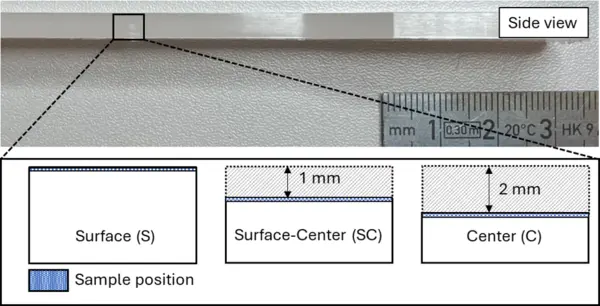
To investigate these gradients, sections were prepared from the middle part of the Type 1A samples. Using a rotating microtome, samples were taken as a thin foil of approximately 50 µm over the cross-section in different depths from the surface, from an intermediate layer, and from the center of the specimen. The sampling approach is illustrated in Figure 1.
This preparation method enables a direct comparison of thermal behavior as a function of depth and provides insight into how localized aging phenomena influence the overall material response. To meet the required sample weight, which should be as constant as possible for all measurements, multiple foils are combined. By pressing the foils together with a stamp, heat transfer from the sample, with individual foils, to the bottom of the aluminum pan can be achieved.
Using multiple foils from different samples aged under the same condition helps furthermore to create a representative mix of amorphous and crystalline areas, as well as degraded and non-degraded regions.
The lid of the Concavus® aluminum crucible was perforated to allow gaseous reaction products to escape.
The NETZSCH evaluation software Proteus® was used to determine the aging behavior over the cross-section of PP samples with a simulated life cycle after thermal aging performed at different temperatures (120 °C, 135 °C, and 150 °C) in a climate test cabinet for a duration of one week and three weeks.
Definitions:
- Peak temperature [°C]: Temperature with the occurring EndothermicA sample transition or a reaction is endothermic if heat is needed for the conversion.endothermic (melting) or ExothermicA sample transition or a reaction is exothermic if heat is generated.exothermic reaction (CrystallizationCrystallization is the physical process of hardening during the formation and growth of crystals. During this process, heat of crystallization is released.crystallization), where the thermal transition reaches its maximum.
- Degree of Crystallinity / Degree of CrystallinityCrystallinity refers to the degree of structural order of a solid. In a crystal, the arrangement of atoms or molecules is consistent and repetitive. Many materials such as glass ceramics and some polymers can be prepared in such a way as to produce a mixture of crystalline and amorphous regions.crystallinity [%]: Ratio of crystalline structures within the total sample. The remaining portion of the samples is described as amorphous. The degree of Crystallinity / Degree of CrystallinityCrystallinity refers to the degree of structural order of a solid. In a crystal, the arrangement of atoms or molecules is consistent and repetitive. Many materials such as glass ceramics and some polymers can be prepared in such a way as to produce a mixture of crystalline and amorphous regions.crystallinity can be easily calculated with the NETZSCH Proteus® evaluation software with predefined enthalpy for fully crystallized samples.
- Energy conversion [%]: Area (integral) between the baseline and the heating curve with a specific temperature step size, usually between the onset and offset temperature. It describes the energy required to melt crystallites.
| Standard | DIN EN ISO 11357 |
| DSC Instrument | DSC 214 Polyma |
| Evaluation Software | NETZSCH Proteus® |
| Program for PP (isotactic) | Heating to + 220 °C Cooling to – 70 °C |
| Heating/ Cooling rate | 10 K/min |
| Sample weight | 3 ± 0.2 mg |
| Number of repetitions | n=2 |
Thermal Behavior of Virgin Material
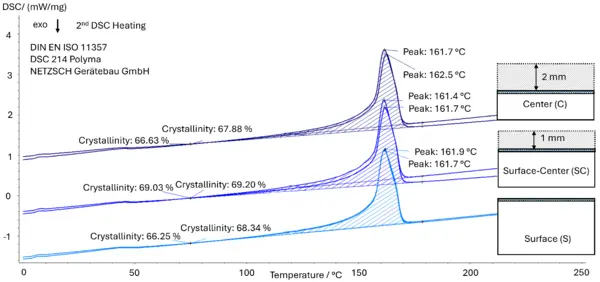
The DSC heating curves of virgin PP measured at different depths are shown in Figure 2. The results demonstrate that, in the absence of aging, the thermal behavior is consistent across the entire cross-section. This confirms that any differences observed after aging can be attributed to degradation processes rather than inherent material inhomogeneity.
Aging Effects in the First DSC Heating
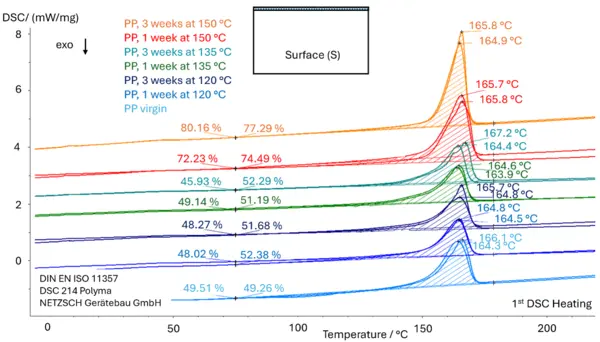
The first DSC heating reflects the thermal history of the material and is therefore sensitive to structural changes introduced during aging. Figure 3 shows the first heating curves for surface samples aged at different temperatures and durations.
Even under elevated aging conditions, the peak temperature changes only slightly, typically within a range of a few degrees Celsius. At the same time, an increase in the degree of Crystallinity / Degree of CrystallinityCrystallinity refers to the degree of structural order of a solid. In a crystal, the arrangement of atoms or molecules is consistent and repetitive. Many materials such as glass ceramics and some polymers can be prepared in such a way as to produce a mixture of crystalline and amorphous regions.crystallinity is observed with increasing aging severity. This effect can be explained by enhanced chain mobility resulting from chain scission, which allows shorter polymer chains to reorganize more easily into crystalline structures. Under particularly harsh and accelerated conditions, such as 3-week exposure to temperatures of 150 °C, the melting peaks become sharper and more pronounced. These effects reflect structural rearrangements rather than a fundamental loss of material identity.
Second DSC Heating: Intrinsic Material Properties
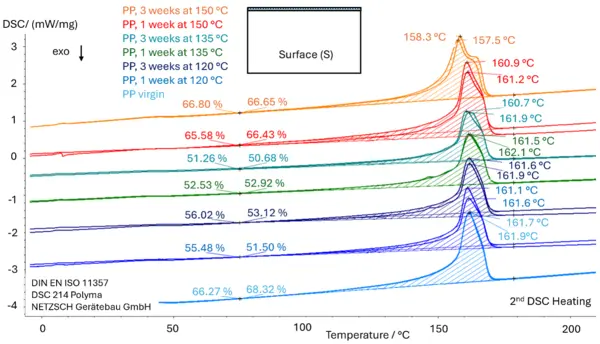
The second DSC heating removes the thermal history and reveals the intrinsic material properties. The corresponding curves for surface samples are shown in Figure 4.
Here, significant shifts in peak temperature are observed, especially for strongly aged surface samples compared to the virgin, thermally untreated samples. For the sample aged at 150 °C for 3 weeks, a pronounced double peak is measured. The differences typically remain within approximately 3–4 °C compared to virgin material. The degree of Crystallinity / Degree of CrystallinityCrystallinity refers to the degree of structural order of a solid. In a crystal, the arrangement of atoms or molecules is consistent and repetitive. Many materials such as glass ceramics and some polymers can be prepared in such a way as to produce a mixture of crystalline and amorphous regions.crystallinity remains largely comparable between the virgin material and strongly aged samples, and the overall melting enthalpy shows no significant change between virgin and aged samples.
A broader melting peak can be observed for strongly aged surface samples, indicating a wider distribution of crystallite sizes. This is attributed to the formation of shorter polymer chains during degradation, which results in more heterogeneous crystalline structures. Importantly, these effects are primarily visible in surface-near regions.
Beyond Peak Values: Advanced Curve Evaluation
While conventional DSC parameters such as peak temperature and degree of Crystallinity / Degree of CrystallinityCrystallinity refers to the degree of structural order of a solid. In a crystal, the arrangement of atoms or molecules is consistent and repetitive. Many materials such as glass ceramics and some polymers can be prepared in such a way as to produce a mixture of crystalline and amorphous regions.crystallinity provide useful information, they are often not sufficient to capture subtle structural changes. A more detailed evaluation of the curve shape can therefore be beneficial.
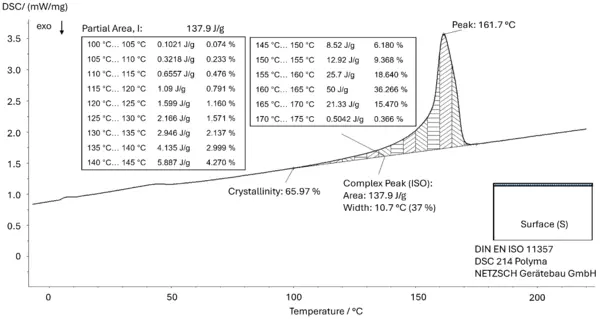
One approach is the analysis of partial areas under the DSC curve, representing the energy required to melt crystallites over defined temperature intervals. Figure 5 illustrates this concept for a virgin PP sample in the second heating using the Proteus® Partial Area function.
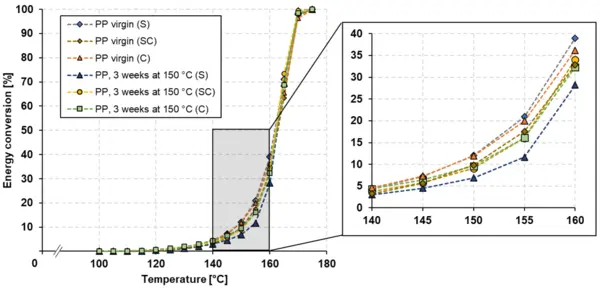
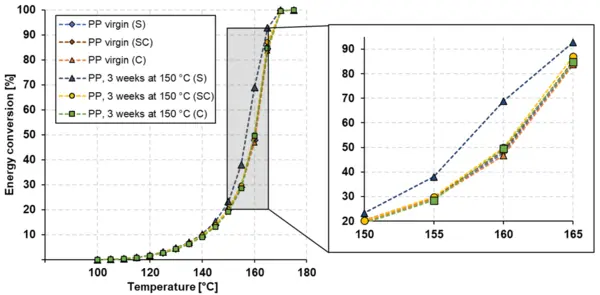
By evaluating the cumulative energy conversion as a function of temperature, differences in melting behavior become more apparent. The results of this analysis for samples taken from different depths are shown in Figures 6 and 7 for the first and second DSC heating, respectively.
In the first heating (Figure 6), surface samples aged under extreme conditions show a shift in energy conversion toward higher temperatures. This behavior is associated with Post Crystallization (Cold Crystallization)The post crystallization of semi-crystalline plastics occurs primarily at elevated temperatures and increased molecular mobility above the glass transition.post-crystallization effects and the formation of more complex crystalline structures.
In the second heating (Figure 7), which reflects the intrinsic material properties, the surface sample still shows a measurable deviation. The energy conversion curve indicates a shift toward lower melting energies, consistent with smaller crystallite sizes resulting from reduced molecular weight. In contrast, samples taken from the intermediate layer and the center overlap closely with the behavior of virgin PP.
Interpreting Aging Effects in a Realistic Context
The depth-resolved analysis clearly shows that aging in PP is not a uniform process. Instead, it is dominated by surface effects, while the bulk material remains largely unchanged, even after accelerated aging.
It is important to note that the conditions used in such studies—such as exposure to temperatures above 120 °C for several weeks—represent highly accelerated and rather extreme scenarios. These conditions are useful for understanding mechanisms and for demonstrating the sensitivity of analytical methods, but they do not necessarily reflect typical service conditions encountered in most applications or recyclate streams.
As a result, while DSC is capable of detecting aging effects with high sensitivity, the overall thermal fingerprint of PP remains remarkably stable when the entire material is considered. This explains why, in many practical cases, recyclates exhibit thermal behavior that is comparable to virgin material.
Conclusion
DSC, especially when combined with controlled sample preparation and advanced evaluation methods, is a powerful tool for investigating aging phenomena in polymers. It enables the detection of localized degradation effects, the differentiation between surface and bulk behavior, and the identification of subtle structural changes.
At the same time, the results demonstrate that for materials such as polypropylene, aging effects are often confined to surface regions and remain limited in their influence on the overall thermal properties. Even under strongly accelerated conditions, the bulk material retains a thermal behavior that is close to that of virgin PP.
This highlights an important perspective: while aging exists and can be measured, it does not necessarily compromise the thermal fingerprint of the material to the extent often assumed. Instead, DSC provides the means to place degradation effects into the correct context and to distinguish between localized phenomena and relevant changes in material performance.
NETZSCH DSC Products
References
[1] N. Rudolph, R. Kiesel, and C. Aumnate, Einführung Kunststoffrecycling, 1st ed. München, Germany: Carl Hanser Verlag GmbH & Co. KG, 2020. doi: 10.1007/978-3-446-46128-4.
[2] S. Hoebel, F. Bittner, J. Lecinski, H. Behnsen, and H.-J. Endres, “Effect of thermo-oxidative aging during use phase on mechanical and thermal properties of polypropylene used in automotive applications,” Journal of Polymer Research, vol. 33, no. 1, p. 29, Jan. 2026, doi: 10.1007/s10965-025-04732-2.
[3] G. W. Ehrenstein and S. Pongratz, Beständigkeit von Kunststoffen, 1st ed., vol. 1. München, Germany: Carl Hanser Verlag GmbH & Co. KG, 2007. doi: 10.1007/978-3-446-41149-4.
Further resources
Tips for Sample Preparation for DSC Measurements: https://analyzing-testing.NETZSCH.com/en/know-how/tips-tricks/dsc/tips-for-sample-preparation-for-dsc-measurements
Factors Influencing the DSC and TGA Measurement Results: https://analyzing-testing.NETZSCH.com/en/know-how/tips-tricks/dsc/factors-influencing-the-dsc-and-tga-measurements-results






Become an Expert with our Free E-Learning Courses
All NETZSCH E-Learning Basic Courses are free of charge! The content is created by our laboratory method experts, who share their personal experiences with you. Take advantage of flexible online learning, fully adapted to your training needs!