Introduction
Silicone-based gap pads are widely used as thermal interface materials (TIMs) in electronics, power modules and battery systems. Their main function is to bridge air gaps between heat-generating components and heat sinks while compensating for surface roughness and mechanical tolerances. Besides mechanical compliance, the Thermal ConductivityThermal conductivity (λ with the unit W/(m•K)) describes the transport of energy – in the form of heat – through a body of mass as the result of a temperature gradient (see fig. 1). According to the second law of thermodynamics, heat always flows in the direction of the lower temperature.thermal conductivity of the pad is one of the key parameters for evaluating its suitability in a specific thermal management design.
Method and Measurement Conditions
To obtain meaningful Thermal ConductivityThermal conductivity (λ with the unit W/(m•K)) describes the transport of energy – in the form of heat – through a body of mass as the result of a temperature gradient (see fig. 1). According to the second law of thermodynamics, heat always flows in the direction of the lower temperature.thermal conductivity values, especially at low temperatures, the LFA measurement is ideally complemented by DSC-based Specific Heat Capacity (cp)Heat capacity is a material-specific physical quantity, determined by the amount of heat supplied to specimen, divided by the resulting temperature increase. The specific heat capacity is related to a unit mass of the specimen.specific heat capacity determination. The powerful combination of LFA, DSC and DensityThe mass density is defined as the ratio between mass and volume. density data provides an overall and dependable picture of the material’s thermal performance.
Therefore, the Thermal DiffusivityThermal diffusivity (a with the unit mm2/s) is a material-specific property for characterizing unsteady heat conduction. This value describes how quickly a material reacts to a change in temperature.thermal diffusivity was measured by Laser Flash Analysis using the NETZSCH LFA 717 HyperFlash®. The Specific Heat Capacity (cp)Heat capacity is a material-specific physical quantity, determined by the amount of heat supplied to specimen, divided by the resulting temperature increase. The specific heat capacity is related to a unit mass of the specimen.specific heat capacity (cp) was determined separately by DSC using the NETZSCH DSC 204 F1 Phoenix®. Together with the sample DensityThe mass density is defined as the ratio between mass and volume. density, the Thermal ConductivityThermal conductivity (λ with the unit W/(m•K)) describes the transport of energy – in the form of heat – through a body of mass as the result of a temperature gradient (see fig. 1). According to the second law of thermodynamics, heat always flows in the direction of the lower temperature.thermal conductivity was calculated according to:
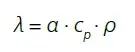
with
λ = Thermal ConductivityThermal conductivity (λ with the unit W/(m•K)) describes the transport of energy – in the form of heat – through a body of mass as the result of a temperature gradient (see fig. 1). According to the second law of thermodynamics, heat always flows in the direction of the lower temperature.thermal conductivity in W/(m·K)
α = Thermal DiffusivityThermal diffusivity (a with the unit mm2/s) is a material-specific property for characterizing unsteady heat conduction. This value describes how quickly a material reacts to a change in temperature.thermal diffusivity in mm²/s
cp = Specific Heat Capacity (cp)Heat capacity is a material-specific physical quantity, determined by the amount of heat supplied to specimen, divided by the resulting temperature increase. The specific heat capacity is related to a unit mass of the specimen.specific heat capacity in J/(g·K)
ρ = DensityThe mass density is defined as the ratio between mass and volume. density in g/cm³
The measurements were carried out under a nitrogen atmosphere. The DSC measurement was used to determine the Specific Heat Capacity (cp)Heat capacity is a material-specific physical quantity, determined by the amount of heat supplied to specimen, divided by the resulting temperature increase. The specific heat capacity is related to a unit mass of the specimen.specific heat capacity and energetic transitions of the silicone pad. In total, two samples were tested and for calculation of Thermal ConductivityThermal conductivity (λ with the unit W/(m•K)) describes the transport of energy – in the form of heat – through a body of mass as the result of a temperature gradient (see fig. 1). According to the second law of thermodynamics, heat always flows in the direction of the lower temperature.thermal conductivity the averaged Specific Heat Capacity (cp)Heat capacity is a material-specific physical quantity, determined by the amount of heat supplied to specimen, divided by the resulting temperature increase. The specific heat capacity is related to a unit mass of the specimen.cp values were taken.
The LFA measurement provided the temperature-dependent Thermal DiffusivityThermal diffusivity (a with the unit mm2/s) is a material-specific property for characterizing unsteady heat conduction. This value describes how quickly a material reacts to a change in temperature.thermal diffusivity.
Table 1 shows the measurement conditions for DSC and LFA.
Table 1: Measurement conditions for DSC and LFA
| Method | DSC | LFA |
|---|---|---|
| Instrument | DSC 204 F1 Phoenix® | LFA 717 HyperFlash® |
| Atmosphere | Nitrogen | Nitrogen |
| Temperature program | -150°C to 310°C | -100°C to 300°C |
| Heating rate | 10 K/min | 10 K/min |
| Sample mass | Sample 1: 11.205 mg; Sample 2: 11.224 mg | - |
| Sample dimensions | Ø 4 mm, 1 mm thick | 20 mm x 20 mm x 0.8 mm |
| Sensor/thermocouple | DSC 204 F1 t-sensor, type E | MCT, type K |
Results
The DSC measurement shows the temperature-dependent Specific Heat Capacity (cp)Heat capacity is a material-specific physical quantity, determined by the amount of heat supplied to specimen, divided by the resulting temperature increase. The specific heat capacity is related to a unit mass of the specimen.specific heat capacity of the silicone pad between -150°C and 310°C (Figure 1). At low temperatures, a Glass Transition TemperatureThe glass transition is one of the most important properties of amorphous and semi-crystalline materials, e.g., inorganic glasses, amorphous metals, polymers, pharmaceuticals and food ingredients, etc., and describes the temperature region where the mechanical properties of the materials change from hard and brittle to more soft, deformable or rubbery.glass transition is observed at approximately -121°C. The change in specific heat capacity at the Glass Transition TemperatureThe glass transition is one of the most important properties of amorphous and semi-crystalline materials, e.g., inorganic glasses, amorphous metals, polymers, pharmaceuticals and food ingredients, etc., and describes the temperature region where the mechanical properties of the materials change from hard and brittle to more soft, deformable or rubbery.glass transition is about 0.09 J/(g·K). A pronounced EndothermicA sample transition or a reaction is endothermic if heat is needed for the conversion.endothermic peak occurs at approximately -41°C, which is assigned to the melting transition of crystalline or ordered silicone-related domains. The measured melting enthalpy is approximately 23 J/g.
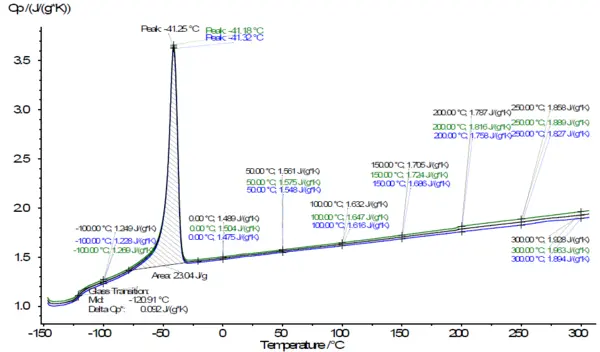
The results show a gradual increase in cp with increasing temperature, as expected for polymeric materials. The EndothermicA sample transition or a reaction is endothermic if heat is needed for the conversion.endothermic effect around -41°C was not used directly for the thermal conductivity calculation. Instead, the Specific Heat Capacity (cp)Heat capacity is a material-specific physical quantity, determined by the amount of heat supplied to specimen, divided by the resulting temperature increase. The specific heat capacity is related to a unit mass of the specimen.cp curve was interpolated across this transition region in order to avoid including latent heat contributions in the conductivity calculation.
The Thermal DiffusivityThermal diffusivity (a with the unit mm2/s) is a material-specific property for characterizing unsteady heat conduction. This value describes how quickly a material reacts to a change in temperature.thermal diffusivity of the silicone pad decreases continuously with increasing temperature, see Figure 2. At low temperatures around -100°C, the diffusivity is approximately 0.18 mm²/s. At room temperature, values around 0.14 mm²/s are observed. At 300°C, the diffusivity decreases to approximately 0.08 mm²/s.
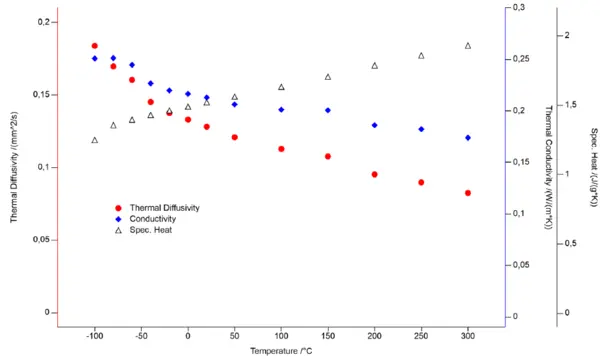
This behaviour is typical for polymer-based materials. With increasing temperature, phonon transport becomes less efficient due to increasing molecular mobility and enhanced scattering processes. As a result, the Thermal DiffusivityThermal diffusivity (a with the unit mm2/s) is a material-specific property for characterizing unsteady heat conduction. This value describes how quickly a material reacts to a change in temperature.thermal diffusivity decreases, even though the specific heat capacity increases.
The calculated thermal conductivity remains within a comparatively narrow range over the investigated temperature interval. At low temperatures, the conductivity is approximately 0.25 W/(m·K). With increasing temperature, the conductivity decreases and reaches values of approximately 0.17 W/(m·K) at 300°C.
Conclusion
This example shows that the LFA 717 HyperFlash® provides reliable thermal diffusivity data over a wide temperature range – including challenging cryogenic conditions – thanks to its high sensitivity and precise temperature control, even with slow-reacting silicone-based interface pads. Especially in the low-temperature range, the supplementary determination of the specific heat capacity using DSC is crucial, as only the combination of LFA data, cp values and DensityThe mass density is defined as the ratio between mass and volume. density allows for reliable calculation of the thermal conductivity. This ability to deliver reliable results even below room temperature is a clear advantage for the development of modern silicone TIMs.