DSC 204 F1 Phoenix®
The premium DSC for all requirements
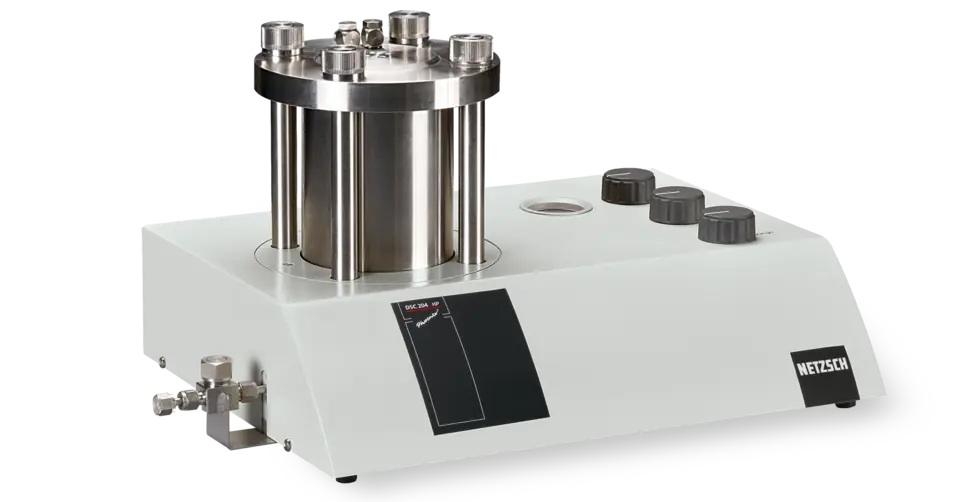
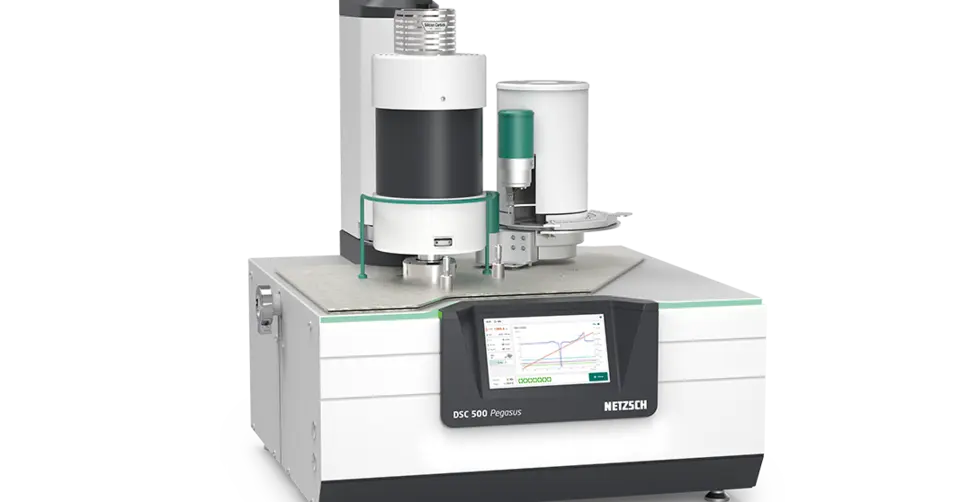
The versatile Premium Differential Scanning Calorimeter, DSC 204 F1 Phoenix®, fascinates with its unique concept: all essential operational components are integrated into the instrument and optional add-ons can be installed anytime on site.
The DSC measuring cell consists of a cylindrical high-conductivity silver block with an embedded heating coil for broad thermal symmetry (3D symmetry) in the sample chamber, the cooling ports for liquid nitrogen or compressed air cooling and a cooling ring for connection of the intracooler (also with simultaneous liquid nitrogen cooling). The gas-tight construction and integrated mass flow controllers for the purge and protective gases allow coupling to an FT-IR or MS for gas analysis.


Exchangeable sensors are tailored to their tasks:
With its disk-shaped silver carrier plate and supersensitive thermosensors of nickel-chromium constantan, the Tau-sensor offers a high level of calorimetric sensitivity along with extremely short signal time constants of only 0.6 seconds, which guarantees good separation of overlapping thermal effects.
The µ-sensor stands out for its high level of calorimetric sensitivity, never before achieved with a Differential Scanning Calorimeter, DSC. For example, it is extremely well suited for pharmaceutical applications with small sample weights.
Technical Data

Compressed air cooling:
RT to 700°C
Intracooler for the extended range:
-85°C to 600°C
Automatically controlled LN2 cooling:
-180°C to 700°C
Indium Response Ratio (*):
>160 mW/K
(*) Peak Height [mW]/Peak with at 50% Height [K] of Indium melting peak
Gas control for 2 sample gases and 1 protective gas through integrated mass flow controller and software
Automatic sample changer:
for 192 samples and reference crucibles (optional)

The DSC 204 F1 Phoenix® runs under Proteus® Software on Windows®. The Proteus® Software includes everything you need to carry out a measurement and evaluate the resulting data. Through the combination of easy-to-understand menus and automated routines, a tool has been created that is extremely user-friendly and, at the same time, allows sophisticated analysis. The Proteus® software is licensed with the instrument and can of course be installed on other computer systems.
DSC features:
- Determination of onset, peak, inflection and end temperatures
- Automatic peak search
- Transformation enthalpies: analysis of peak areas (enthalpies) with selectable baseline and partial peak area analysis
- Evaluation of CrystallizationCrystallization is the physical process of hardening during the formation and growth of crystals. During this process, heat of crystallization is released.crystallization
- Comprehensive Glass Transition TemperatureThe glass transition is one of the most important properties of amorphous and semi-crystalline materials, e.g., inorganic glasses, amorphous metals, polymers, pharmaceuticals and food ingredients, etc., and describes the temperature region where the mechanical properties of the materials change from hard and brittle to more soft, deformable or rubbery.glass transition analysis
- Automatic baseline correction
- Specific heat determination
- BeFlat® for optimized baselines through a multi-dimensional, temperature and heating rate dependent polynomial
- Tau-R® Mode: takes into account the time constant and thermal resistance of the instrument and reveals thus sharper DSC effects from the sample
- Optional TM-DSC (temperature modulation) for separation of reversing (thermodynamic) and non-reversing (kinetic) effects
- Sector-specific software solutions for conformance to e.g. GLP and GMP
You can use the following software with this product
The DSC 204 F1 Phoenix® is set up for various cooling systems. The entire temperature range from -180°C to 700°C can be covered by different liquid nitrogen cooling devices for LN2 and GN2 operation. A supplement to fill the cooling agent tank without having to dismount the supply system is available. Alternatively, an efficient, economical closed-loop intracooler is available, which operates between -85°C and 600°C. Compressed air cooling via compressor or central supply in the laboratory serves for tests above room temperature.
A wide range of crucibles (pans) (aluminum, platinum, stainless steel for pressure applications, etc.) is available for nearly all possible applications and materials.
For the sealing press exchangeable inserts are available, for all cold-weldable aluminum crucibles/pans and stainless steel crucibles (pans) for pressures up to 20 bar (Photo).
The 3in1 Box comes exclusively with the new Concavus® pan by NETZSCH. It offers comprehensive protection during transport and storage, allows for easy withdrawal and features a unique archiving system for the pans following measurement.
The automatic sample changer DSC 204 F1 Phoenix®-ASC is designed for routine measurements. It works day and night, giving you time for other tasks, and provides for optimal use of the DSC 204 F1 Phoenix® (e.g. calibrations on the weekend).
The DSC system with an automatic sample changer can handle up to 192 crucibles/pans evenly distributed on two removable trays. Different types of crucibles/pans are allowed up to 8 mm Ø in and 8 mm in height. A four-needle gripper handles different crucibles by using the appropriate gripping pressure for the chosen pan. For calibration and correction purposes, a fixed strip with additional 12 crucible/pan positions is available. Crucible/pan recognition in flight is available. A crucible/pan and lid data base is linked to the ASC. The sample trays are covered by an automatically controlled cover. After closing the cover, the space above the sample pans is purged by branching gas channels integrated in the cover. The purge gas rate is adapted to opening and closing the cover. For this purpose, a further purge gas inlet is available only for the use with the ASC. A “remove lid” function is integrated to cover the sample while waiting its turn to be inserted into the DSC cell. Alternatively, a piercing device is optionally available for piercing the lid prior to measurement. The DSC system has a refuse bin for disposing lids and non-reusable pans. It is possible to archive the micro-plate trays (storage sample). For better identification, the plates have a serial number and 2D code. The tray identification feature is linked to a crucible/lid data base.The same ASC can also be used with our new TG 209 F1 Libra®.


To analyze the UV Curing (Crosslinking Reactions)Literally translated, the term “crosslinking“ means “cross networking”. In the chemical context, it is used for reactions in which molecules are linked together by introducing covalent bonds and forming three-dimensional networks.curing of light-sensitive resin systems, adhesives, paints, coatings and dental masses, the DSC 204 F1 Phoenix® can be configured as a Photo-DSC. Standard lamps by a variety of manufacturers can serve as a source of radiation.
For adhesives, we recommend the DELOLUX04 high-pressure mercury lamp (315-500 nm), which can easily be triggered using Proteus® software.
For paints and inks, we recommend the DSC be equipped with an OmniCure® S2000 lamp. The measurement parameters (e.g. exposure time and intensity) can be programmed and monitored by segment via the Proteus® software.
The luminous intensity of the high-pressure mercury lamp can be calibrated with the Radiometer R2000.

Standard Crucibles (Pans) Made of Aluminum for the DSC 204 F1 Phoenix®
| Material (Purity) | Temperature Range | Consisting of | Dimension/ Volume | Remarks | Order Number |
| Al (99.5) | Max. 600°C | Crucible + lid | ø 6 mm; 25/40 μl* | Set of 100, cold weldable** | 6.239.2-64.5.00 |
| Al (99.5) | Max. 600°C | Crucible + lid | ø 6 mm; 25/40 μl* | Set of 500, cold weldable** | 6.239.2-64.51.00 |
| Al (99.5) | Max. 600°C | Crucible + lid with laser-cut hole (50 μm) | ø 6 mm; 40 μl | Set of 100, cold weldable** | 6.239.2-64.8.00 |
| Al (99.5) | Max. 600°C | Crucible + lid with laser-cut hole (50 μm) | ø 6 mm; 40 μl | Set of 500, cold weldable** | 6.239.2-64.81.00 |
| Al (99.5) | Max. 600°C | Crucible | ø 6.7mm; 85 μl | Set of 100 pieces | NGB810405 |
| Al (99.5) | Max. 600°C | Lid | 100 pieces, for NGB810405 | NGB810406 |
* Crucible (pan) volumes of either 25 μl or 40 μl can be achieved by simply reversing the lid.
** One and the same sealing press is capable of sealing all standard Al crucibles (pans); order no. 6.240.10-80.0.00A.
Crucibles (Pans) for General Applications – DSC 204 F1 Phoenix®
| Material (Purity) | Temperature Range | Consisting of | Dimension/ Volume | Remarks | Order Number |
| Al2O3 (99.7) | Max. 1700°C | Crucible | ø 6.8 mm/85 μl | GB399972 | |
| Al2O3 (99.7) | Max. 1700°C | Lid | For GB399972 | GB399973 | |
| Fused silica | Max. 1000°C | Crucible | ø 6.7 mm/85 μl | GB399974 | |
| Fused silica | Max. 1000°C | Lid | For GB399974 | GB399975 | |
| Pt/Rh (80/20) | Max. 1700°C | Crucible | ø 6.8 mm/85 μl | GB399205 | |
| Pt/Rh (80/20) | Max. 1700°C | Crucible | ø 6.8 mm/190 μl | NGB801556 | |
| Pt/Rh (80/20) | Max. 1700°C | Lid | For GB399205 and NGB801556 | GB399860 | |
| Gold (99.9) | Max. 900°C | Crucible + Lid | ø 6.7 mm/85 μl | 6.225.6-93.3.00 | |
| Silver | Max. 750°C | Crucible + Lid | ø 6.7 mm/85 μl | 6.225.6-93.4.00 |

This instrument is LabV®-primed
LabV® takes the data from your analytical instrument: It automatically imports all measurement data into a central and secure database solution, the LabV®️ software. This allows you to visualize the data in LabV®️ and to make them searchable. Your data will now be accessible from anywhere. Moreover you have the possibility to generate reports.
Application Literature

Our latest blog articles
- 07.10.2026
From the Green Body to a Dense Ceramic – How NETZSCH Termica Neo Makes Sintering Transparent
- 03.10.2026
What DSC Can Reveal About Aging in Polypropylene

- 22.09.2026
NETZSCH Analysis Instruments in Use at South Korean Research Institutes

- 09.09.2026
Introduction to the Rheology of Dispersions – Fundamentals, Influencing Factors and Measurement Methods

- 04.08.2026
Can Artificial Cartilage Behave Like the Real Thing? Rheology Provides the Answer

- 28.07.2026
Beyond Heat and Smoke: Why Gas Analysis Matters in Modern Fire Testing