DSC 3500 Sirius
Differential Scanning Calorimeter
The cost-effective starter instrument for material characterization
The DSC 3500 Sirius unites state-of-the-art technology with high sensitivity in a robust, easy-to-operate measuring system across a temperature range from -170°C to 600°C. The most important characteristics of the DSC 3500 Sirius measuring cell are its silver furnace with long-life heating element and its monolithic DSC sensor featuring high stability and optimal resolution.
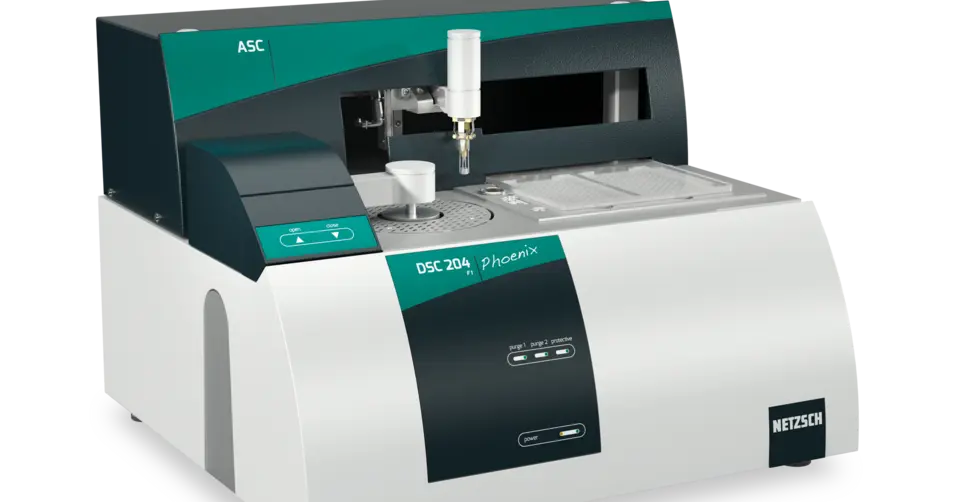
For high sample throughput, we recommend that the unit be equipped with an automatic sample changer (ASC) – this accommodates up to 20 samples and references, even of different crucible types.
The design of the DSC 3500 Sirius developed in Japan is tailored to routine tasks in quality control and failure analysis as well as for material characterization of technical textiles, of food products, in packaging, in the polymer and cosmetic industry and for further organic or inorganic materials.

Technical Data
(depending on temp.)

Sensor:
heat flux system
Measurement range:
± 650 mW
Temperature accuracy:
0.1 K
Enthalpy accuracy:
generally < 2%
Atmospheres:
oxid., inert (static, dynamic)
Automatic sample changer (ASC)
for up to 20 samples and references (optional)

The DSC 3500 Sirius runs under Proteus Software on Windows®. The Proteus® Software includes everything you need to carry out a measurement and evaluate the resulting data. Through the combination of easy-to-understand menus and automated routines, a tool has been created that is extremely user-friendly and, at the same time, allows sophisticated analysis. The Proteus® Software is licensed with the instrument and can of course be installed on other computer systems.
DSC features:
- Determination of onset, peak, inflection and end temperatures
- Automatic peak search
- Transformation enthalpies: analysis of peak areas (enthalpies) with selectable baseline and partial peak area analysis
- Evaluation of CrystallizationCrystallization is the physical process of hardening during the formation and growth of crystals. During this process, heat of crystallization is released.crystallization
- Comprehensive Glass Transition TemperatureThe glass transition is one of the most important properties of amorphous and semi-crystalline materials, e.g., inorganic glasses, amorphous metals, polymers, pharmaceuticals and food ingredients, etc., and describes the temperature region where the mechanical properties of the materials change from hard and brittle to more soft, deformable or rubbery.glass transition analysis
- Automatic baseline correction
- Specific heat determination
- Tau-R® Mode: takes into account the time constant and thermal resistance of the instrument and reveals thus sharper DSC effects from the sample (optional)
- Optional TM-DSC (temperature modulation) for separation of reversing (thermodynamic) and non-reversing (kinetic) effects
You can use the following software with this product
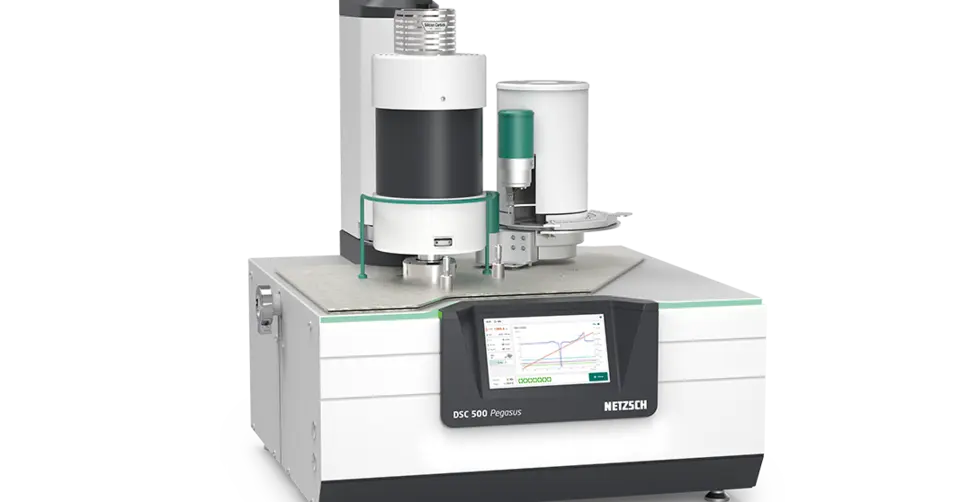
The DSC 3500 Sirius can be equipped with various accessories and extensions for optimum adjustment of the system to your requirements. Various cooling systems (forced air via compressor or pressurized air) can be used to cool the furnace back to room temperature. The liquid nitrogen cooling system allows tests at subambient temperatures from -170°C up to 600°C.
The cost-efficient intracooler IC40 offers an alternative to liquid nitrogen cooling and makes it possible to run measurements between -40°C to 600°C.
The more powerful intracooler IC70 ensures faster cooling rates and enables working within a temperature range between -70°C and 600°C.
All cooling options can be upgraded to the DSC 3500 Sirius.
For investigation of the oxidative stability (e.g. Oxidative-Induction Time, Oxidative-Induction Time (OIT) and Oxidative-Onset Temperature (OOT)Oxidative Induction Time (isothermal OIT) is a relative measure of the resistance of a (stabilized) material to oxidative decomposition. Oxidative-Induction Temperature (dynamic OIT) or Oxidative-Onset Temperature (OOT) is a relative measure of the resistance of a (stabilized) material to oxidative decomposition.OIT), the DSC 3500 Sirius can be equipped with a software-controlled MFC gas flow control system for three gases.


Standard Crucibles Made of Aluminum for the DSC 3500 Sirius
| Material | Temperature Range (Max.) | Consisting of | Dimension/ Volume | Remarks | Order Number |
| Al | 600°C | Crucible + lid | ø 6 mm/ 25/40 μl* | Set of 100/500 pcs, cold weldable** | 6.239.2-64.5.00/ 6.239.2-64.51.00 |
| Al | 600°C | Crucible + lid with laser-cut hole (50 μm) | ø 6 mm/ 40 μl | Set of 100/500 pcs, cold weldable** | 6.239.2-64.8.00/ 6.239.2-64.81.00 |
Crucibles for General and Special Applications – DSC 3500 Sirius
| Material | Temperature Range (Max.) | Consisting of | Dimension/ Volume/Pressure | Remarks | Order Number |
| Al | 600°C | Concavus® pan + lid | ø 5mm/ 30/40 μl | Set of 96 Concavus® pans and lids incl. 3in1 Box, cold weldable* | DSC21400A66.010-00 |
| Cu | 600°C | Crucible | ø 6 mm/ 25/40 μl | For Oxidative-Induction Time (OIT) and Oxidative-Onset Temperature (OOT)Oxidative Induction Time (isothermal OIT) is a relative measure of the resistance of a (stabilized) material to oxidative decomposition. Oxidative-Induction Temperature (dynamic OIT) or Oxidative-Onset Temperature (OOT) is a relative measure of the resistance of a (stabilized) material to oxidative decomposition.OIT measurements according to ASTM D3895, Set of 25 | 6.239.2.-64.6.00 |
| CrNi steel | 250°C | Crucible + lid + elastomer seal | 120 μl/ 20 bar | Set of 25 pieces | 6.240.1-68.1.00 |
| CrNi steel | 500°C | Crucible + lid, gold-plated surface, reusable | ø 6mm/ 27 μl/ max. 100 bar | 10 crucibles + 50 Au sealing disks*** | 6.239.2-92.31.00 |
| CrNi steel | 500°C | Crucible + lid, gold-plated surface, reusable | ø 6mm/ 100 μl/ max. 100 bar | 1 crucible + 5 Au sealing disks*** | 6.239.2-92.8.00 |
| Titanium | 500°C | Crucible + lid, reusable | ø 6 mm/ 27 μl/ max. 100 bar | 1 crucible + 5 Au sealing disks*** | 6.239.2-92.6.00 |
| Titanium | 500°C | Crucible + lid, reusable | ø 6 mm/ 100 μl/ max. 100 bar | 1 crucible + 5 Au sealing disks*** | 6.239.2-92.9.00 |
| Al2O3 | 1700°C | Crucible | ø 6.8 mm/ 85 μl | GB399972 | |
| Al2O3 | 1700°C | Lid | For GB399972 | GB399973 | |
| Pt/Rh | 1700°C | Crucible | ø 6.8 mm/ 85 μl | GB399205 | |
| Pt/Rh | 1700°C | Crucible | ø 6.8 mm/ 190 μl | NGB801556 | |
| Pt/Rh | 1700°C | Lid | For GB399205 and NGB801556 | GB399860 |
* Crucible volumes of either 25 μl or 40 μl can be achieved by simply reversing the lid.
** One and the same sealing press is capable of sealing all standard Al crucibles; order no. 6.240.10-80.0.00A.
*** Sealing tool order no. 6.239.2-92.4 required.
Other crucibles and number of pieces per set are available on demand.