Introduction
Efficient heat dissipation is crucial in high-performance electronics and optoelectronics, where high thermal loads occur in very confined spaces.
Diamond is especially well suited for such applications since it combines extreme hardness with the highest Thermal ConductivityThermal conductivity (λ with the unit W/(m•K)) describes the transport of energy – in the form of heat – through a body of mass as the result of a temperature gradient (see fig. 1). According to the second law of thermodynamics, heat always flows in the direction of the lower temperature.thermal conductivity of any naturally occurring material, exceeding 2000 W/(m·K) at room temperature. Its low thermal expansion and electrical insulation further support its use in demanding cooling concepts.
Accurate Thermal ConductivityThermal conductivity (λ with the unit W/(m•K)) describes the transport of energy – in the form of heat – through a body of mass as the result of a temperature gradient (see fig. 1). According to the second law of thermodynamics, heat always flows in the direction of the lower temperature.thermal conductivity testing of diamond, however, remains challenging due to its exceptional heat transport and optical transparency, making the selection of method, instrument, and procedure critical.
Advanced In-Plane Testing
When testing the Thermal DiffusivityThermal diffusivity (a with the unit mm2/s) is a material-specific property for characterizing unsteady heat conduction. This value describes how quickly a material reacts to a change in temperature.thermal diffusivity of diamond in the through-plane direction, specific thickness requirements are typically imposed on the sample [1].
When the sample is very thin, the heat transfer occurs within an extremely short time. This makes high temporal resolution especially important for obtaining a high-quality detector signal. Although pulse durations as short as 10 µs support improved signal capture, the narrow measurement window can increase the complexity of signal separation and curve fitting. With appropriate consideration of these factors, reliable calculations can still be achieved.
With the NETZSCH LFA 717 HyperFlash® as an example, the detector data acquisition frequency is 2 MHz, which yields a time interval of 0.5 μs between adjacent data points. According to ASTM E1461, at least 100 data points are generally required to be recorded up to the half time (t₁/₂). However, for transparent diamond samples possessing ultrahigh Thermal ConductivityThermal conductivity (λ with the unit W/(m•K)) describes the transport of energy – in the form of heat – through a body of mass as the result of a temperature gradient (see fig. 1). According to the second law of thermodynamics, heat always flows in the direction of the lower temperature.thermal conductivity, 250 data points are recommended, resulting in a minimum half time (t₁/₂) of 0.125 ms. The minimum testable sample thickness (dₘᵢₙ) can then be roughly estimated using the Parker’s formula, where α is the Thermal DiffusivityThermal diffusivity (a with the unit mm2/s) is a material-specific property for characterizing unsteady heat conduction. This value describes how quickly a material reacts to a change in temperature.thermal diffusivity in the through-plane direction of the sample:
For single-crystal diamond with a α around 1000 mm²/s, it is recommended that the sample thickness be no less than 0.95 mm to ensure sufficient testing accuracy. Though samples with thicknesses slightly less than this value are feasible, the signal quality will deteriorate, for instance, the signal-to-noise ratio decreases.
If the Sample Thickness is Significantly Smaller than this Recommended Thickness, how Should the Thermal Diffusivity Be Tested?
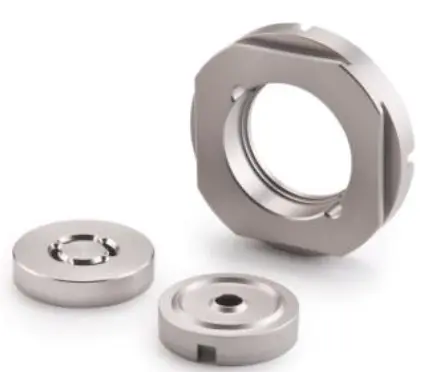
In such cases, the sample can be tested using an in-plane holder (Figure 1), which induces a longer heat-diffusion path within the sample to measure the in-plane direction instead.
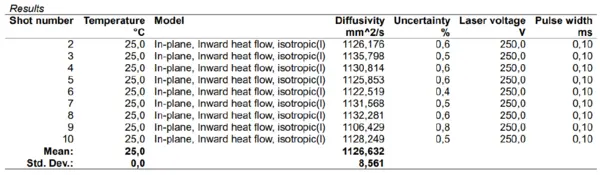
Table 1 summarizes the in-plane Thermal DiffusivityThermal diffusivity (a with the unit mm2/s) is a material-specific property for characterizing unsteady heat conduction. This value describes how quickly a material reacts to a change in temperature.thermal diffusivity results obtained for a 0.638 mm thick diamond sample using an in-plane sample holder. The measurements were carried out at room temperature. An average in-plane Thermal DiffusivityThermal diffusivity (a with the unit mm2/s) is a material-specific property for characterizing unsteady heat conduction. This value describes how quickly a material reacts to a change in temperature.thermal diffusivity of 1126.6 mm²/s was determined with a standard deviation of 8.6 mm²/s. The low scattering of the individual shots demonstrates the excellent repeatability of the measurement. The measured in-plane value is consistent with the diffusivity range observed for comparable diamond specimens analyzed in the through-plane direction in Application Note 438. This agreement confirms that the in-plane LFA setup is suitable for characterizing materials with very high Thermal DiffusivityThermal diffusivity (a with the unit mm2/s) is a material-specific property for characterizing unsteady heat conduction. This value describes how quickly a material reacts to a change in temperature.thermal diffusivity.
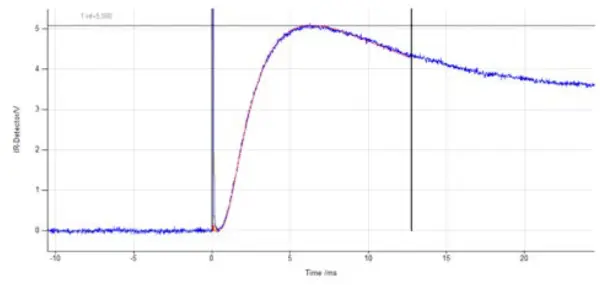
The corresponding temperature rise curve is presented in Figure 2. The measured signal exhibits a sharp increase immediately after the light impulse, followed by a gradual decay. The very good agreement between the experimental curve and the fitted model curve indicates that the selected in-plane heat-flow model accurately represents the thermal response of the diamond sample. The stable fit quality and the low measurement uncertainty support the reliability of the in-plane diffusivity value obtained.
Conclusion
The results clearly demonstrate that the LFA method is suitable for investigating highly conductive materials in the in-plane direction. Even for diamond, which exhibits very rapid heat propagation, the in-plane measurement delivered highly reproducible and reliable results.
The average in-plane thermal diffusivity of 1126.6 mm²/s, combined with a relative standard deviation of approximately 0.76 %, confirms the stability of the measurement approach. The excellent agreement between the measured temperature rise curve and the fitted model further supports the validity of the applied in-plane evaluation.
Therefore, in-plane LFA analysis represents a valuable method for determining directional thermal transport properties, particularly for thin and highly conductive materials. With an appropriate sample holder, suitable measurement parameters and a dedicated in-plane evaluation model, reliable in-plane thermal diffusivity data can be obtained.
These reliable values support material selection, thermal design, and simulation accuracy, helping reduce local overheating and improve component performance and lifetime.