Introduction
Although Laser Flash Analysis (LFA) is most commonly used to measure the Thermal DiffusivityThermal diffusivity (a with the unit mm2/s) is a material-specific property for characterizing unsteady heat conduction. This value describes how quickly a material reacts to a change in temperature.thermal diffusivity of cylindrical samples in the through-plane direction, specialized sample holders also enable the characterization of this thermophysical property in the in-plane direction. In this configuration, the dedicated sample holder is equipped with two masks that selectively expose different regions of the specimen to the light flash and the detector, thereby forcing radial heat diffusion within the sample.
Traditionally, these masks are made of stainless steel to enable measurements at temperatures even above 500°C. While this design is well suited for materials exhibiting high Thermal DiffusivityThermal diffusivity (a with the unit mm2/s) is a material-specific property for characterizing unsteady heat conduction. This value describes how quickly a material reacts to a change in temperature.thermal diffusivity, it significantly compromises the measurement accuracy, reproducibility, and, in extreme cases, the overall reliability of the results for specimens with thermal diffusivities of approximately 10 mm2/s or below. This occurs because such Thermal DiffusivityThermal diffusivity (a with the unit mm2/s) is a material-specific property for characterizing unsteady heat conduction. This value describes how quickly a material reacts to a change in temperature.thermal diffusivity values are comparable to or lower than that of stainless steel, leading to a significant influence of the sample holder on the detector signal during the measurement.
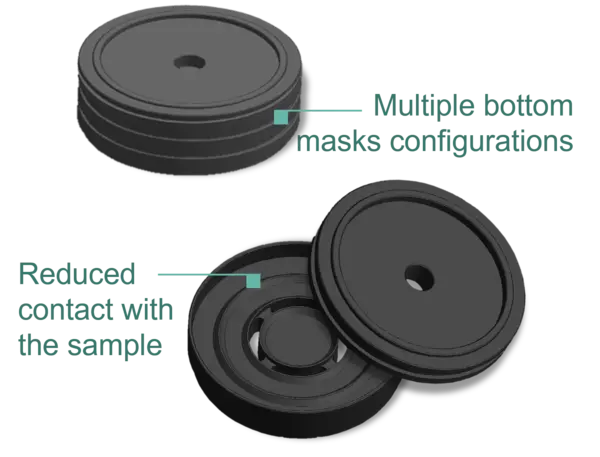
The PEEK sample holder for in-plane measurements (Figure 1) has been developed to overcome this limitation. The low Thermal DiffusivityThermal diffusivity (a with the unit mm2/s) is a material-specific property for characterizing unsteady heat conduction. This value describes how quickly a material reacts to a change in temperature.thermal diffusivity of PEEK, combined with a design that reduces sample contact and the use of up to three lower masks minimizes the holder’s influence on the measurement. As a result, this sample holder enables reliable in-plane Thermal DiffusivityThermal diffusivity (a with the unit mm2/s) is a material-specific property for characterizing unsteady heat conduction. This value describes how quickly a material reacts to a change in temperature.thermal diffusivity characterization of low-thermal- diffusivity materials up to 250°C.
Materials and Methods
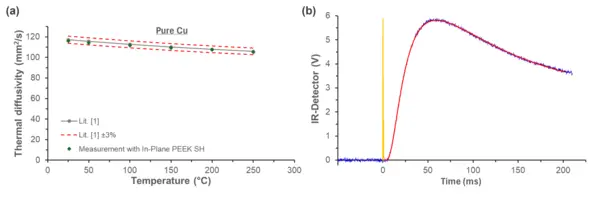
The measurement precision using the PEEK sample holder for in-plane measurements was evaluated for materials with low thermal diffusivity, using Pyroceram® 9606 and Pyrex® 7740 specimens. In addition, the performance of this sample holder for materials with high thermal diffusivity was assessed through the analysis of a pure copper sample. All samples had a diameter between 25.0 and 25.3 mm and a thickness ranging from 240 to 530 μm.
Prior to analysis, the sample regions exposed to the light flash and the infrared detector were coated with graphite spray to enhance the surface’s absorption and emission properties, while the remaining areas of the upper and lower surfaces were left uncoated. All measurements were performed under a nitrogen atmosphere using an LFA 717 HyperFlash® equipped with an InSb detector.
For the copper sample measurements, the PEEK sample holder for in-plane measurements was used in a configuration with a single lower mask, and data analysis was performed using the In-Plane Model implemented in the NETZSCH Proteus®® software. For the characterization of low-thermal-diffusivity materials, sample holders with a three-lower-mask configuration were employed, and the data were analyzed using the "In-Plane low-λ Model" for low-thermal-diffusivity materials.
Results and Discussion
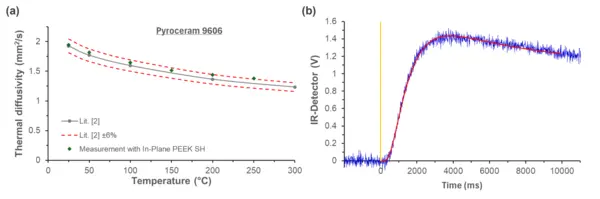
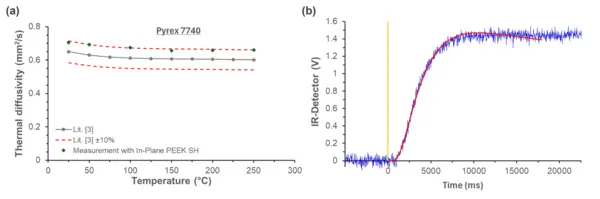
Figures 2a, 3a and 4a show the thermal diffusivity results obtained for the Cu, Pyroceram® 9606, and Pyrex® 7740 samples. During data analysis, the In-Plane model was fitted to the detector signal from the flash event (time origin) up to ten times the half time, t1/2, for the Cu and Pyroceram® 9606 samples (Figures 2b and 3b). The good agreement between the detector signal and the LFA model indicates the reliability of the results obtained. Compared to literature values, the deviations observed for the Cu sample are well below ±3% over the entire investigated temperature range.
For the Pyroceram® 9606 sample, a comparable measurement precision was observed at temperatures below 100°C. However, as the in-plane thermal diffusivity decreases, the measurement precision is slightly reduced. The results obtained exhibit deviations of approximately 6% relative to literature values for thermal diffusivities below 1.5 mm2/s.
For the Pyrex® 7740 sample, the fitting of the In-Plane model to the detector signal was limited to 18000 ms (Figure 4b). At longer measurement times, the influence of the sample holder becomes significantly more pronounced, resulting in poorer agreement between the model and the detector signal as well as increased measurement uncertainty. The deviation observed for this sample is approximately 10% with respect to the corresponding literature value.
Summary
The results demonstrate the suitability of the PEEK sample holder for in-plane measurements at temperatures up to 250°C. Thanks to its optimized design and the low thermal diffusivity of PEEK, in-plane LFA characterization of materials with thermal diffusivities even slightly below 1 mm2/s is achievable, significantly extending the applicability of LFA to in-plane measurements of low-diffusivity materials.