Introduction
Heat management is an important topic for a wide range of applications, and its relevance is continuously growing. This especially applies to modern high-power electronic and optoelectronic devices (5-G applications, high-speed computing, or high-power semiconductor chips), which generate significant heat within extremely small areas. To quickly dissipate heat, heat sinks/thermal coatings made of materials with high Thermal ConductivityThermal conductivity (λ with the unit W/(m•K)) describes the transport of energy – in the form of heat – through a body of mass as the result of a temperature gradient (see fig. 1). According to the second law of thermodynamics, heat always flows in the direction of the lower temperature.thermal conductivity must be positioned at the heat source (such as radiators, fans, heat sinks, etc.).
In search of optimal material candidates, diamond has emerged as a promising solution. Not only is diamond one of the the hardest material currently produced on an industrial scale, it also feature the highest Thermal ConductivityThermal conductivity (λ with the unit W/(m•K)) describes the transport of energy – in the form of heat – through a body of mass as the result of a temperature gradient (see fig. 1). According to the second law of thermodynamics, heat always flows in the direction of the lower temperature.thermal conductivity of any natural material known. At room temperature, its Thermal ConductivityThermal conductivity (λ with the unit W/(m•K)) describes the transport of energy – in the form of heat – through a body of mass as the result of a temperature gradient (see fig. 1). According to the second law of thermodynamics, heat always flows in the direction of the lower temperature.thermal conductivity can exceed 2000 W/(m·K), which is approximately four to five times higher than that of copper or silver. Combined with its exceptionally low coefficient of thermal expansion and its electrical insulating properties at room temperature, diamond is an outstanding material for advanced thermal management applications. When using diamond in thermal management, it is particularly crucial to accurately test its Thermal ConductivityThermal conductivity (λ with the unit W/(m•K)) describes the transport of energy – in the form of heat – through a body of mass as the result of a temperature gradient (see fig. 1). According to the second law of thermodynamics, heat always flows in the direction of the lower temperature.thermal conductivity. Diamond's ultra-high Thermal ConductivityThermal conductivity (λ with the unit W/(m•K)) describes the transport of energy – in the form of heat – through a body of mass as the result of a temperature gradient (see fig. 1). According to the second law of thermodynamics, heat always flows in the direction of the lower temperature.thermal conductivity and extremely high optical transparency pose significant challenges on precise measurements of the thermal performance. Consequently, the selection of thermal testing methods and instruments, along with testing techniques, becomes equally important.
In this context, Laser/Light Flash Analysis (LFA), a non-contact thermal measurement technique, is highly suited for evaluating the Thermal ConductivityThermal conductivity (λ with the unit W/(m•K)) describes the transport of energy – in the form of heat – through a body of mass as the result of a temperature gradient (see fig. 1). According to the second law of thermodynamics, heat always flows in the direction of the lower temperature.thermal conductivity of materials with high Thermal ConductivityThermal conductivity (λ with the unit W/(m•K)) describes the transport of energy – in the form of heat – through a body of mass as the result of a temperature gradient (see fig. 1). According to the second law of thermodynamics, heat always flows in the direction of the lower temperature.thermal conductivity. This application example will mainly introduce the method of testing samples with high Thermal ConductivityThermal conductivity (λ with the unit W/(m•K)) describes the transport of energy – in the form of heat – through a body of mass as the result of a temperature gradient (see fig. 1). According to the second law of thermodynamics, heat always flows in the direction of the lower temperature.thermal conductivity and transparent samples, such as diamond, using the NETZSCH LFA 717 HyperFlash® and the experimental techniques involved in the testing process.
Through-Plane Characterization
Figure 1 shows the Thermal DiffusivityThermal diffusivity (a with the unit mm2/s) is a material-specific property for characterizing unsteady heat conduction. This value describes how quickly a material reacts to a change in temperature.thermal diffusivity, the Specific Heat Capacity (cp)Heat capacity is a material-specific physical quantity, determined by the amount of heat supplied to specimen, divided by the resulting temperature increase. The specific heat capacity is related to a unit mass of the specimen.specific heat capacity, and the Thermal ConductivityThermal conductivity (λ with the unit W/(m•K)) describes the transport of energy – in the form of heat – through a body of mass as the result of a temperature gradient (see fig. 1). According to the second law of thermodynamics, heat always flows in the direction of the lower temperature.thermal conductivity results for a 2.69 mm thick diamond sample. It can be seen that the sample's Thermal DiffusivityThermal diffusivity (a with the unit mm2/s) is a material-specific property for characterizing unsteady heat conduction. This value describes how quickly a material reacts to a change in temperature.thermal diffusivity at room temperature is approximately 1100 mm²/s, while its Thermal ConductivityThermal conductivity (λ with the unit W/(m•K)) describes the transport of energy – in the form of heat – through a body of mass as the result of a temperature gradient (see fig. 1). According to the second law of thermodynamics, heat always flows in the direction of the lower temperature.thermal conductivity is around 2000 W/(m·K). The thermal conductivity of the diamond sample decreases rapidly with increasing temperature, due to the sharp increase in phonon-phonon scattering (Umklapp processes) [1]. At 300°C, the thermal conductivity of this sample drops below 1000 W/(m·K), indicating that the diamond's thermal conductivity is significantly affected by temperature changes. Table 1 details the measurement conditions.
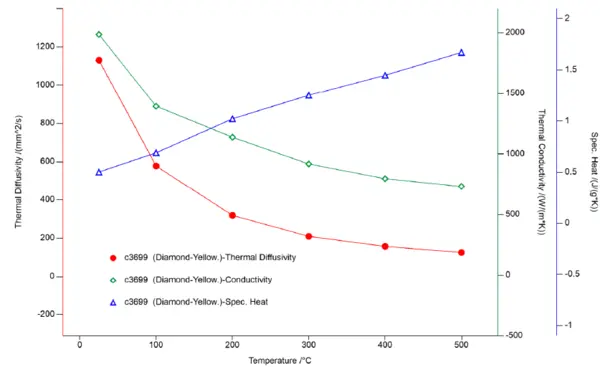
Table 1: LFA measurement conditions
| Sample | Diamond |
|---|---|
| Sample preparation | Sputtered with gold and coated with a thin graphite layer |
| Sample size | 10 mm; thickness: 2.69 mm |
| Sample holder | 4 samples square slot |
| Temperature range | RT to 500°C |
| Atmosphere | Nitrogen |
| Pulse width | 50 μs |
| Model | Transparent |
When analyzing materials with such high Thermal DiffusivityThermal diffusivity (a with the unit mm2/s) is a material-specific property for characterizing unsteady heat conduction. This value describes how quickly a material reacts to a change in temperature.thermal diffusivity using LFA, minimizing the light pulse length and its energy is essential to obtain accurate and reliable results at the required temperature. The LFA 717 combines an adjustable pulse width over a wide range from 10 to 1500 µs and a high-sensitivity detector and a data acquisition frequency of 2 MHz, ensuring accurate characterization of the thermal conductivity even for diamond samples.
Sample Preparation and its Influence
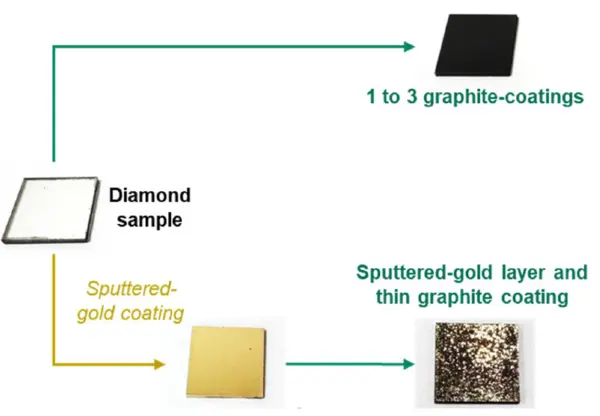
During LFA testing, samples are typically coated with graphite to enhance their surface absorption and emission capabilities for light radiation while reducing reflectivity (see Figure 2). For conventional samples, the influence of the graphite coating on the Thermal DiffusivityThermal diffusivity (a with the unit mm2/s) is a material-specific property for characterizing unsteady heat conduction. This value describes how quickly a material reacts to a change in temperature.thermal diffusivity results is negligible. However, for diamond – particularly single-crystal diamond with exceptionally high thermal conductivity – the impact of the graphite coating cannot be ignored. Excessively thick graphite coatings significantly lower the measured Thermal DiffusivityThermal diffusivity (a with the unit mm2/s) is a material-specific property for characterizing unsteady heat conduction. This value describes how quickly a material reacts to a change in temperature.thermal diffusivity. Conversely, an insufficient coating thickness is unable to completely absorb the flashlight, and light transmission into the sample (due to diamond's high light transmittance) compromises the quality of the detector signal and thus the accuracy of the analysis. An efficient solution regarding this is the deposition of a thin gold-sputtered coating on the diamond sample surface to make it effectively opaque, followed by a thin graphite coating to improve its radiation absorption and emission capabilities.
Measurements on Diamonds with Different Coatings
Table 2 presents the Thermal DiffusivityThermal diffusivity (a with the unit mm2/s) is a material-specific property for characterizing unsteady heat conduction. This value describes how quickly a material reacts to a change in temperature.thermal diffusivity of a single-crystal diamond sample with a thickness of 1.948 mm, comparing the effects of four surface coating methods: single-layer, double-layer, and triple-layer graphite coatings, as well as gold sputtering followed by thin graphite coating at room temperature. It can be observed that when graphite is directly coated onto the sample, each graphite layer increases the sample thickness by approximately 10 μm. The sample thickness increased by about 30 μm after three layers of graphite were coated. Correspondingly, the Thermal DiffusivityThermal diffusivity (a with the unit mm2/s) is a material-specific property for characterizing unsteady heat conduction. This value describes how quickly a material reacts to a change in temperature.thermal diffusivity of the diamond sample decreased with increasing graphite coating thickness. As expected, the combination of a thin sputtered-gold coating with a thin, not complete graphite layer minimizes the influence of the required surface coating on the analysis.
Table 2: Thermal DiffusivityThermal diffusivity (a with the unit mm2/s) is a material-specific property for characterizing unsteady heat conduction. This value describes how quickly a material reacts to a change in temperature.Thermal diffusivity at room temperature and sample thickness of the diamond sample after surface coating according to four methods. Original sample thickness before coating: 1.948 mm.
| Sample preparation | Thickness (mm) | Thermal DiffusivityThermal diffusivity (a with the unit mm2/s) is a material-specific property for characterizing unsteady heat conduction. This value describes how quickly a material reacts to a change in temperature.Thermal diffusivity (mm²/s) |
|---|---|---|
| Once graphite-coated | 1.960 | 1093.16 |
| Twice graphite coated | 1.969 | 1011.42 |
| 3 Times graphite coated | 1.978 | 731.84 |
| Sputtered-gold-layer + thin graphite coating | 1.956 | 1223.25 |
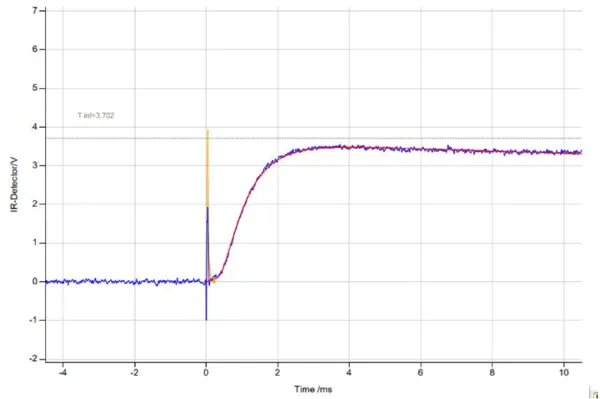
To verify the Thermal DiffusivityThermal diffusivity (a with the unit mm2/s) is a material-specific property for characterizing unsteady heat conduction. This value describes how quickly a material reacts to a change in temperature.thermal diffusivity results obtained, two additional diamond samples with different thicknesses (0.915 and 3.001 mm) were analyzed. The consistency of the Thermal DiffusivityThermal diffusivity (a with the unit mm2/s) is a material-specific property for characterizing unsteady heat conduction. This value describes how quickly a material reacts to a change in temperature.thermal diffusivity values for all three samples – all around 1240 mm²/s with a standard deviation within 3% – points out the high reproducibility of this analysis performed with the NETZSCH LFA 717 (see Table 3). Remarkably, the detector signals recorded for the three samples showed excellent agreement with the model-fitted curves as illustrated in Figure 3.
Table 3: Thermal DiffusivityThermal diffusivity (a with the unit mm2/s) is a material-specific property for characterizing unsteady heat conduction. This value describes how quickly a material reacts to a change in temperature.Thermal diffusivity of diamond samples with different thicknesses (with thin sputtered-gold coating and partial graphite layer).
| Sample | Thermal DiffusivityThermal diffusivity (a with the unit mm2/s) is a material-specific property for characterizing unsteady heat conduction. This value describes how quickly a material reacts to a change in temperature.Thermal diffusivity (mm²/s) |
|---|---|
| Diamond-0.915 mm | 1225.25 |
| Diamond-1.948 mm | 1223.25 |
| Diamond-3.001 mm | 1277.61 |
Conclusion
The measurements performed using the LFA 717 HyperFlash® demonstrate its excellent capability for accurately determining the thermal properties of highly challenging materials such as diamond, which combines ultra-high thermal conductivity with significant optical transparency. The results highlight that, when appropriate surface preparation and evaluation strategies are applied, reliable and highly reproducible data can be obtained even under demanding measurement conditions.
For such samples, a combined coating approach – initial gold sputtering followed by a thin graphite layer – was applied to ensure optimal signal quality in the curves of the temperature rise. This preparation enabled stable signal detection and significantly improved data quality. Based on the resulting signal behavior, the most suitable evaluation model (standard or transparent model) was selected, ensuring accurate determination of the Thermal DiffusivityThermal diffusivity (a with the unit mm2/s) is a material-specific property for characterizing unsteady heat conduction. This value describes how quickly a material reacts to a change in temperature.thermal diffusivity.
Overall, the LFA 717 proved to deliver high measurement precision and robustness, while offering flexible analysis options that allow reliable characterization of materials with extreme thermal and optical properties.