methods
Simultaneous Thermal Analysis (STA)
based on, e.g., ISO 11358, ASTM E793, DIN 51004, DIN 51006, DIN 51007
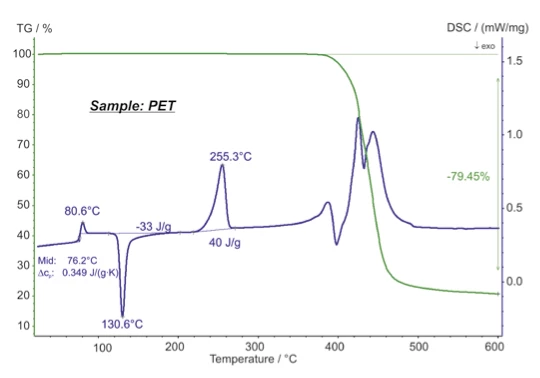
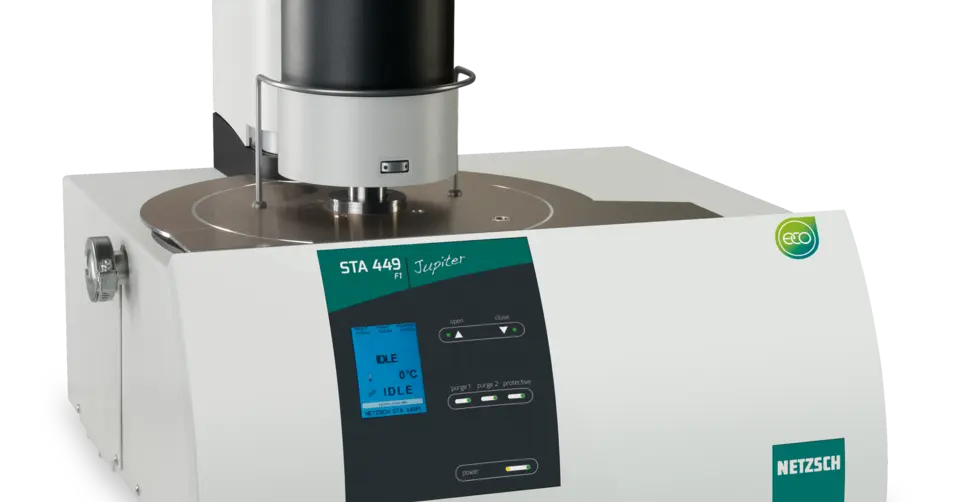
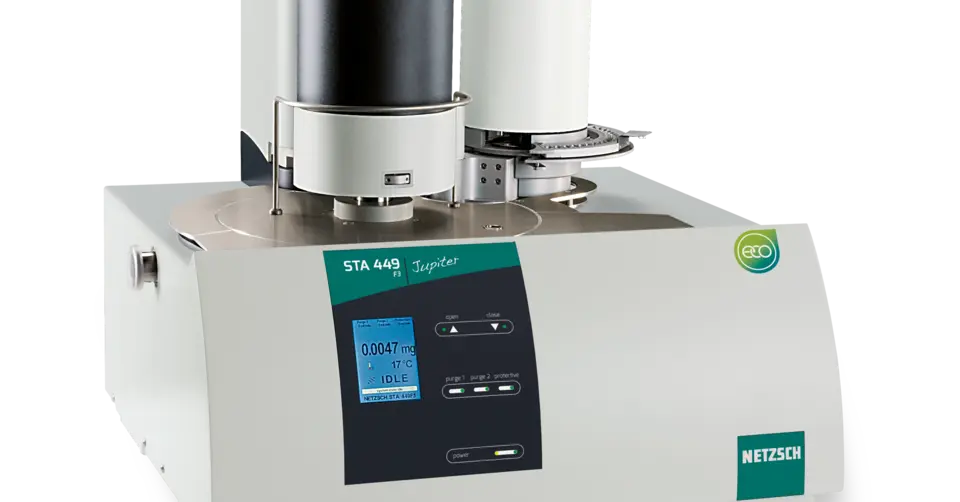
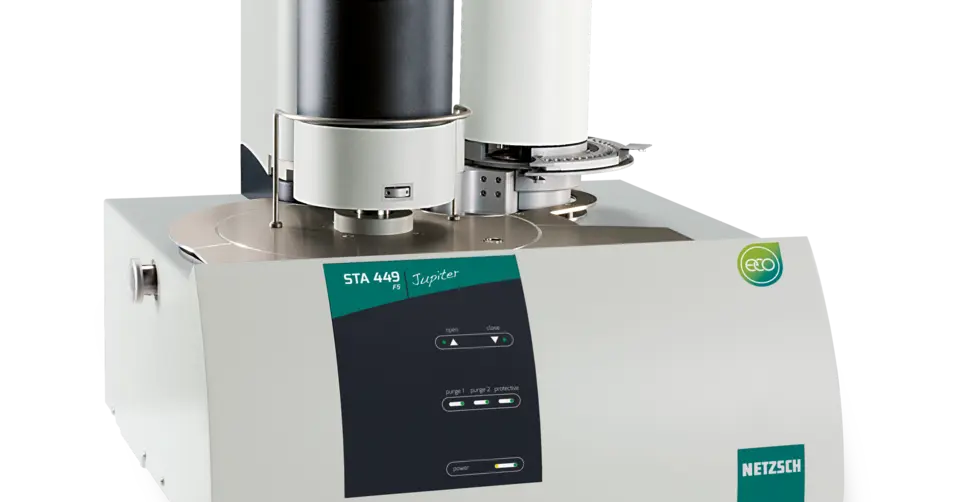
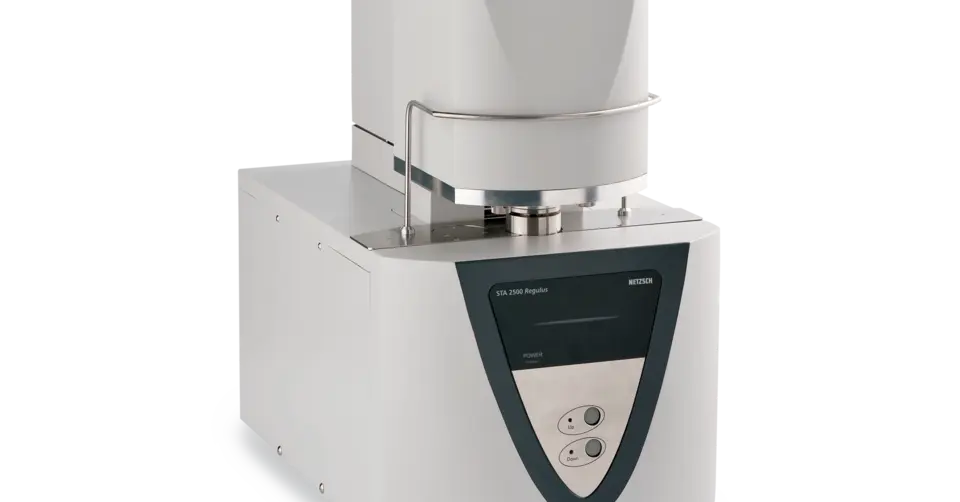
Simultaneous Thermal Analysis (STA) generally refers to the simultaneous application of Thermogravimetry (TGA) and Differential Scanning Calorimetry (DSC) to one and the same sample in a single instrument.
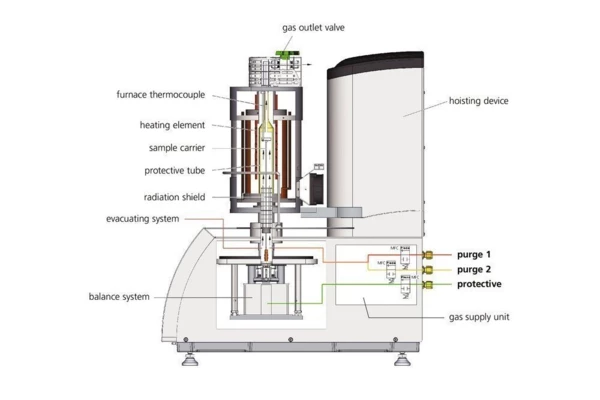
The advantages are obvious:
The test conditions are perfectly identical for the TGA and DSC signals (same atmosphere, gas flow rate, vapor pressure on the sample, heating rate, thermal contact to the sample crucible and sensor, radiation effect, etc.). Furthermore, sample throughput Is improved as more information can be gathered from each test run.
DSC Possibilities
- Melting Temperatures and EnthalpiesThe enthalpy of fusion of a substance, also known as latent heat, is a measure of the energy input, typically heat, which is necessary to convert a substance from solid to liquid state. The melting point of a substance is the temperature at which it changes state from solid (crystalline) to liquid (isotropic melt).Melting behavior
- CrystallizationCrystallization is the physical process of hardening during the formation and growth of crystals. During this process, heat of crystallization is released.crystallization behavior
- Solid-solid transitions
- PolymorphismPolymorphism is the ability of a solid material to form different crystalline structures (synonyms: forms, modifications).Polymorphism
- Degree of Crystallinity / Degree of CrystallinityCrystallinity refers to the degree of structural order of a solid. In a crystal, the arrangement of atoms or molecules is consistent and repetitive. Many materials such as glass ceramics and some polymers can be prepared in such a way as to produce a mixture of crystalline and amorphous regions.crystallinity
- Glass Transition TemperatureThe glass transition is one of the most important properties of amorphous and semi-crystalline materials, e.g., inorganic glasses, amorphous metals, polymers, pharmaceuticals and food ingredients, etc., and describes the temperature region where the mechanical properties of the materials change from hard and brittle to more soft, deformable or rubbery.Glass transitions
- Curing (Crosslinking Reactions)Literally translated, the term “crosslinking“ means “cross networking”. In the chemical context, it is used for reactions in which molecules are linked together by introducing covalent bonds and forming three-dimensional networks.Cross-linking reactions
- Oxidative stability
- Purity Determination
- Specific Heat Capacity (cp)Heat capacity is a material-specific physical quantity, determined by the amount of heat supplied to specimen, divided by the resulting temperature increase. The specific heat capacity is related to a unit mass of the specimen.Specific heat capacity
- Thermokinetics
TGA Possibilities
- Mass changes
- Thermal StabilityA material is thermally stable if it does not decompose under the influence of temperature. One way to determine the thermal stability of a substance is to use a TGA (thermogravimetric analyzer). Temperature stability
- OxidationOxidation can describe different processes in the context of thermal analysis.Oxidation/reduction behavior
- Decomposition reactionA decomposition reaction is a thermally induced reaction of a chemical compound forming solid and/or gaseous products. Decomposition
- Thermal Corrosion StudiesThermal corrosion or high-temperature corrosion is a chemical interaction of a material (typically a metal) with the surrounding gas atmosphere as a result of heating.Corrosion studies
- Compositional analysis
- Thermokinetics
Plastics: PET
Plastic bottles, textile fibers and films (for example, packaging for food) are well known applications of the polymer PET (polyethylene terephthalate). This STA measure-ment under nitrogen exhibits a step in the DSC signal below 100°C which is due to the Glass Transition TemperatureThe glass transition is one of the most important properties of amorphous and semi-crystalline materials, e.g., inorganic glasses, amorphous metals, polymers, pharmaceuticals and food ingredients, etc., and describes the temperature region where the mechanical properties of the materials change from hard and brittle to more soft, deformable or rubbery.glass transition. A corresponding increase in specific heat of 0.35 J/(g·K) was detected. The EndothermicA sample transition or a reaction is endothermic if heat is needed for the conversion.endothermic DSC peak at 81°C is due to RelaxationWhen a constant strain is applied to a rubber compound, the force necessary to maintain that strain is not constant but decreases with time; this behavior is known as stress relaxation. The process responsible for stress relaxation can be physical or chemical, and under normal conditions, both will occur at the same time. relaxation, the ExothermicA sample transition or a reaction is exothermic if heat is generated.exothermic peak at 131°C is due to CrystallizationCrystallization is the physical process of hardening during the formation and growth of crystals. During this process, heat of crystallization is released.crystallization and the EndothermicA sample transition or a reaction is endothermic if heat is needed for the conversion.endothermic peak at 255°C is due to melting. At temperatures above 360°C, the pyrolytic Decomposition reactionA decomposition reaction is a thermally induced reaction of a chemical compound forming solid and/or gaseous products. decomposition of the sample occurred with a total mass loss of 79.5%.