Introduction
Citric acid is a widely used tricarboxylic acid found in the food, pharmaceutical, and cosmetic industries, as well as in chemical applications such as chelating agents and bio-based polymer synthesis. Since it is frequently exposed to elevated temperatures during processing and storage, precise understanding of its Thermal StabilityA material is thermally stable if it does not decompose under the influence of temperature. One way to determine the thermal stability of a substance is to use a TGA (thermogravimetric analyzer). thermal stability, dehydration behavior, and Decomposition reactionA decomposition reaction is a thermally induced reaction of a chemical compound forming solid and/or gaseous products. decomposition pathway is essential to avoid unwanted loss of active substances or the release of gaseous Decomposition reactionA decomposition reaction is a thermally induced reaction of a chemical compound forming solid and/or gaseous products. decomposition products. Simultaneous thermal analysis coupled with evolved gas analysis provides a powerful tool to characterize not only the mass loss and associated heat effects, but also the chemical identity of the volatiles released, allowing reliable and unambiguous interpretation of the underlying thermal processes.
Measurement Conditions
Table 1: Measurement conditions
| Instrument | STA Jupiter® FT-IR INVENIO |
|---|---|
| Sample | Citric acid |
| Sample mass | 14 mg |
| Temperature range | 30 - 400°C |
| Heating rate | 20 K/min |
| Atmosphere | N2, 70 ml/min |
| Crucible | Pt, 85 μl with pierced lid |
Results and Discussion
The TGA-DSC curve in Figure 1 shows a multi-step thermal behavior of citric acid.
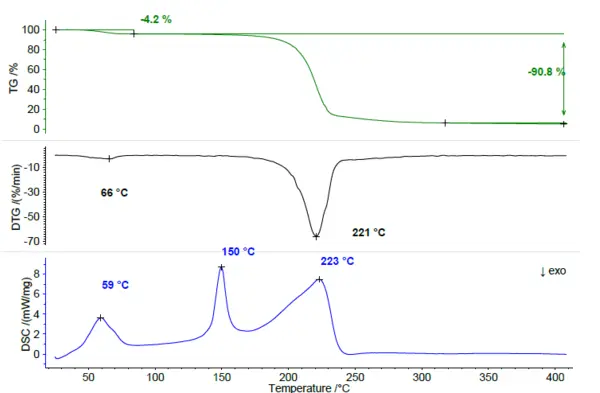
A small mass loss of 4.2 % occurs up to approximately 100°C, accompanied by a broad EndothermicA sample transition or a reaction is endothermic if heat is needed for the conversion.endothermic DSC signal with a peak temperature of 59°C and a DTG peak at 66°C. This step is attributed to the release of crystal water.
At 150°C, the DSC curve shows a sharp EndothermicA sample transition or a reaction is endothermic if heat is needed for the conversion.endothermic peak, which results from the melting of citric acid. Above this temperature, the material enters the thermal degradation region. The main Decomposition reactionA decomposition reaction is a thermally induced reaction of a chemical compound forming solid and/or gaseous products. decomposition step occurs between approximately 190°C and 240°C and results in a major mass loss of 90.8 %. The DTG curve shows the maximum Decomposition reactionA decomposition reaction is a thermally induced reaction of a chemical compound forming solid and/or gaseous products. decomposition rate at 221°C, while the DSC curve displays a strong EndothermicA sample transition or a reaction is endothermic if heat is needed for the conversion.endothermic peak at 223°C. This close agreement between DTG and DSC confirms that the largest mass-loss process is directly linked to an EndothermicA sample transition or a reaction is endothermic if heat is needed for the conversion.endothermic Decomposition reactionA decomposition reaction is a thermally induced reaction of a chemical compound forming solid and/or gaseous products. decomposition reaction.
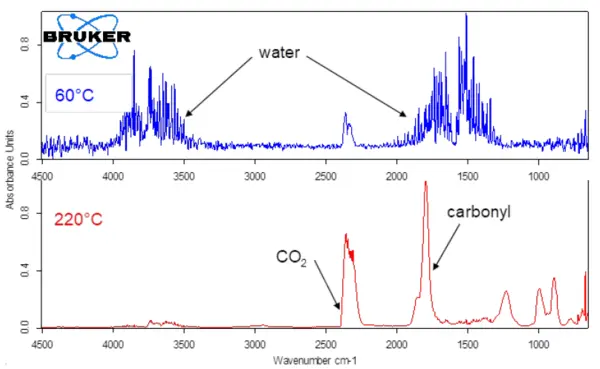
The TGA-DSC data provide clear information about the temperature range, mass loss, and thermal character of the events. However, these data alone cannot identify the chemical nature of the released gases. For this reason, coupling thermal analysis with FT-IR spectroscopy of the evolved gas phase is essential. The FT-IR spectrum recorded at 60 °C, corresponding to the first mass-loss step, shows the characteristic rotational-vibrational fine structure of gaseous water in the regions around 3500-4000 cm-¹ and 1300-2000 cm-¹, confirming that the initial low-temperature mass loss is due to physically or loosely bound water rather than to any Decomposition reactionA decomposition reaction is a thermally induced reaction of a chemical compound forming solid and/or gaseous products. decomposition reaction, see Figure 2. In contrast, the FT-IR spectrum recorded at 220°C, which corresponds to the major mass-loss step, reveals two dominant absorption features, a doublet band near 2300-2360 cm-¹ characteristic of carbon dioxide, and a strong, sharp band near 1750-1800 cm-¹ assigned to carbonyl stretching vibrations. These signals demonstrate that the main Decomposition reactionA decomposition reaction is a thermally induced reaction of a chemical compound forming solid and/or gaseous products. decomposition step is driven by the decarboxylation of the citric acid molecule, with simultaneous formation of carbonyl-containing fragments.
Summary
The thermal characterization of citric acid by simultaneous TGA-DSC combined with FT-IR gas-phase analysis reveals a three-step thermal profile consisting of an initial loss of residual moisture, melting and a major decarboxylation-driven decomposition above approximately 200°C. The coupling of thermal analysis and evolved gas data by FT-IR proved essential to correctly assign each thermal event to a specific physical or chemical process, providing a solid basis for defining safe processing and storage temperature limits for citric acid in industrial applications.