Introduction
OxidationOxidation can describe different processes in the context of thermal analysis.Oxidation processes are of central importance in materials science, as they influence the long-term stability, reactivity, and performance of metals, alloys, and ceramics. Exposure to oxygen can lead to the formation of oxide layers, phase transformations, or even degradation of structural integrity. The kinetics and mechanisms of OxidationOxidation can describe different processes in the context of thermal analysis.oxidation depend heavily on temperature, oxygen partial pressure, and microstructural characteristics such as grain size and porosity.
Simultaneous Thermal Analysis (STA), in particular thermogravimetry (TGA), provides a flexible and reliable means of studying such processes. A key advantage is the availability of different TGA crucible geometries, which can be selected with the specific requirements of the sample in mind, whether powder, bulk, or irregular material. The top-loading design enables easy placement of the sample on the microbalance and allows highly sensitive mass-change detection under welldefined conditions. The direction of the gas flow in the STA, from bottom to top, ensures a homogeneous atmosphere around the sample (see figure 1).
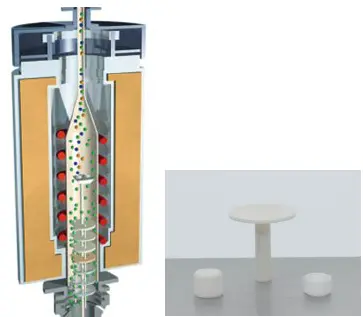
Careful selection of experimental parameters, including atmospheric composition, gas flow rate, heating rate, and sample geometry, remains critical to obtaining meaningful and reproducible results. These conditions directly influence the OxidationOxidation can describe different processes in the context of thermal analysis.oxidation kinetics observed and the stability of the oxide phases formed.
Measurement Conditions
Table 1 details the measurement conditions.
Table 1: Measurement conditions
| Instrument | STA Jupiter® series |
|---|---|
| Furnace | Rh furnace |
| Sample carrier | TGA pin, type S |
| Crucibles | Al2O3 crucible with pierced lid, Al2O3 crucible open, Al2O3 plate (see figure 1) |
| Sample mass | 10 mg (Cu powder or plate) |
| Gas flow | 70 ml/min |
Temperature program | RT-800°C, Ar atmosphere, 10 min isotherm in Ar atmosphere, 10 min isotherm in Ar + 14%O2, 10 min isotherm in Ar |
Results and Discussion
In this study, the OxidationOxidation can describe different processes in the context of thermal analysis.oxidation behavior of pure copper was studied in the STA using different crucible geometries (see figure 1). For all measurements, the same sample amount of about 10 mg was used. For the complete OxidationOxidation can describe different processes in the context of thermal analysis.oxidation which follows the equation
2 Cu + O2 → 2 CuO
After heating the samples in an inert atmosphere to 800°C and keeping them IsothermalTests at controlled and constant temperature are called isothermal.isothermal for 10 minutes, the atmosphere was switched to a 14% oxygen-containing atmosphere. This atmospheric change caused an immediate mass increase; see figure 2. At first, a first-order solid-gas reaction between O2 and Cu was initiated, which can be identified by a rather steep slope in the mass increase. After some minutes, the reaction speed decreased, and the reaction turned into a diffusion-controlled second-order reaction.
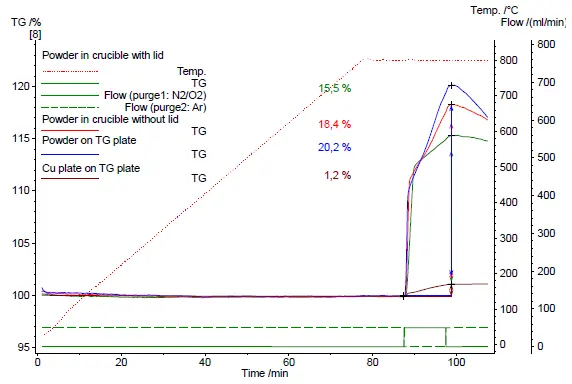
After 10 minutes of treatment under oxidizing conditions, the atmosphere was switched back to an argon atmosphere. The oxidizing reaction stopped immediately, and the thermal reduction started, causing an immediate mass decrease. In the short time interval, neither OxidationOxidation can describe different processes in the context of thermal analysis.oxidation nor reduction were complete. However, a clear influence of the geometry used was visible. Less OxidationOxidation can describe different processes in the context of thermal analysis.oxidation was observed for the setup with the sample in the crucible with pierced lid (green curve), as access to the sample by oxygen was hindered most. A clear increase in OxidationOxidation can describe different processes in the context of thermal analysis.oxidation behavior was already seen when no lid was used (red curve). The best results were obtained when the sample powder was placed directly as a thin layer on the Al2O3 plate (blue curve). Within 10 minutes under oxidizing conditions, a mass increase of more than 20% was detected.
As a fourth experiment, a sheet metal copper sample was also put on the plate and exposed to the same conditions (purple curve). In this case, a mass increase of only 1.2% was found, due to the smaller active surface and the formation of a passivation layer. Here, the process is diffusion-controlled from the beginning. More details can be seen in the zoomed view in figure 3.
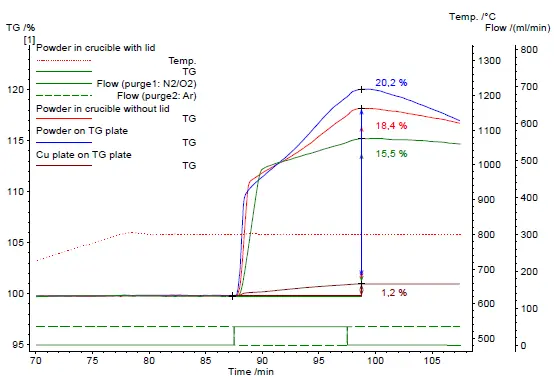
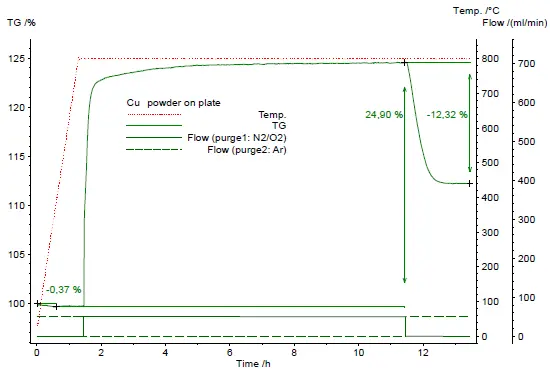
Figure 4 depicts the OxidationOxidation can describe different processes in the context of thermal analysis.oxidation of the copper powder on the plate geometry with extended reaction times. After 10 h, the mass increase nearly reached the stoichiometric value and OxidationOxidation can describe different processes in the context of thermal analysis.oxidation was complete. The subsequent thermal reduction caused a mass loss of 12.3%.
Summary
The choice of the sample material, its geometry, and the measurement parameters have significant influence on the OxidationOxidation can describe different processes in the context of thermal analysis.oxidation behavior observed. The high flexibility in comsample carriers, crucible geometries and measurement conditions of the STA Jupiter® series enables adaptation to diverse measurement scenarios, ensuring that reliable and reproducible insights into OxidationOxidation can describe different processes in the context of thermal analysis.oxidation mechanisms can be obtained.