Introduction
Glucose is a sugar that plays a central role as an energy supplier for most living organisms. It is involved in the cellular respiration process. For humans, glucose is a primary energy source for the brain, red blood cells, and muscles during intense activity. Proper regulation of glucose levels is essential for health, as both high and low blood glucose can lead to serious conditions, such as diabetes and hypoglycemia.
Glucose exists in several forms. L- and D-glucose have the same chemical formula, but differ structurally: one is the mirror image of the other. Furthermore, D-glucose exists under two different forms called alpha (α) and beta (β), which can interconvert from one to the other. D-glucose is the naturally occurring form of glucose in living organisms, particularly in plants and animals.
The kinetics of glucose Decomposition reactionA decomposition reaction is a thermally induced reaction of a chemical compound forming solid and/or gaseous products. decomposition are significant because they help us understand how glucose breaks down over time under different conditions; such knowledge is vital in various biological, industrial, and medical contexts.
In the following, thermogravimetric measurements are used to carry out kinetic studies of the Decomposition reactionA decomposition reaction is a thermally induced reaction of a chemical compound forming solid and/or gaseous products. decomposition reaction of α-D-glucose.
Measurement Conditions
To this end, four samples with an initial mass between 2.7 and 2.9 mg were prepared in aluminum oxide crucibles. Each crucible was placed in the thermobalance and subjected to a controlled heating run under a dynamic flow of nitrogen. Each sample was measured at a different heating rate between 1 and 10 K/min.
TGA Measurements
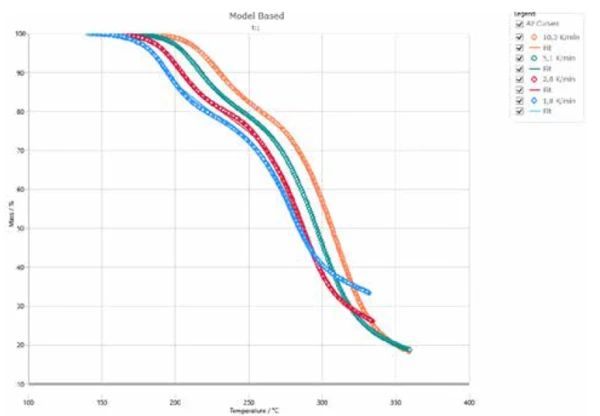
Figure 1 shows the curves resulting from the thermogravimetric measurements at the different heating rates.
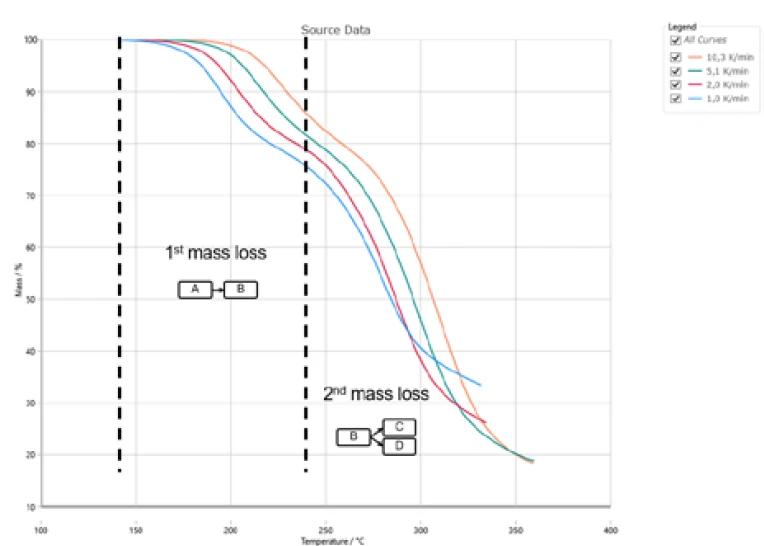
Two mass-loss steps are detected. During the first one, the curves run parallel to each other. Increasing the heating rate leads to a shift in the detected effects toward higher temperatures, but has no influence on the amount of mass loss. Consequently, the reaction step will have the form:
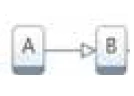
where A and B are the reactants and the products, respectively.
In contrast, the second mass-loss step results in different residual masses, dependent on the heating rate. This dependence of the weight loss on the heating rate indicates that this Decomposition reactionA decomposition reaction is a thermally induced reaction of a chemical compound forming solid and/or gaseous products. decomposition stage contains at least two competing reactions that run simultaneously. This corresponds to the following reaction steps:
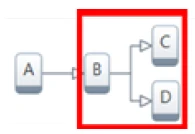
where C and D are the products of both competitive reactions.
Kinetic Analysis
The reaction kinetic was analyzed with the Kinetics Neo software, using the three-step reaction model described above.
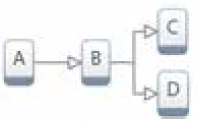
For each of those steps, the software calculates the kinetic parameters, i.e., reaction type, activation energy and order of reaction, for a specific reaction type. An autocatalysis reaction was selected for the first reaction step, and nth order reactions for both competitive steps.
Table 1 displays the kinetic parameters determined for the calculation; and figure 2 the curves calculated with these parameters compared to the measured curves.
Table 1: Kinetic analysis of α-D-glucose Decomposition reactionA decomposition reaction is a thermally induced reaction of a chemical compound forming solid and/or gaseous products. decomposition
| A → B | B → C | B → D | |
|---|---|---|---|
| Reaction type | Autocatalysis | nth order | nth order |
| Equation | see [1] | see [2] | see [3] |
| Activation energy | 96.53 | 1.13 | 182.28 |
| Log(PreExp) | 7.69 | -3.39 | 14.45 |
| Reaction order n | 1.76 | 13.96 | 1.96 |
| Log(AutocatPreExp) | 0.69 | - | - |
| Contribution | 0.28 | 0.36 | 0.37 |



The calculated and the measured curves accord very well, with a coefficient of correlation higher than 0.999.
Prediction of the Glucose Decomposition
Based on the determined kinetics parameters, Kinetics Neo is capable of simulating the Decomposition reactionA decomposition reaction is a thermally induced reaction of a chemical compound forming solid and/or gaseous products. decomposition behavior of glucose for any time/temperature condition, thus predicting its stability and shelf life.
An example is given in figure 3, which depicts the simulation of the Decomposition reactionA decomposition reaction is a thermally induced reaction of a chemical compound forming solid and/or gaseous products. decomposition process for different isotherms between 20°C and 200°C. As expected, the higher the temperature, the faster the reaction. A conversion of 1 corresponds to completion of the reaction. This state is reached after approx. 20 months at 200°C.
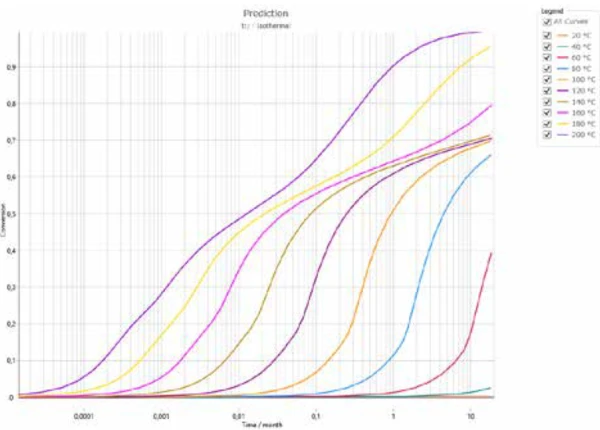
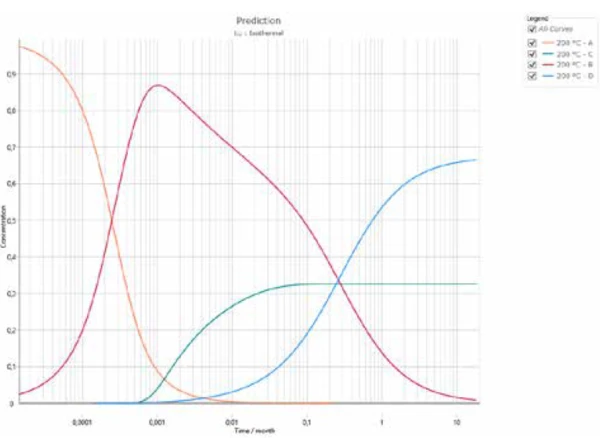
Figure 4 shows the corresponding concentrations of the reactants A and products B, C and D that are produced during the reaction.
Conclusion
The decomposition kinetics of α-D-glucose were investigated using thermogravimetric measurements and the Kinetics Neo software.
The Kinetics Neo software allows for simulating the material behavior for any time/temperature conditions, and is therefore an effective tool for predicting stability and shelf life.