Introduction
Carbon/carbon (C/C) and carbon/carbon-silicon carbide (C/C-SiC) fiber composites are leading high-performance materials engineered for extreme thermal and mechanical environments. Their defining features include an outstanding strength-to-weight ratio and exceptional stability at high temperatures. The C/C material class is primarily used in aerospace applications such as reentry heat shields, while C/C-SiC is employed in highperformance braking systems for aircraft, race cars, and high-speed trains [1]. Additionally, the excellent biocompatibility and inertness of C/C composites make them invaluable for niche medical fields, such as orthopedic implants and prosthetic heart valve components.
A key property of both material classes is their Thermal ConductivityThermal conductivity (λ with the unit W/(m•K)) describes the transport of energy – in the form of heat – through a body of mass as the result of a temperature gradient (see fig. 1). According to the second law of thermodynamics, heat always flows in the direction of the lower temperature.thermal conductivity, which is significantly higher than conventional structural ceramics and is crucial for heat management. Highly graphitized C/C composites can exhibit in-plane Thermal ConductivityThermal conductivity (λ with the unit W/(m•K)) describes the transport of energy – in the form of heat – through a body of mass as the result of a temperature gradient (see fig. 1). According to the second law of thermodynamics, heat always flows in the direction of the lower temperature.thermal conductivity comparable to, or even higher than, refractory metals like Tungsten and Tantalum [2]. While generally exhibiting lower conductivity due to the SiC matrix, C/C-SiC composites still offer significant performance advantages over most ceramics. This highly efficient heat dissipation from thermally stressed structures prevents local overheating, thermal stresses, and potential structural failure. The crucial combination of mechanical stability, low thermal expansion, and effective heat removal makes C/C and C/C-SiC composites especially promising for demanding future energy applications, such as components within Generation IV and fusion reactor systems [3].
Thermal Conductivity Measurements
The precise determination of Thermal ConductivityThermal conductivity (λ with the unit W/(m•K)) describes the transport of energy – in the form of heat – through a body of mass as the result of a temperature gradient (see fig. 1). According to the second law of thermodynamics, heat always flows in the direction of the lower temperature.thermal conductivity in the high-temperature range can only be achieved using laser flash analysis (LFA) in combination with differential scanning calorimetry (DSC) and dilatometry (DIL) or thermomechanical analysis (TMA). All of these methods contribute to the calculation of the Thermal ConductivityThermal conductivity (λ with the unit W/(m•K)) describes the transport of energy – in the form of heat – through a body of mass as the result of a temperature gradient (see fig. 1). According to the second law of thermodynamics, heat always flows in the direction of the lower temperature.thermal conductivity (λ) according to the following equation (equation 1, [4]):

The Thermal DiffusivityThermal diffusivity (a with the unit mm2/s) is a material-specific property for characterizing unsteady heat conduction. This value describes how quickly a material reacts to a change in temperature.thermal diffusivity, α, is determined by means of LFA; the Specific Heat Capacity (cp)Heat capacity is a material-specific physical quantity, determined by the amount of heat supplied to specimen, divided by the resulting temperature increase. The specific heat capacity is related to a unit mass of the specimen.specific heat capacity, Specific Heat Capacity (cp)Heat capacity is a material-specific physical quantity, determined by the amount of heat supplied to specimen, divided by the resulting temperature increase. The specific heat capacity is related to a unit mass of the specimen.cp, by means of DSC; and the temperature-dependent DensityThe mass density is defined as the ratio between mass and volume. density change, ρ, is calculated by means of thermal expansion based on dilatometer or TMA measurements. All properties are dependent upon temperature (T) and must be characterized across the entire temperature range of interest to accurately determine the Thermal ConductivityThermal conductivity (λ with the unit W/(m•K)) describes the transport of energy – in the form of heat – through a body of mass as the result of a temperature gradient (see fig. 1). According to the second law of thermodynamics, heat always flows in the direction of the lower temperature.thermal conductivity. This is a major challenge, particularly in the high-temperature range of up to 2000°C and above.
Experimental
Samples of C/C and C/C-SiC were examined using the LFA 427 and the DSC 500 Pegasus® in combination with thermal expansion data up to 1300°C and just under 2000°C, respectively. The measurement parameters for the LFA and DSC measurements are detailed in tables 1 and 2.
Table 1: LFA measurement parameters
| LFA model | LFA 427 with 2000°C furnace |
|---|---|
| Sample | 1 x C/C, 1 x C/C-SiC |
Sample dimensions | Ø12.7 mm; thickness approx. 3 mm |
| Sample holder | 12.7 mm graphite |
| Coating | None |
| Atmosphere | Argon (120 ml/min) |
Temperature points | C/C-SiC: RT/400/1000/1300 C/C: RT/400/1000/1300/1500/1700/1990 |
Table 2: DSC measurement parameters
DSC model and furnace | DSC 500 Pegasus® with Rhodium furnace |
|---|---|
Sample carrier/ thermocouple | DSC cp / Typ S |
| Samples | 1 x C/C, 1 x C/C-SiC |
| Sample mass | C/C: 38.000 mg C/C-SiC: 59.713 mg |
| Crucible | Graphite with lid and Al2O3 washer |
| Atmosphere | Argon (70 ml/min) |
Temperature program | C/C: RT - 1400°C at 20 K/min C/C-SiC: RT - 1300°C at 20 K/min |
Calibration standard | C/C-SiC: RT/400/1000/1300 POCO Graphite |
Results and Discussion
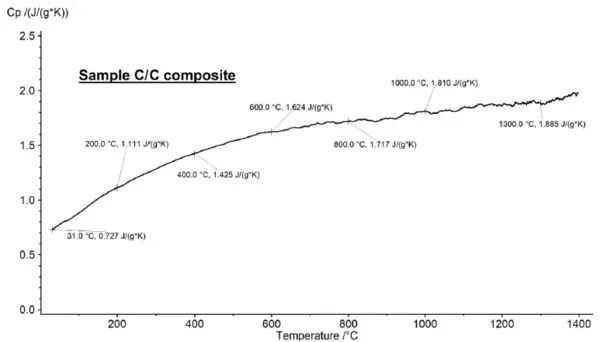
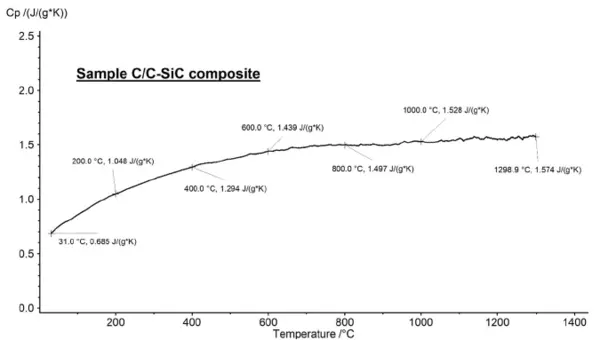
Figures 1 and 2 show the Specific Heat Capacity (cp)Heat capacity is a material-specific physical quantity, determined by the amount of heat supplied to specimen, divided by the resulting temperature increase. The specific heat capacity is related to a unit mass of the specimen.specific heat capacity of the C/C and C/C-SiC samples at temperatures ranging from room temperature to ~1400°C in an argon atmosphere. In accordance with the Debye theory, the Specific Heat Capacity (cp)Heat capacity is a material-specific physical quantity, determined by the amount of heat supplied to specimen, divided by the resulting temperature increase. The specific heat capacity is related to a unit mass of the specimen.cp values increase with rising temperature. Following the measurements, a mass loss of approximately 0.15% was observed for the C/C sample and approximately 0.06% for the C/C-SiC sample.
It should be noted that the Specific Heat Capacity (cp)Heat capacity is a material-specific physical quantity, determined by the amount of heat supplied to specimen, divided by the resulting temperature increase. The specific heat capacity is related to a unit mass of the specimen.cp determination could also theoretically be carried out using LFA. However, the anisotropic structure of the samples makes this unsuitable.
2The DSC measurements were carried out at 1300°C and 1400°C, respectively. Graphite crucibles are generally used when examining carbon samples. Additionally, Al₂O₃ discs are positioned between the graphite crucible and the Pt/Rh sample holder to protect the sensor and prevent interactions between the materials at high temperatures. Use of the graphite crucible is guaranteed and technically approved up to 1400°C. At higher temperatures, however, interactions between graphite and Al₂O₃ are to be expected. To calculate the thermal conductivity up to 2000°C, the Specific Heat Capacity (cp)Heat capacity is a material-specific physical quantity, determined by the amount of heat supplied to specimen, divided by the resulting temperature increase. The specific heat capacity is related to a unit mass of the specimen.specific heat capacity of the C/C sample was extrapolated from the DSC measurement data up to 1400°C.
Figures 3 and 4 depict the thermophysical properties of the two samples.
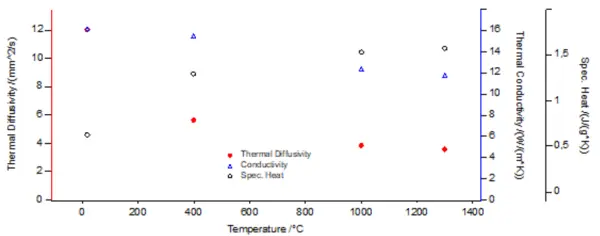
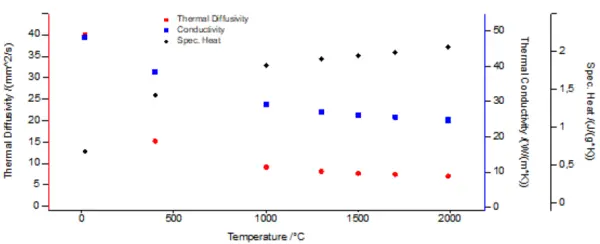
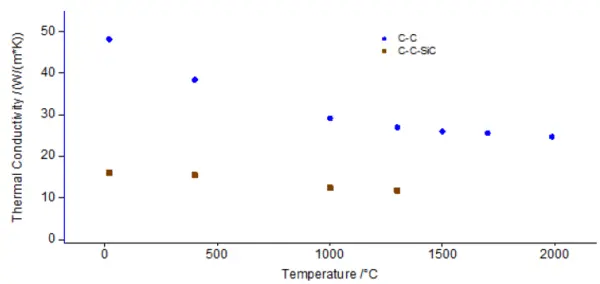
As expected for most materials due to the stronger phonon-phonon interaction at higher temperatures, both the temperature and thermal conductivity decrease with increasing temperature in both samples.
Since the Thermal DiffusivityThermal diffusivity (a with the unit mm2/s) is a material-specific property for characterizing unsteady heat conduction. This value describes how quickly a material reacts to a change in temperature.thermal diffusivity, α, depends on the sample thickness, d, among other things (see equation 2, [1]), the values were corrected using data on thermal expansion.
If the thermal expansion is not corrected, an increased error must be expected at higher temperatures.

To calculate the thermal conductivity, the Specific Heat Capacity (cp)Heat capacity is a material-specific physical quantity, determined by the amount of heat supplied to specimen, divided by the resulting temperature increase. The specific heat capacity is related to a unit mass of the specimen.specific heat capacity from the DSC measurements (partially extra-polated) and the temperature-dependent DensityThe mass density is defined as the ratio between mass and volume. density via thermal expansion were taken into account (assuming an isotropic body). The LFA signals were evaluated using the standard Cape-Lehman model for homogeneous and isotropic materials.
Figure 5 shows a comparison of the thermal conductivity of the two samples. The C/C sample exhibits significantly higher values than the C/C-SiC sample.
Summary
Precise determination of the thermal conductivity in the high-temperature range poses several challenges and requires selection of the appropriate measurement methods. The structure of the samples must also be considered. The example of the C/C and C/C-SiC high-performance materials shows that the LFA 427 and the DSC 500 Pegasus®, along with the thermal expansion, are indispensable for determining the thermal conductivity in the high-temperature range, as is the trio of LFA, DSC, and DIL/TMA.