Introduction
Carbon dioxide (CO2), the main greenhouse gas, is closely related to global warming and climate change due to combustion of fossil fuels, for example, in power plants. Necessary actions have to be taken to reduce the environmental impact of CO2.
CO2 from fossil fuels is mainly released through flue gas at higher temperatures, typically above 350°C. Due to the high temperature of the gas, most of the conventional physical adsorbents cannot be used because of the decrease in physical adsorption with increasing temperature. By cooling down the temperature of CO2 in the flue gas, physical adsorbents could be employed but would result in longer desorption cycles.
To overcome this limitation, the application of chemical sorbents (liquid or solid) at higher temperatures could be the key. Those materials directly absorb CO2 at high temperatures; no cooling of the gas is required; and an efficient separation of gas mixtures can be realized.
Typical high-temperature CO2 chemical adsorbents mainly include ammonia adsorbents, calcium-based adsorbents and lithium-based adsorbents [1]. Lithiumbased adsorbents offer the possibility to store and transport CO2 due to the reaction process which converts CO2 from the gas state to the solid state [2].
Among these alkali metal ceramic adsorbents, Na2ZrO3, which is also in the alkali metal group, has lower preparation cost, faster adsorption capacity, and higher adsorption temperature. Therefore, the study of Na2ZrO3 has attracted the attention of many investigators.
The adsorption reaction process of Na2ZrO3 with CO2 is shown in the following Eq.(1) [4-7]:
Na2ZrO3 + CO2 ⇆ Na2CO3 + ZrO2 (1)
The adsorption temperature of CO2 by Na2ZrO3 is in the range of 400°C to 800°C [4-6]. When the temperature is lower than 800°C, the reaction proceeds spontaneously and shifts to the side of the products, and Na2ZrO3 reacts with CO2 to form Na2CO3. Vice versa, with temperatures higher than 800°C, the reaction proceeds in the reverse direction, and the Decomposition reactionA decomposition reaction is a thermally induced reaction of a chemical compound forming solid and/or gaseous products. decomposition of Na2CO3 releases CO2 and re-forms Na2ZrO3. The reversible reaction enables the adsorption and desorption of CO2 in a cyclic manner.
In this work, the adsorption-desorption properties of Na2ZrO3 for CO2 were investigated and the effects of the preparation method of Na2ZrO3 were compared.
Experimental
The CO2 cyclic adsorption-desorption performance (measurement program in figure 1) was tested with an STA 2500 Regulus by placing about 10 mg of adsorbent in an alumina crucible and heating it from room temperature to 850°C at a heating rate of 20 K/min under a pure N2 atmosphere (gas flow 100 ml/min), holding it IsothermalTests at controlled and constant temperature are called isothermal.isothermal for 10 minutes to remove impurities from the sample, and then cooling it down to 650°C at 20 K/min. When the temperature reached 650°C, the atmosphere was switched to a N2/CO2 mixture which contained 15% CO2.

The adsorption reaction was carried out in an IsothermalTests at controlled and constant temperature are called isothermal.isothermal segment for 30 min. Afterwards, the atmosphere was switched back to pure N2 and the sample was heated to 850°C at 20 K/min. Desorption was characterized in an IsothermalTests at controlled and constant temperature are called isothermal.isothermal segment for 10 minutes at 850°C. The stability of the adsorbent was tested by performing that temperature program 10 times.
The different sample preparation possibilities for Na2ZrO3 are depicted in table 1.
Table 1: Sample preparation of Na2ZrO3.
| Sample | Synthesis Method | Drying Method |
|---|---|---|
| WM-HD | wet-mixing method (WM) | heated-drying (HD) |
| WM-FD | wet-mixing method (WM) | freeze-drying (FD) |
| SG-HD | sol-gel method (SG) | heated-drying (HD) |
| SG-FD | sol-gel method (SG) | freeze-drying (FD) |
Results and Discussion
Figure 2 shows the TGA curve of the different Na2ZrO3 samples synthesized by methods. It can be seen that the mass of each curve significantly increased while CO2 was present as a reaction partner. After CO2 was removed from the system, the mass decreased again. When the reaction reached the eighth cycle, the adsorption performance of the four adsorbents stabilized and remained comparable with the ninth and tenth cycle. It can be seen that the Na2ZrO3 obtained by the wet mixing method (WM-HD, green; and WM-FD, red) has better adsorption performance than the samples synthesized by the sol-gel method. The adsorption amounts of the four adsorbents were in the following order from the largest to the smallest: WM-HD (18.7%) > WM-FD (17.1%) > SG-FD (16.6%) > SG-HD (15.7%).
When deriving the TGA curve, shown in figure 2, the mass-loss rate or DTG curve can be obtained, which indicates the change in the rate of weight change with respect to temperature/time. Those curves represent the CO2 adsorption rate for the different synthesized conditions of Na2ZrO3.
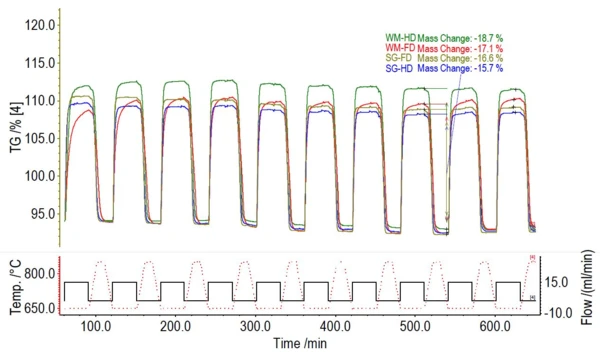
Figure 3 depicts the DTG curve of the CO2 adsorption of the four adsorbents in the eighth cycle. From the figure, it can be seen that the adsorption rates of adsorbents have, in general, the same trend. However, SG-FD shows the highest adsorption rate compared to the other three samples. Besides that, the rates for SG-HD and WM-HD are similar and sample WM-FD shows the lowest adsorption rate. The Na2ZrO3 adsorbent was synthesized by wet-mixing and sol-gel methods, followed by freeze-drying and heated-drying. It can be speculated that the method of sol-gel mixing and freeze-drying is more suitable for the formation of porous structure, and a higher specific surface area could be obtained through this synthetic approach.

Conclusion
The NETZSCH STA 2500 Regulus can be used to investigate the adsorption properties of different materials. In this example, four different synthesized Na2ZrO3 samples were investigated, and the CO2 adsorption properties were characterized. It can be assumed that the synthesis route using the sol-gel method and subsequent freeze-drying leads to a significantly higher surface reactivity.
By understanding the relationship between synthesis and adsorption properties, the optimum adsorption performance for an individual application can be considered and adjusted accordingly.