Introduction
The use of high-purity chemicals and materials is essential for reliable and consistent results. In numerous research and industrial applications, such as polymer analysis, the pharmaceutical industry or materials science, the precise detection of even the smallest of mass losses is of critical importance. To meet even the highest purity requirements, accurate quality control is key – and this is precisely where thermogravimetry or simultaneous thermal analysis comes into play. Thermogravimetry (TGA) is a precise and sensitive analytical method that is used, for example, to determine composition. Typically, a sample mass of 20 to 30 mg is used for a standard measurement.
To detect the smallest traces of a substance, the Residuum Value function, which is integrated into the NETZSCH Proteus® software, can be used (see corresponding application note AN 182). However, this method does not provide any conclusive results as to whether the sample exhibits multiple mass-loss steps.
An alternative approach is to use the highest possible sample mass at the beginning of the measurement in order to increase the absolute mass loss. When using standard crucibles (85 μl) to determine small mass losses of around 0.01%, one quickly encounters limitations due to the low crucible volume.
To optimize analytical accuracy and methodological flexibility, NETZSCH offers a wide range of alumina crucibles suitable for the broadest possible temperature range, with varying volumes from 85 μl to 10 ml (see figure 1). Larger crucible volumes are particularly well suited for detecting minimal mass losses, as they allow for a higher absolute sample mass.

Experimental Section & Results
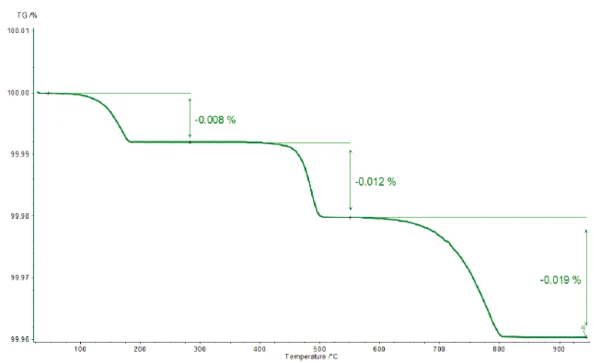
To demonstrate that mass-loss steps of approximately 0.01% can be detected using the NETZSCH STA, an alumina crucible (85 μl) filled with 9.96 mg of calcium oxalate monohydrate (CaC₂O₄·H₂O) was placed into a 10-ml Al₂O₃ beaker that had previously been filled with 15.5 g of Al₂O₃ spheres. Those spheres were used to set up a model system with only a small mass loss (figure 2). Upon heating calcium oxalate monohydrate, three successive mass-loss steps can be detected: first, the release of water (i), followed by the release of CO (ii), and finally CO₂ (iii).
(i) CaC2O4·H2O → CaC2O4 + H2O
(ii) CaC2O4 → CaCO3 + CO
(iii) CaCO3 → CaO2 + CO2
The theoretical mass losses of the individual steps can be easily calculated based on the stoichiometric balance of the reaction. Table 1 summarizes the theoretical mass losses during each step, the measured mass losses (determined based on the mass of the sample and inert material), and the mass losses calculated based on the sample mass.
The comparison of the experimentally determined mass losses with the theoretically calculated steps shows excellent agreement, provided that only the weighed amount of calcium oxalate monohydrate is taken into account.
Table 1: Theoretical and measured mass loss of the Decomposition reactionA decomposition reaction is a thermally induced reaction of a chemical compound forming solid and/or gaseous products. decomposition steps of calcium oxalate monohydrate (CaC2O4·H2O)
| Decomposition reactionA decomposition reaction is a thermally induced reaction of a chemical compound forming solid and/or gaseous products. Decomposition Steps | Theoretical Mass Loss | Detected Mass Loss of Model Sample (9.96 mg CaC2O4·H2O + 15.5369 g Al2O3 balls) | Detected Mass Loss relative to the weighed amount of C2O4·H2O |
|---|---|---|---|
| CaC2O4·H2O → CaC2O4 + H2O | 12.32% | 0.008% | 12.40% |
| CaC2O4 → CaCO3 + CO | 19.16% | 0.012% | 19.04% |
| CaCO3 → CaO2 + CO2 | 30.11% | 0.019% | 30.26% |
However, when the model system – that is, the total sample mass consisting of calcium oxalate monohydrate and Al₂O₃ spheres – is taken into consideration, it becomes clear that even minimal mass losses in the range of 0.01% can be reliably detected using the NETZSCH STA.
Conclusion
The use of high-purity chemicals and materials is essential for precise and reproducible results. To meet these purity requirements, quality control through simultaneous thermal analysis is an indispensable tool.
Conventional crucible volumes quickly reach their limits, especially when analyzing trace impurities of around 0.01%. NETZSCH addresses this challenge with a wide range of crucible volumes – from 85 μl to 10 ml. This flexibility enables users to optimally adapt their measurement conditions to the respective sample size and reliably detect even the smallest of mass losses. This ensures that even the highest quality standards can be met with confidence. Besides that, the flexibility of the application can be further enhanced by a wide range of crucible materials (crucible volumes may vary).