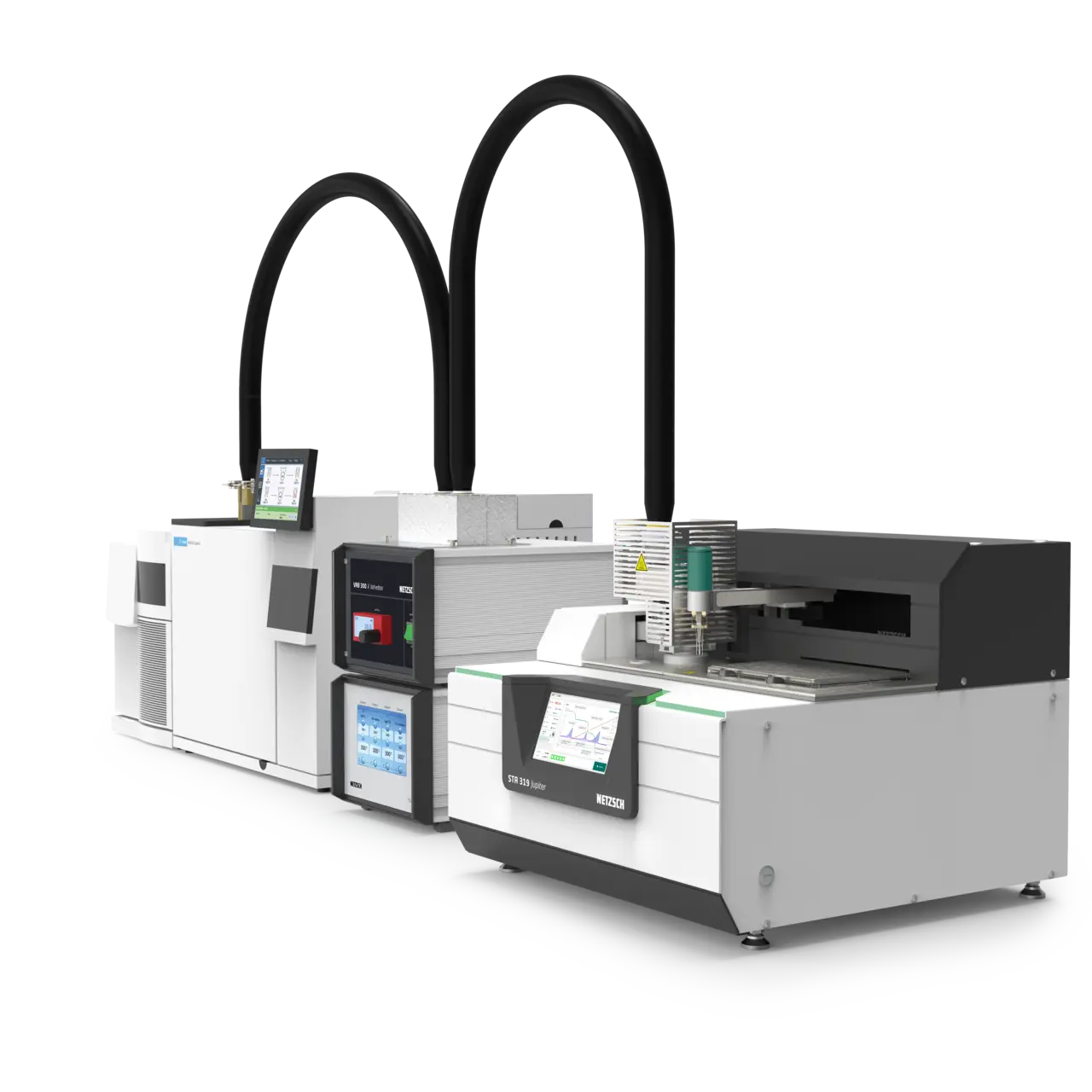
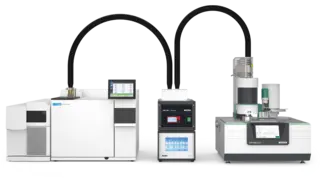
STA 319 Jupiter® Coupled to GC-MS
The Ideal Interface for Advanced Evolved Gas Analysis
Highlights
Thermal Analysis Coupled with GC-MS - Clear Identification Down to the Last Molecule
The GC-MS coupling transforms the STA 319 Jupiter® into a powerful analytical system for highly selective evolved gas analysis. Combining simultaneous thermal analysis (TGA-DSC/DTA) with gas chromatography and mass spectrometry not only enables effective separation and reliable identification of complex gas mixtures released during thermal Decomposition reactionA decomposition reaction is a thermally induced reaction of a chemical compound forming solid and/or gaseous products. decomposition, but also correlates these gases with thermal transitions and reaction enthalpies via the DSC signal. While other spectroscopic methods cannot separate components before identification, GC-MS - thanks to its initial chromatographic step - enables reliable distinction of even chemically similar or simultaneously released species by their retention time and characteristic ion patterns.
The compact, smart interface ensures efficient transfer of evolved gases from the STA furnace to the GC-MS. Heated capillaries and optimized flow paths minimize memory effects and prevent condensation - delivering fast response, sharp chromatographic peaks, and dependable detection of volatile, semi-volatile, and reactive species.
The STA 319 Jupiter® coupled to GC-MS fits seamlessly into research and industrial environments, supporting quality assurance, polymer and materials development, formulation studies, Decomposition reactionA decomposition reaction is a thermally induced reaction of a chemical compound forming solid and/or gaseous products. decomposition and reaction analysis, and forensic applications. Existing STA 319 Jupiter® systems can be upgraded with the GC-MS coupling at any time.

Coupling a NETZSCH STA with a Gas Chromatography-Mass Spectrometry (GC-MS) system enables simultaneous measurement of mass changes and detailed analysis of evolved gases. While the TGA records mass changes during thermal events, the gas chromatograph (GC) first separates the evolved gases based on their retention time to the stationary phase. The mass spectrometer (MS) then analyzes the ionized fragments of these separated gases according to their mass-to-charge (m/z) ratio. This powerful combination provides deep insight into Decomposition reactionA decomposition reaction is a thermally induced reaction of a chemical compound forming solid and/or gaseous products. decomposition processes, reaction pathways, and the composition of complex gas mixtures.
Method
Gas Chromatography-Mass Spectrometry (GC-MS) Coupled to Thermal Analysis
Thermal analysis monitors mass changes and thermal events across wide temperature ranges. However, to fully understand the chemical reactions and Identify the compounds released during these processes, the evolved gases must be separated and analyzed. Coupling TGA with GC-MS closes this gap: gas chromatography separates overlapping components, while mass spectrometry provides molecular fingerprints for reliable identification. The NETZSCH Proteus® software manages the entire process - controlling sampling, injection timing, and data synchronization - so thermal analysis and GC-MS results are automatically linked. This preserves the complete temperature-time relationship between TGA curves, chromatograms, and mass spectra, providing clear, correlated insights without the need for external software.
Smart Gas Injection for Efficient GC-MS Coupling
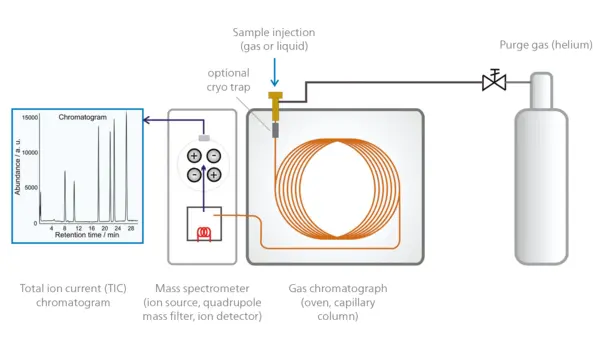
As GC separation requires time that depends on the sample and column conditions, a continuous online gas feed is not suitable for effective analysis. NETZSCH addresses this issue with a quasi-continuous coupling via a heated valve system for software-controlled sampling and short-interval injections managed by Proteus®. The injected (or split) gas passes through the GC column and then - after pressure reduction - enters the quadrupole MS as a molecular beam. The column can run at a constant temperature in quasi-continuous mode or with a temperature program for event-triggered runs. The MS records a TIC (Total Ion Current) chromatogram versus retention time, and each peak is analyzed to Identify the corresponding volatile species.
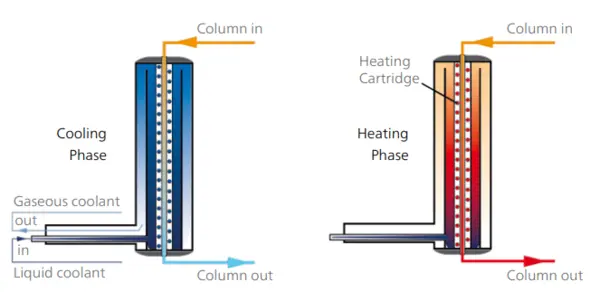
Multi-Injection and Cryo Trap Mode
A cryo trap is a device used in gas analysis systems to condense and collect volatile compounds at very low temperatures. As illustrated in the image on the left, during a TGA or STA measurement, the outer jacket of the cryo trap is cooled with liquid nitrogen (cooling phase) to condense and concentrate volatile outgassing compounds. Once gas collection is complete, the trap is rapidly heated using the built-in heating cartridge (heating phase), releasing the concentrated gases in a sharp pulse for injection into the GC column.
Specifications
Gas Sampling & Injection
Heated Transfer Line
GC-MS Detection
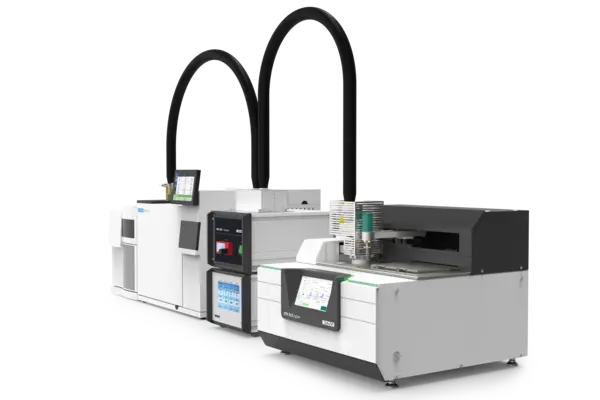
STA 319 Jupiter® Coupled to GC-MS – Optimized Gas Transfer
The STA 319 Jupiter®–GC-MS coupling provides a fully heated gas path from the thermobalance to the valve box and GC injector, with the furnace adapter heated up to 400 °C and the glass-lined steel transfer line up to 350 °C. An integrated flow-control system ensures forced flow through the sampling loop for reliable, loss-free transfer. The valve-based, double-loop injector permits short injection intervals and is fully integrated into Proteus® software. Special thermal insulation (up to 350 °C) prevents cold spots throughout the system. The setup connects easily to any standard GC S/SL injector and can be switched quickly between STA coupling and conventional GC applications such as liquid sampling. For maximum flexibility, the column can be bypassed for direct MS coupling.
GC-MS Platform: Flexible, Fast, and Service-Proven
The GC supports split, splitless, and pulsed split injections, a funace temperature of up to 450 °C, optional fast column changes without venting the MS, and a choice of application-specific columns. The MS offers a mass range of up to 1011 u, scan rates of up to 20,000 u/s, tool-free servicing (including simplified ion-source maintenance), and multiple ionization modes (EI, CI, PI). It can also operate as a stand-alone detector. For GC-MS coupling, NETZSCH partners with world-renowned suppliers like Agilent and JEOL, ensuring top-tier hardware and service quality, as well as optimized performance for NETZSCH systems.
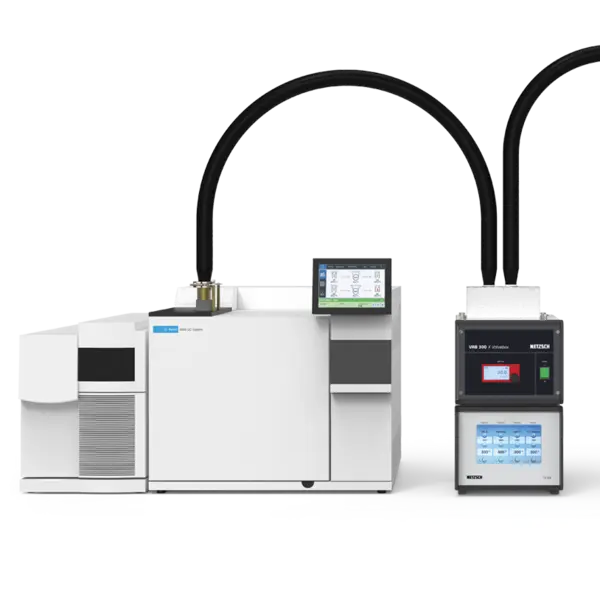



Proven Excellence in Service
At NETZSCH Analyzing & Testing, we offer a comprehensive range of services globally to ensure the optimal performance and longevity of your thermoanalytical equipment. With a track record of proven excellence, our services are designed to maximize the effectiveness of your devices, extend their lifespan, and minimize downtime.
Unlock the full potential of your equipment with our tailored solutions, backed by years of industry expertise and innovation.
Related Devices

Consultancy & Sales
Do you have further questions about the instrument or the method and would like to speak to a sales representative?
Service & Support
Do you already have an instrument and need technical support or spare parts?