Introduction
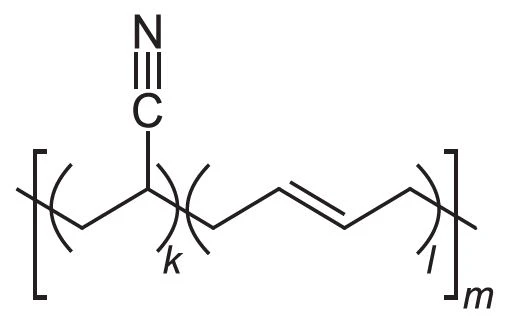
Acrylonitrile butadiene rubber (NBR, structural formual in figure 1) is a copolymer produced by the polymerization of acrylonitrile and butadiene monomers. The main process used to manufacture this caoutchouc is low-temperature emulsion polymerization [1]. The acrylonitrile content of the copolymers is typically between 18 and 50 mol.-% [1]. NBRs generally show good resistance to nonpolar solvents, high abrasion resistance, gas impermeability and good temperature resistance. As a result, they are widely used in the manufacture of various oilresistant rubber products, such as bellows, gaskets and other seals, rubber gloves, oil-resistant soles, printing blankets, etc., and have become an indispensable elastic material in the automotive, aviation, petroleum, packaging, food, printing and other industries [2].
Some NBR products are subjected to constant StrainStrain describes a deformation of a material, which is loaded mechanically by an external force or stress. Rubber compounds show creep properties, if a static load is applied.strain and elevated temperatures during service. Therefore, knowledge of the RelaxationWhen a constant strain is applied to a rubber compound, the force necessary to maintain that strain is not constant but decreases with time; this behavior is known as stress relaxation. The process responsible for stress relaxation can be physical or chemical, and under normal conditions, both will occur at the same time. relaxation and deformation set − either tension or compression set − is important to the customer during product design. When a material is used under constant StrainStrain describes a deformation of a material, which is loaded mechanically by an external force or stress. Rubber compounds show creep properties, if a static load is applied.strain, the material response may become irreversible under longer time scales and/or higher temperatures. This can result in a non-zero, permanent deformation of the material after the StrainStrain describes a deformation of a material, which is loaded mechanically by an external force or stress. Rubber compounds show creep properties, if a static load is applied.strain is removed. This non-reversible part is an important factor in determining the applicability of certain rubber materials. There are several international standards and Chinese standards for testing the relevant RelaxationWhen a constant strain is applied to a rubber compound, the force necessary to maintain that strain is not constant but decreases with time; this behavior is known as stress relaxation. The process responsible for stress relaxation can be physical or chemical, and under normal conditions, both will occur at the same time. relaxation and deformation set properties of elastomers, such as ASTM D395, GB/T 7759.1, GB/T 7759.2, and GB/T 1683.
However, information on the material performance for these properties can also be obtained with the NETZSCH DMA 303 Eplexor® by simulating the material behavior under application-relevant conditions.
Relaxation and Compression Set Measurements onAs-Received and Post-Vulcanized NBR
Two different NBR samples were measured in compression mode with the DMA 303 Eplexor®® using the appropriate compression steel sample holder and pushrod, as shown in figure 2. One is an as-received NBR sample that underwent a primary vulcanization process at 170°C in static air, and the other is a post-vulcanized NBR sample that was further heat-treated at 170°C for 2 h in an oven in static air. The diameter of the samples was 5.18 mm and 5.22 mm for the as-received and post-vulcanized NBR samples, respectively. The height of the sample was determined by the automatic length detection feature of the DMA 303 Eplexor®.
The experiment was performed using the following six-segment procedure:
- A static force of 0.05 N was applied to ensure contact with the sample during IsothermalTests at controlled and constant temperature are called isothermal.isothermal stabilization at 25°C for 5 min. At the end of the segment, the initial thickness, L0, was measured.
- The temperature was then raised to 100°C at a heating rate of 10 K min-1.
- To stabilize temperature and allow the entire sample to equilibrate at 100°C, the temperature was held for 5 min before the next step.
- A target static StrainStrain describes a deformation of a material, which is loaded mechanically by an external force or stress. Rubber compounds show creep properties, if a static load is applied.strain of 25% based on the length measured at the end of the previous segment was applied. The StrainStrain describes a deformation of a material, which is loaded mechanically by an external force or stress. Rubber compounds show creep properties, if a static load is applied.strain was held constant at this temperature for 60 min and the decay of the force and the RelaxationWhen a constant strain is applied to a rubber compound, the force necessary to maintain that strain is not constant but decreases with time; this behavior is known as stress relaxation. The process responsible for stress relaxation can be physical or chemical, and under normal conditions, both will occur at the same time. relaxation modulus were observed as a function of time throughout the segment.
- The applied force was reduced to the previous 0.05 N and then cooled back to 25°C at 10 Kmin-1.
- The temperature was held constant at 25°C for 20 min to stabilize the temperature and allow the sample to fully equilibrate at the given temperature. At the end of the segment, the length of the sample, L1, was measured again and the residual, non-reversible StrainStrain describes a deformation of a material, which is loaded mechanically by an external force or stress. Rubber compounds show creep properties, if a static load is applied.strain, ε = (L1 – L0)/L0, was determined.

Experimental
The sample length measured at the end of the first segment is L0 = 7.722 mm. After applying a static StrainStrain describes a deformation of a material, which is loaded mechanically by an external force or stress. Rubber compounds show creep properties, if a static load is applied.strain of -25 % at the beginning of the IsothermalTests at controlled and constant temperature are called isothermal.isothermal segment at 100°C, the static force decreases from its maximum value of 24.97 N to 20.41 N after one hour. Correspondingly, the RelaxationWhen a constant strain is applied to a rubber compound, the force necessary to maintain that strain is not constant but decreases with time; this behavior is known as stress relaxation. The process responsible for stress relaxation can be physical or chemical, and under normal conditions, both will occur at the same time. relaxation modulus decreases from 4.77 MPa to 3.87 MPa. At the end of the measurement, the specimen has a length of L1 = 7.464 mm. This corresponds to a residual StrainStrain describes a deformation of a material, which is loaded mechanically by an external force or stress. Rubber compounds show creep properties, if a static load is applied.strain of ε = -3.34 % after one hour.
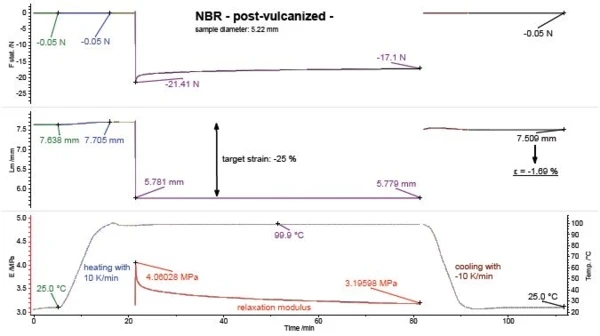
For the post-vulcanized NBR sample, a length of L0 = 7.638 mm was measured prior to the start of the heating segment. The static StrainStrain describes a deformation of a material, which is loaded mechanically by an external force or stress. Rubber compounds show creep properties, if a static load is applied.strain of -25% requires an initial force of 21.41 N, which decreases to 17.10 N after 1 h at 100°C. The RelaxationWhen a constant strain is applied to a rubber compound, the force necessary to maintain that strain is not constant but decreases with time; this behavior is known as stress relaxation. The process responsible for stress relaxation can be physical or chemical, and under normal conditions, both will occur at the same time. relaxation modulus decreases from an initial value of 4.06 MPa to 3.19 MPa during the IsothermalTests at controlled and constant temperature are called isothermal.isothermal segment. At the end of the experiment, a specimen length of L1 = 7.509 mm was measured. Hence, the calculated residual StrainStrain describes a deformation of a material, which is loaded mechanically by an external force or stress. Rubber compounds show creep properties, if a static load is applied.strain in this case was ε = -1.69%.
Measurement Results
While the as-received NBR still shows a residual strain of -3.34%, the post-vulcanized NBR sample only shows a value of -1.69%. This shows a drastic influence of the post-vulcanization process treatment on NBR highlighted by the reduction of the residual strain by about 50.6% compared to the as-received state. From a microstructural point of view, the difference in residual strain can be explained by the higher degree of intermolecular chemical cross-linking of the polymer chains for the post-vulcanized NBR sample. As a result, their mobility and ability to undergo configurational changes at elevated temperatures and/or under longer time scales is drastically reduced. Since irreversible, viscous flow requires movement of the main polymer chains into new metastable configurations, the increased degree of chemical cross-linking reduces the possibilities for configurational changes during deformation of the sample. The irreversible microstructural changes are reflected on the macroscopic scale by the reduction in force during the IsothermalTests at controlled and constant temperature are called isothermal.isothermal RelaxationWhen a constant strain is applied to a rubber compound, the force necessary to maintain that strain is not constant but decreases with time; this behavior is known as stress relaxation. The process responsible for stress relaxation can be physical or chemical, and under normal conditions, both will occur at the same time. relaxation segment as shown in figures 3 and 4.

For product designers, the advantage of post-vulcanization of elastomers is that they can expect fewer physical and chemical changes within their product during service, such as the residual strain shown here. This allows them to tailor their final product more closely to the application of the material.
Conclusion
In addition, compared to RelaxationWhen a constant strain is applied to a rubber compound, the force necessary to maintain that strain is not constant but decreases with time; this behavior is known as stress relaxation. The process responsible for stress relaxation can be physical or chemical, and under normal conditions, both will occur at the same time. relaxation and compression set experiments carried out in accordance with several international standards, dynamic mechanical analysis also allows in-situ observation of the reduction in force during constant strain. This can provide a product designer with additional information about the behavior of their material in service.