Identify
The Database System for Material Identification and Quality Control
Confident Identification of Materials and Mixtures
Identify is part of the Proteus® analysis system and is a unique thermal analysis database. With a single click, measurement curves — even those that have not yet been evaluated — can be checked for agreement with stored curves and literature data. Identify can therefore automatically recognize and interpret curves and materials, and can also be employed for quality control. Identify can also be used as an archive or data management system for storing measurements and conditions.
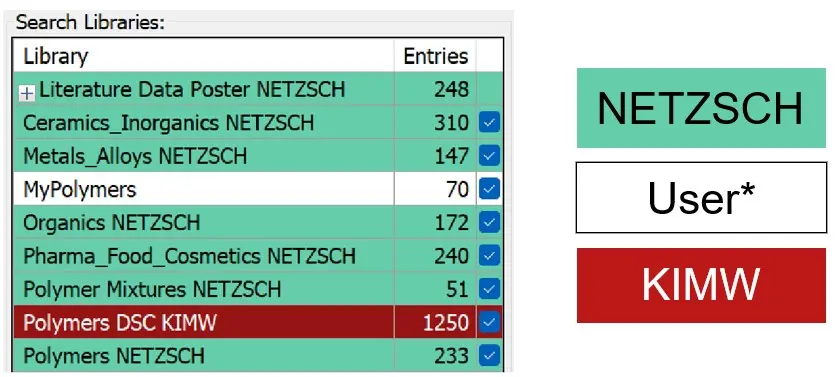
Currently, Identify supports DSC, TGA, TGA-c-DTA®, STA, CP, DIL/TMA and DMA measurements and signals. The supplied NETZSCH libraries include more than 1,400 entries from the fields of polymers, organics, food, pharmaceuticals, metals/alloys, ceramics, inorganics and chemical elements. In collaboration with the Kunststoff-Institut Lüdenscheid, NETZSCH-Gerätebau provides a polymer database for DSC analysis, comprising 1,250 measurements of different commercially available polymers (174 types).
For comparison purposes, any measurement curve from the database can be superimposed on another, even if they are of different types. Finally, Identify's results can be printed or exported as a customisable report.
Identify in a Nutshell
- Unique database system for Thermal Analysis
- More than 2,650 database entries (measurements and literature data)
- NETZSCH and user libraries as well as KIMW database
- Polymer, organic, food, pharmaceutical, metal/alloy, ceramic, inorganic materials
- DSC, TGA, c-DTA®, STA, DIL, TMA, Cp, and DMA data types
- Curve and material identification
- Quality Control functionalities (“PASS!”/”FAIL!” validation)
- Always access to the entire database (including evaluations and measurement conditions)
- Filtering of database entries
- Overlay of measurement curves
- Customizable reports

Database Contents (Status 2025):
Identify now includes more than 2,650 database entries, comprising 1,401 NETZSCH records plus an optional 1,250-entry KIMW set. The supplied NETZSCH libraries include more than 1,400 entries from the fields of polymers, organics, food, pharmaceuticals, metals/alloys, ceramics, inorganics and chemical elements.
*The user libraries are unlimitedly expandable and can be shared concurrently across a computer network, so multiple users can simultaneously access and grow the collection.
Tailored Algorithms for Smart Matching
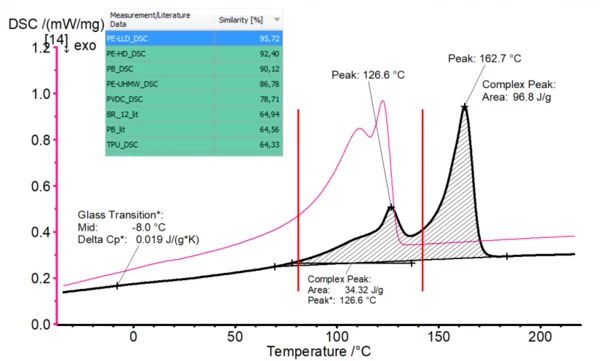
Identify uses dedicated algorithms for each signal type:
- Effect-based and datapoint-based approaches
- Similarity scores calculated using shape and value differences
- Adjustable algorithms and selectable search temperature range for, e.g., identification of individual effects
The result: robust matching even for complex or partially unknown samples — enabling confident material assessment in R&D, QC, and failure analysis.

Why Identify Is Different
- Identify is more than a database search — it's a validation tool
- Built-in intelligence based on intense algorithm development
- Transparent and adjustable — full control over search behavior
- Future-ready — AI-driven material identification with growing database content
Typical Application Examples
Polymer Identification by Means of DSC
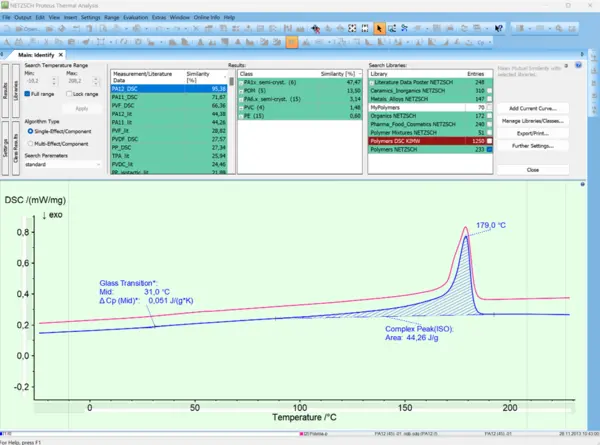
With one click, the DSC measurement on an „unknown“ polymer (blue input curve) was evaluated autonomously by AutoEvaluation, and the sample material was clearly recognized by Identify as a polymer of type PA12.
The DSC measurement of the best match from the "Polymers NETZSCH" library is displayed for comparison (pink database curve)1.
1 Input and database curves are from the 2nd heatings of the samples.
Polymer Identification by Means of TGA-c-DTA®
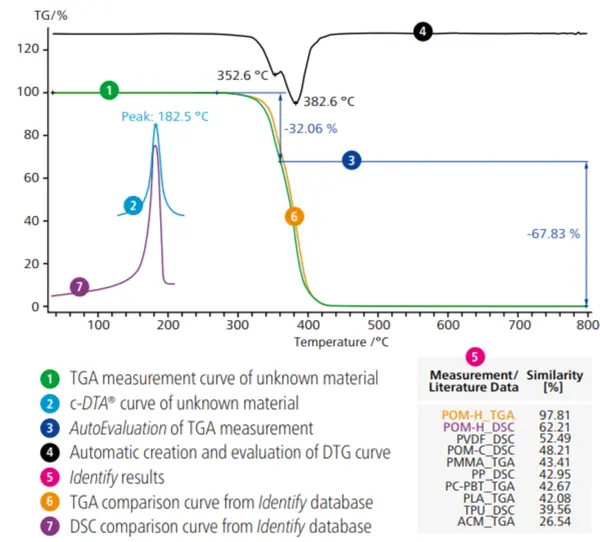
It is particularly advantageous that Identify can even simultaneously incorporate two types of measurements, such as TGA and DSC or c-DTA®, during identification. This can significantly reduce multiple interpretations, and thus increase the chances of correct material identification1.
As illustrated in the example, the evaluated TGA and c-DTA® curves can be used together by Identify: Analysis reveals that the TGA Decomposition reactionA decomposition reaction is a thermally induced reaction of a chemical compound forming solid and/or gaseous products. decomposition result is very similar to that of the POM-H polymer found in the database. There is a DSC curve for POM-H that agrees well with the melting effect at a peak temperature of 183°C, which is also reflected in the c-DTA® curve of the input measurement. The material can therefore be identified as POM-H material with high confidence; all other polymer types present in the database can be ruled out.
Ceramics Identification by Means of TGA-DSC
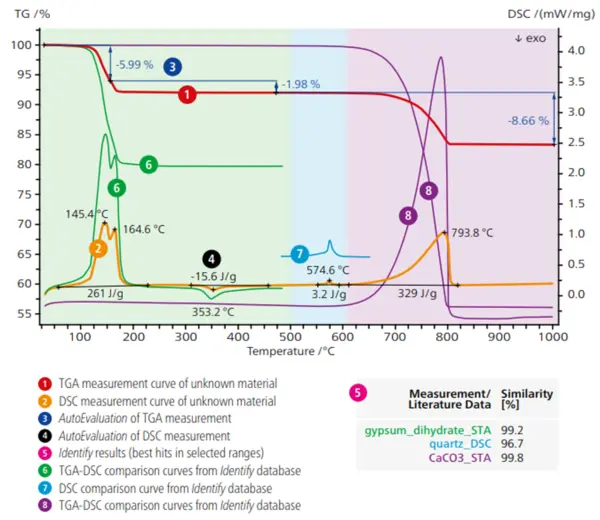
In this application, Identify simultaneously uses two types of measurements (TGA and DSC) for identification of the sample composition. Database comparisons were carried out in different temperature ranges – another powerful feature. As illustrated in the example, analysis with Identify in the temperature range below 500°C reveals that the TGA-DSC results are very similar to those found for gypsum (dihydrate, CaSO4·2H2O) in the database.
The DSC peak detected at 575°C, which is due to the structural α→β transition of quartz, occurs also in the most similar database curve in that temperature range. Above 600°C, the best hit from the database search is a measurement showing the Decomposition reactionA decomposition reaction is a thermally induced reaction of a chemical compound forming solid and/or gaseous products. decomposition of calcium carbonate. In summary, the investigation showed that the unknown material consists of gypsum, quartz and calcium carbonate.
Curve Comparisons
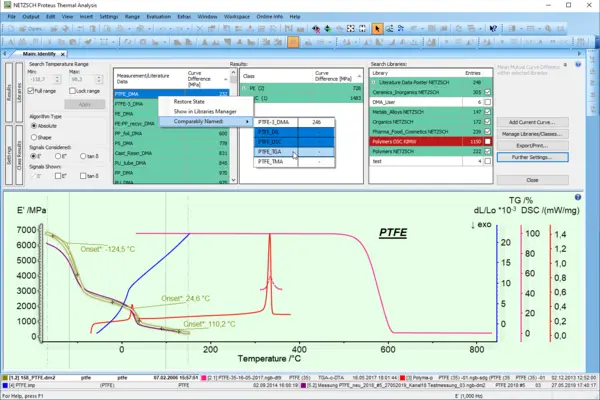
Identify offers always access to all database entries available and allows for curve comparisons as demonstrated in this example. The DMA input measurement (only the storage modulus E’ is displayed for better clarity) is overlaid with the most similar DMA measurement on PTFE as well as with PTFE measurements of DIL, DSC, and TGA-c-DTA® signal types that were all found in the NETZSCH polymer library.
Such curve comparisons serve for better interpretation of effects, but also for selection of measurement conditions. It is, for example, helpful to see that the melting of PTFE starts at about 300°C (visible as a DSC peak above this temperature) and that the Decomposition reactionA decomposition reaction is a thermally induced reaction of a chemical compound forming solid and/or gaseous products. decomposition of PTFE begins at about 500°C, where the TGA curve decreases. The measurement conditions of each individual database measurement can be easily accessed, which is useful for the preparation of a measurement of one’s own on such a material.
Identify for Quality Control (DMA)
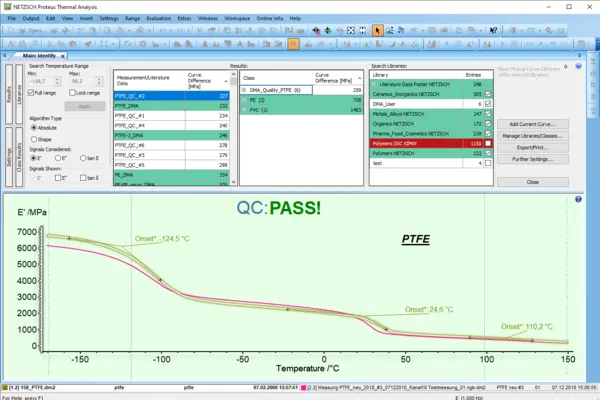
Identify can generally also be used for quality control (QC). This is illustrated in the figure, where the storage modulus E’ of a DMA input measurement is compared with a so-called quality control class; in this case, a group of six custom measurements on PTFE (named “DMA Quality PTFE”). Since the user-defined quality criteria are met, the message “QC: PASS!” is displayed.
Identify for Quality Control (cp)
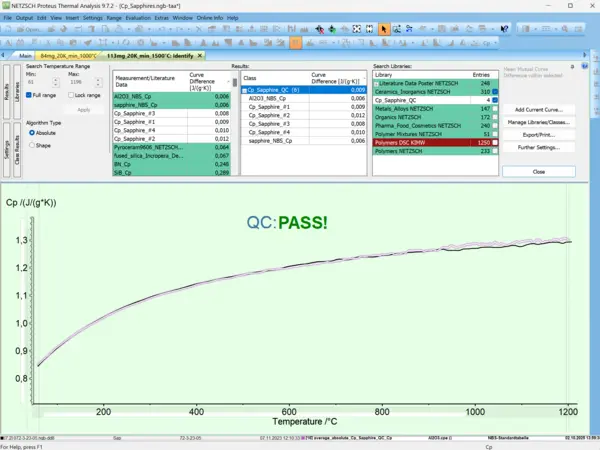
In this example, a Specific Heat Capacity (cp)Heat capacity is a material-specific physical quantity, determined by the amount of heat supplied to specimen, divided by the resulting temperature increase. The specific heat capacity is related to a unit mass of the specimen.specific heat capacity measurement (black curve) is compared with a quality control class from the user’s database (named “Cp_Sapphire_QC”), again revealing the message “QC: PASS!” as can also be seen from the close match with the highlighted reference curve. This intuitive approach provides a quick and effective quality check, enabling users to validate experimental data with confidence.
Identify for Quality Control (DSC)
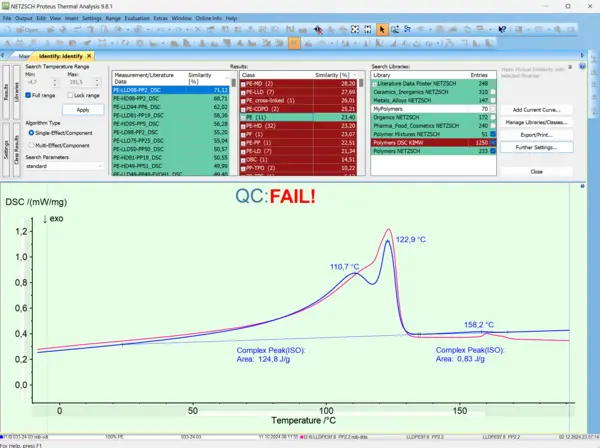
In this example, a DSC measurement on nominally pure polyethylene (PE, blue curve) was analyzed. The hit list and the overlay with the best match, “PE-LLD98-PP2_DSC” (98% PE-LLD + 2% PP, pink curve), contained in the “Polymer Mixtures NETZSCH” library, show that the material is of type PE-LLD. In addition, a polypropylene (PP) impurity of about 2% was detected which is reflected by the small DSC melting peak near 158°C. Identify automatically triggered the message “QC: FAIL!”, because a user-defined similarity threshold with a selected quality control class, PE in this case, was underrun.