Introduction
Heat protection sprays are widely used to safeguard hair from the damaging effects of high temperatures generated by styling tools such as flat irons and curling irons, which can reach up to 220°C or 230°C. While these sprays create a protective barrier to reduce heat-induced degradation of keratin and moisture loss, studies suggest that under such extreme heat, the evaporation or thermal degradation of certain ingredients in these sprays may result in the release of potentially harmful gases like VOCs (volatile organic compounds). Certain polymer- based and silicone-containing sprays may undergo structural breakdown, emitting small amounts of thermal Decomposition reactionA decomposition reaction is a thermally induced reaction of a chemical compound forming solid and/or gaseous products. decomposition products that may pose health risks to both individual users and hairdressers.
Irrespective of the styling result, a number of different commercial products were tested for their gas emissions at maximum application temperatures of 220°C. The temperature-dependent mass loss was determined with an instrument of the STA Jupiter® series. The released gases were analyzed by a GC-MS system coupled to the STA.
In this study, two silicon-containing and two polymerbased sprays were used as examples.
Sample Preparation and Measurement Conditions
The sprays were shaken by hand and the emulsions were pipetted into the crucible. The evolved compounds were collected in the GC cryo trap at -50°C and separated and identified after the TGA run. The TGA measurement parameters are detailed in table 1 and the GC-MS parameters in table 2.
Table 1: TGA measurement parameters
| Sample | 1 (polymer-based) | 2 (polymer-based) | 3 (silicon-containing) | 4 (silicon-containing) |
| Sample mass | 22.9 mg | 27.0 mg | 34.5 mg | 19.7 mg |
| Crucible | Al2O3 crucible (200 μl), open | |||
| Sample carrier | TGA pin, type S + slip-on plate | |||
| Furnace | SiC | |||
| Temperature program | RT-220°C, 30 min isotherm | |||
| Heating rate | 10 K/min | |||
| Gas atmosphere | Nitrogen | |||
| Gas flow (total) | 70 ml/min | |||
Table 2: GC-MS Parameter
| Cryo Trap Mode | |
| Column | Agilent HP-5ms |
| Column length | 30 m |
| Column diameter | 0.25 μm |
| Cryo trap temperature | -50°C, 50 min |
| Column temperature | 45°C, 52 min isotherm, 45°C - 300°C, 10 K/min |
| Gas | He |
| Gas flow (split) | 20 ml/min (10:1) |
| Valve | Every 30 seconds |
Results and Discussion
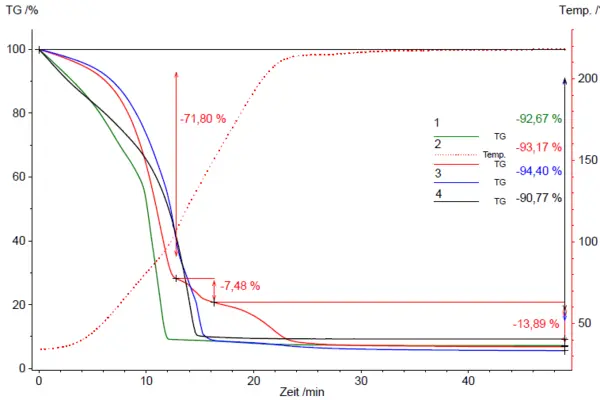
Each of the four samples shows a very different thermogram (figure 1). Samples 1 and 4 show an immediate mass loss already starting at room temperature, suggesting the release of highly volatile solvents such as alcohols in addition to the evaporation of the water base. For samples 1, 3 and 4, the mass loss was complete at approximately 140°C. Only sample 2 showed three separate mass-loss steps up to the isotherm temperature of 220°C. It can be assumed that a larger quantity of high-boiling substances was used in this case. In total, all four samples released more than 90% of their initial masses during heat treatment.
The evaluation of the obtained GC-MS data is illustrated by samples 2 and 4, which represent a polymer-based and a silicone-containing heat protection spray, respectively. Figure 2 displays the resulting total ion current (TIC) of sample 2 after heating the cryo trap at the end of the TGA run. Separation of multiple peaks was achieved, and identification of the resulting compounds was carried out by comparison with the NIST MS library.
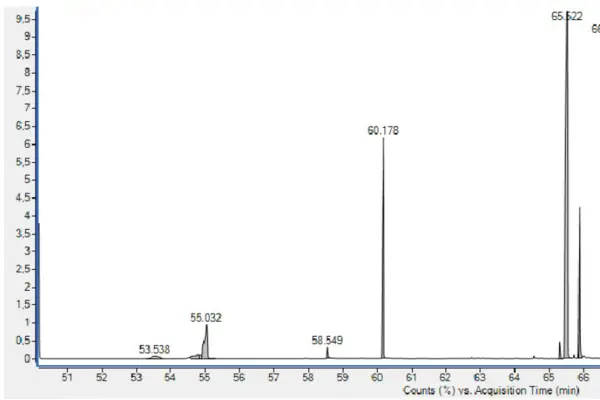
The compounds with the highest hit quality are shown in table 3. As specified on the ingredients list, no silicone compound was identified. Mainly some carboxylic ester compounds were released up to 220°C.
In comparison, sample 4 released completely different compounds within the same temperature treatment. Figure 3 depicts the resulting total ion current.
Table 3: Library search report for sample 2
| RT | Score | Name |
|---|---|---|
| 55.03 | 85.72 | Water |
| 58.55 | 97.07 | Pantolactone |
| 60.18 | 97.87 | Dodecane |
| 65.30 | 95.57 | Isopropyl myristate |
| 65.52 | 90.17 | Isoamyl laurate |
| 65.86 | 90.40 | Dimethyl palmitamine |
| 66.01 | 95.00 | Hexadecanoic acid, methyl ester |
| 66.68 | 93.48 | Isopropyl palmitate |
| 67.13 | 88.95 | 9-Octadecenoic acid (Z)-, methyl ester |
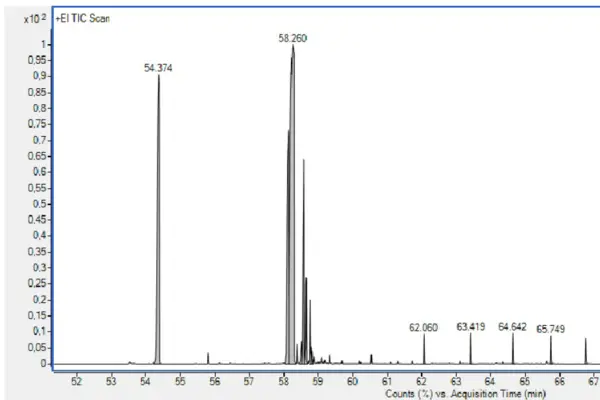
Table 4 shows a list of the identified compounds. Here, mainly alkanes and siloxane compounds were released, which also fit with the list of ingredients. As the mass spectra of the different siloxanes are very similar, there is a possibility that the release of slightly different derivatives is occurring as well.
Table 4: Library search report for sample 4
| RT | Score | Name |
|---|---|---|
| 54.37 | 95.03 | Disiloxane, hexamethyl- |
| 55.80 | 95.80 | Cyclotrisiloxane, hexamethyl- |
| 58.14 | 96.25 | Heptane, 2,2,4,6,6-pentamethyl- |
| 58.51 | 92.45 | 2,2,4,4-Tetramethyloctane |
| 58.65 | 91.98 | Decane, 2,5,9-trimethyl- |
| 58.79 | 94.70 | 2- Propenoic acid, 3-(4-methoxyphenyl)-, 2-ethylhexyl ester |
| 58.82 | 87.45 | Heptane, 5-ethyl-2,2,3-trimethyl- |
| 62.06 | 94.12 | Heptasiloxane, hexadecamethyl- |
| 63.42 | 87.80 | Heptasiloxane, hexadecamethyl- |
| 64.64 | 79.22 | Heptasiloxane, hexadecamethyl- |
| 65.75 | 75.79 | Heptasiloxane, hexadecamethyl- |
| 66.75 | 76.94 | Heptasiloxane, hexadecamethyl- |
| 67.68 | 76.14 | Heptasiloxane, hexadecamethyl- |
| 66.46 | 93.86 | 2-Propenoic acid, 3-(4-methoxyphenyl)-, 2-ethylhexyl ester |
| 69.52 | 75.70 | Heptasiloxane, hexadecamethyl- |
| 69.23 | 78.01 | Heptasiloxane, hexadecamethyl- |
Conclusion
The coupling of STA and GC-MS enables simulation of the application of heat protection hair sprays to their maximum application temperature. The gas chromatography-mass spectrometry (GC-MS) technique has been proven to facilitate the identification of the composition of the primary gases evolved. Furthermore, it can be utilized to determine the presence of silicon compounds within a given product. This information may assist in the optimization of cosmetic products with regard to their environmental compatibility, biodegradability, and health risks for hairdressers and individual customers.