The NETZSCH DMA 523: Goodrich Flexometer Capabilities with Simultaneous Dynamic-Mechanical Analysis
Introduction
Elastomers, as viscoelastic materials, play a fundamental role in multiple industries. It is recognized that the viscous component of mechanical behavior leads to energy loss in the form of heat due to various dissipative processes. Typical DMA measurements involve using small sample sizes, low dynamic amplitudes, and low frequencies, resulting in negligible dissipated heat per cycle. This dissipation does not lead to a relevant temperature increase in the sample. However, certain rubber products, such as tire treads, tank track pads, and large rubber rollers, experience significant force during their service. This can result in circumstances where more heat energy is generated than dissipated to the surrounding environment. The result is a heat build-up (HBU) within the rubber, which can ultimately lead to failure of the product due to blow-out (BO).
The NETZSCH DMA 523 Eplexor® is an optimal solution for performing measurements at high levels of deformation as well as under high static and dynamic force, thanks to its two independent drives. This high-force DMA allows Goodrich Flexometer tests in accordance with the ASTM D623 oder ISO 4666-3/ISO 4666-4 standard, as well as measurement parameters deviating from these standards based on customer demands.
The Possibilities of Flexometer Testing with NETZSCH High-Force DMAs
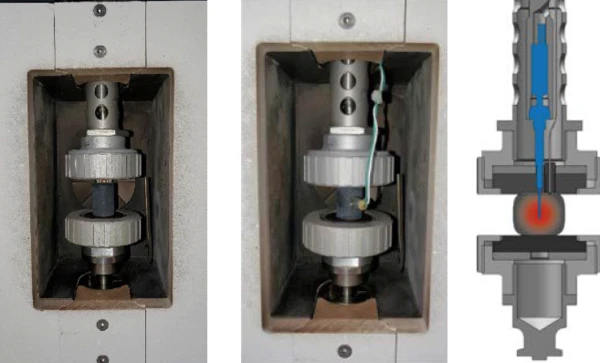
A sample holder with thermally insulating platens that meet the aforementioned standards is necessary for HBU and BO experiments. The platens are made of a laminate material composed of a phenol-based thermoset and hard paper. These are designed to minimize heat loss from the rubber specimen to the sample holder, thereby simulating a Worst-Case ScenarioRelated to a chemical reactor, a worst-case scenario is the situation where temperature and/or pressure production caused by the reaction runs out of control.worst-case scenario under constant heavy dynamic mechanical loads. A thermocouple is positioned within the center of the upper sample holder to accurately measure the surface temperature of the specimen.
A schematic view of this sample holder is shown in figure 1a.
To obtain temperature information from the inside of the sample, NETZSCH offers two options:
- A horizontal needle thermocouple that is manually placed near the center of the sample. This can be used as an add-on with the basic Flexometer sample holder. This thermocouple measures the temperature during the entire duration of the HBU experiment. It isrecommended to avoid using the horizontal needle thermocouple during the BO experiments, as it may lead to damage to the sensor. An example of this set-up is shown in figure 1b.
- A separate sample holder with Pertinax platens and an additional vertical needle thermocouple are pneumatically inserted into the sample after the HBU measurement has been performed. In this configuration, the thermocouple detecting the sample surface temperature is placed slightly off-center. A schematic view of this type of sample holder is shown in figure 1c.
How to Perform a Heat Build-Up and Blow-Out Test with the NETZSCH High-Force DMAs
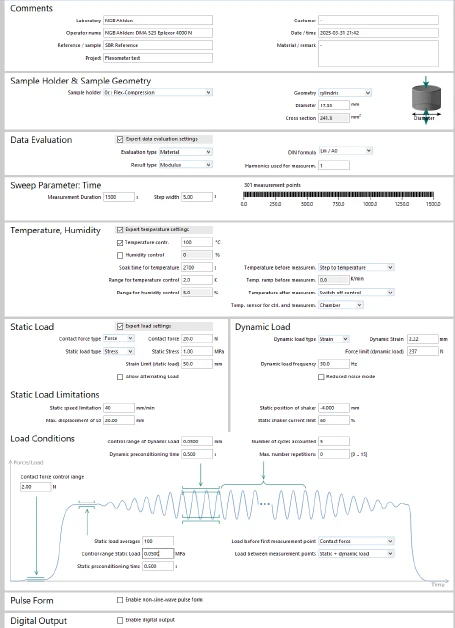
Before proceeding with the measurement, please ensure that the NETZSCH DMA 523 Eplexor® is properly equipped with the appropriate force sensor. Additionally, the blade spring system should be adapted to accommodate higher deformations. Due to the large forces and deformations involved during an HBU and BO test, it is recommended to use at least a force sensor with a nominal maximum force of 2500 N. Regarding the blade spring system, both steel blade springs should be detached by loosening the union nut with special spanners. These steps can be easily completed by the user within a few minutes. The HBU and BO tests are defined in the following standards: ASTM D623 or ISO 4666/3, ISO 4666/4, and JIS K 6265. The sample dimensions are expected to be cylinders with a diameter of 17.8 mm and a height of 25 mm.
In addition to the results from conventional Flexometer tests, such as temporal temperature evolution and thermal set, Flexometer tests with the NETZSCH DMA 523 Eplexor® also provide insight into the viscoelastic properties storage modulus (E’), Viscous modulusThe complex modulus (viscous component), loss modulus, or G’’, is the “imaginary” part of the samples the overall complex modulus. This viscous component indicates the liquid like, or out of phase, response of the sample being measurement. loss modulus (E’’) and loss factor (tan δ).
In the following, the typical parameters for HBU and BO experiments are summarized.
- Heat Build-Up Tests
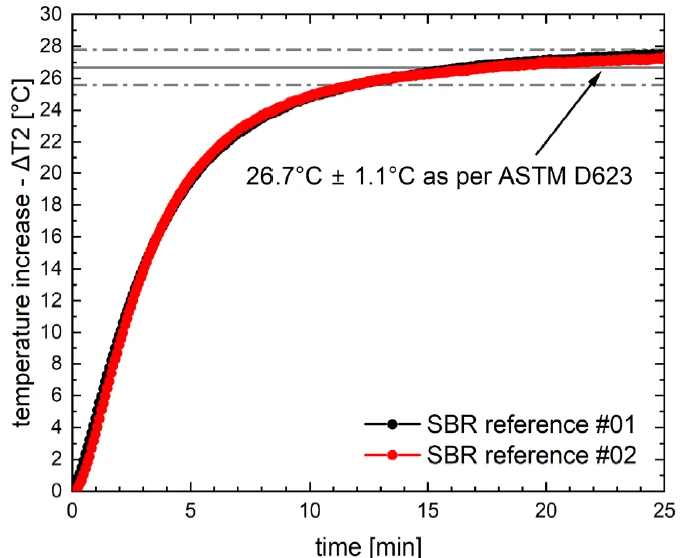
For HBU tests, the ASTM D623ASTM D623 und ISO 4666-3/ISO 4666-4 standard recommends a dynamic amplitude of 2.225 mm, 2.855 mm or 3.175 mm. In most cases, the 2.225-mm option is selected. The static StressStress is defined as a level of force applied on a sample with a well-defined cross section. (Stress = force/area). Samples having a circular or rectangular cross section can be compressed or stretched. Elastic materials like rubber can be stretched up to 5 to 10 times their original length.stress is 1 MPa. The measurements can either be performed at room temperature, 50°C or 100°C, with the latter two being recommended by the standards. The accuracy of the Flexometer setup is confirmed using a styrene-butadiene rubber (SBR) sample with known composition, as outlined in the standard. The temperature increase should be 26.7°C ± 1.1°C after performing an HBU test at 30 Hz for 25 min at an ambient temperature point of 100°C. - Blow-Out Tests
BO tests are performed in a manner analogous to HBU tests. The primary distinction is the application of increased loads on the specimen. Instead of a static StressStress is defined as a level of force applied on a sample with a well-defined cross section. (Stress = force/area). Samples having a circular or rectangular cross section can be compressed or stretched. Elastic materials like rubber can be stretched up to 5 to 10 times their original length.stress of 1 MPa, a static StressStress is defined as a level of force applied on a sample with a well-defined cross section. (Stress = force/area). Samples having a circular or rectangular cross section can be compressed or stretched. Elastic materials like rubber can be stretched up to 5 to 10 times their original length.stress of 2 MPa is used in this case. Similarly, the dynamic deformation amplitude is increased to 3.125 mm. Consequently, the static StressStress is defined as a level of force applied on a sample with a well-defined cross section. (Stress = force/area). Samples having a circular or rectangular cross section can be compressed or stretched. Elastic materials like rubber can be stretched up to 5 to 10 times their original length.stress is accordingly increased to 2 MPa, while the frequency remains unchanged from the HBU tests.
Please note that, depending on the stiffness of the rubber material, it may be necessary to deviate from the proposed measurement parameters given in the standard. The NETZSCH DMA 523 provides full flexibility for DMA testing devices.
As the statics are StressStress is defined as a level of force applied on a sample with a well-defined cross section. (Stress = force/area). Samples having a circular or rectangular cross section can be compressed or stretched. Elastic materials like rubber can be stretched up to 5 to 10 times their original length.stress-controlled, a reliable measurement of the diameter of the rubber sample using a caliper is required. The measurement parameters are entered into the pre-configured pan template files. In the case of an HBU test, the user only needs to adjust the most important settings, such as the sample diameter.
Heat Build-Up and Blow-Out Testing
The typical procedure and the range of Flexometer testing capabilities with the NETZSCH DMA 523 Eplexor® are illustrated using a rubber specimen.
a. Verification of the Temperature Measurement Accuracy with SBR Reference Samples
The accuracy of the Flexometer sample holder setup is confirmed using an SBR reference sample, as previously mentioned. The temperature increase is shown in figure 3 for two different SBR reference samples. Both samples demonstrate a high degree of reproducibility and are within the temperature tolerance specified by the ASTM D623 standard.
b. Heat Build-Up and Blow-Out Tests on a Soft Rubber Sample
After verifying the accuracy of the temperature measurement using the Flexometer sample holder, the rubber samples were initially assessed with the measurement parameters established for HBU testing. The results are outlined in figure 4.
The temperature increases by ~36°C after 25 min. In addition, two distinct temperature regions are evident for all three samples under investigation. The first region extends until the temperature increases linearly with time at approx. 10 min. After this region, the slope of the temperature begins to increase again until it ultimately levels at a plateau value near the end of the HBU experiment.
Interestingly, the increase in temperature and the increase in tan δ occur simultaneously. It is crucial to emphasize that the loss factor rather reflects the temperature-induced changes in the damping of the entire sample volume. The temperature increase is only measured at the top surface of the rubber samples.
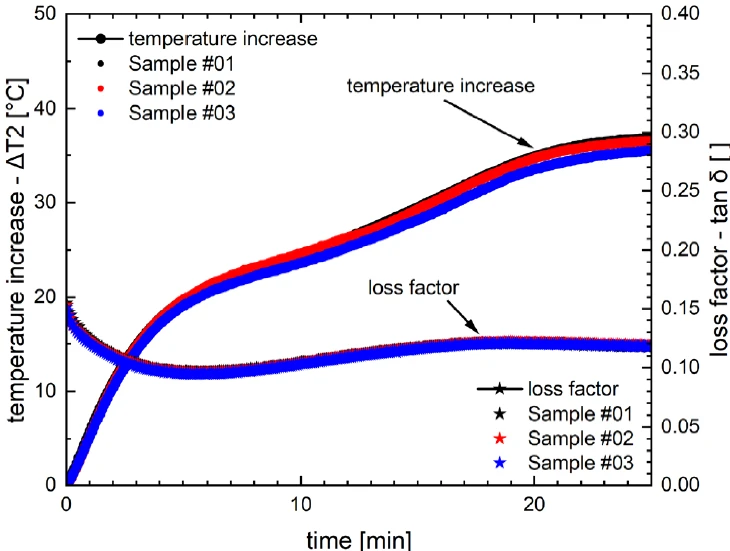
Tan δ first decreases from its initial value of ~0.15 due to the temperature increase within the sample. A decrease in the loss factor indicates a higher degree of elastic response in the total mechanical work applied to the sample. However, after reaching a minimum of ~0.10 at approx. 5 to 6 min, tan δ gradually rises again until it reaches a new local maximum of 0.12 after a measurement time of 18 to 19 min. Based on the post-measurement inspection of the sample cross section shown in figure 5, it is assumed that the increase in loss factor is caused by the formation of cavities within the center of the sample. The reduced integrity of the sample allows for increased flexing, which leads to an apparent increase in the loss factor. However, this effect is not material-intrinsic; it is caused by the formation of gas bubbles inside the sample.

An increased dynamic-mechanical load leads to a faster temperature increase over time. The results for these BO tests are shown in figure 6. In this figure, the temperature increases almost linearly over time. However, at the end of the BO tests, the rate of temperature increase decelerates, ultimately ending in the fracture of the rubber samples by a sudden blow-out. The highest recorded surface temperature before failure is 54°C.
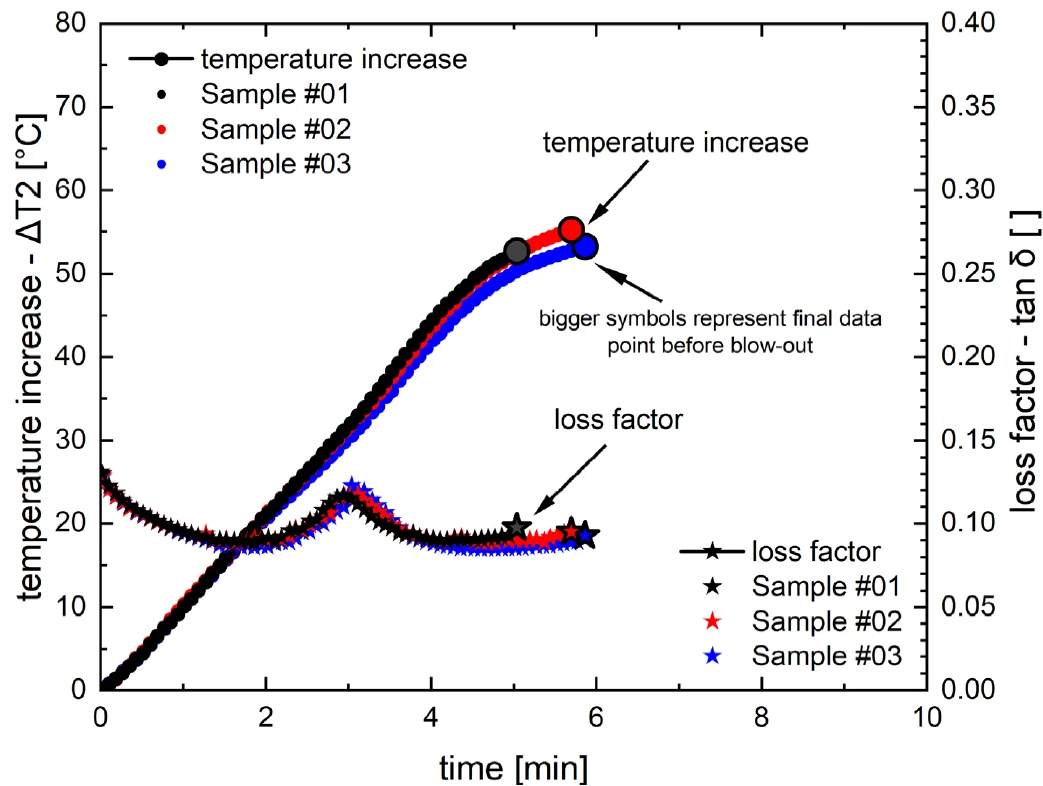
The temporal evolution of tan δ displays comparable characteristics to those observed for the HBU tests. In this case, the increase in loss factor occurs on shorter time scales, as the higher mechanical work applied to the samples leads to earlier formation of the cavities.
Additional information can be obtained by using the vertical needle thermocouple. When activated for a measurement with this Flexometer sample holder (figure 1c), this feature detects a single temperature point after the HBU measurement.
The vertical needle thermo-couple is automatically inserted into the center of the sample to probe the temperature after the end of the HBU measurement. In the case of the investigated elastomers here, the temperature rose by ~57°C on average compared to the ~36°C detected on the surface of the samples.
c. Heat Build-Up Test on a Hard Rubber Sample
If this single measurement point is not sufficient, there is also the possibility of manually inserting a horizontal needle thermocouple into the center of the sample, as shown in figure 1b. The results of this measurement setup are displayed in figure 7. This configuration enables the observation of temperature throughout the entire HBU measurement.
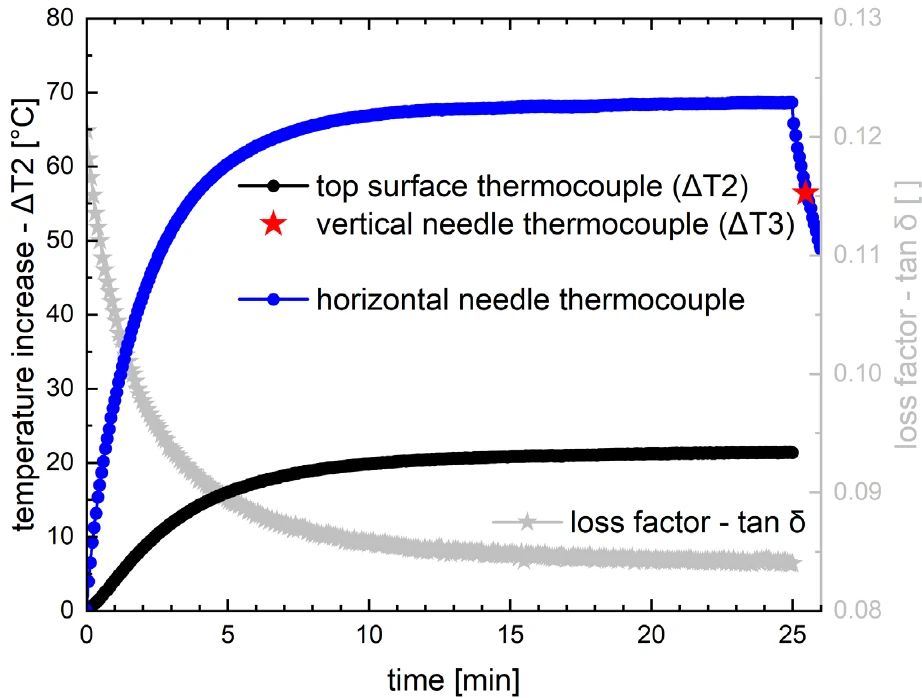
It can clearly be seen that the temperature increase in the center of the sample (~68°C) is significantly higher than the one detected on the sample surface (~20°C). Thus, to accurately measure the temperature at which blow-out of the material occurs, a horizontal needle thermocouple should be inserted. However, there is a certain disadvantage associated with its use that will be discussed in the Conclusion. It also becomes apparent that the slope of tan δ (although inverted) is similar to the slope of the temperature increase in the sample center. This highlights that the surface temperature is not sufficient for describing the changes in the viscoelastic properties of the entire sample volume, which tan δ does provide.
The temperature of the vertical needle thermocouple that is inserted after completion of the HBU measurement corresponds well to the detected temperature in the sample. However, it must be considered that a certain delay exists, during which time the sample temperature in the center does decrease by more than 10°C.
Relevance of Thermal Set During Heat Build-Up Experiments
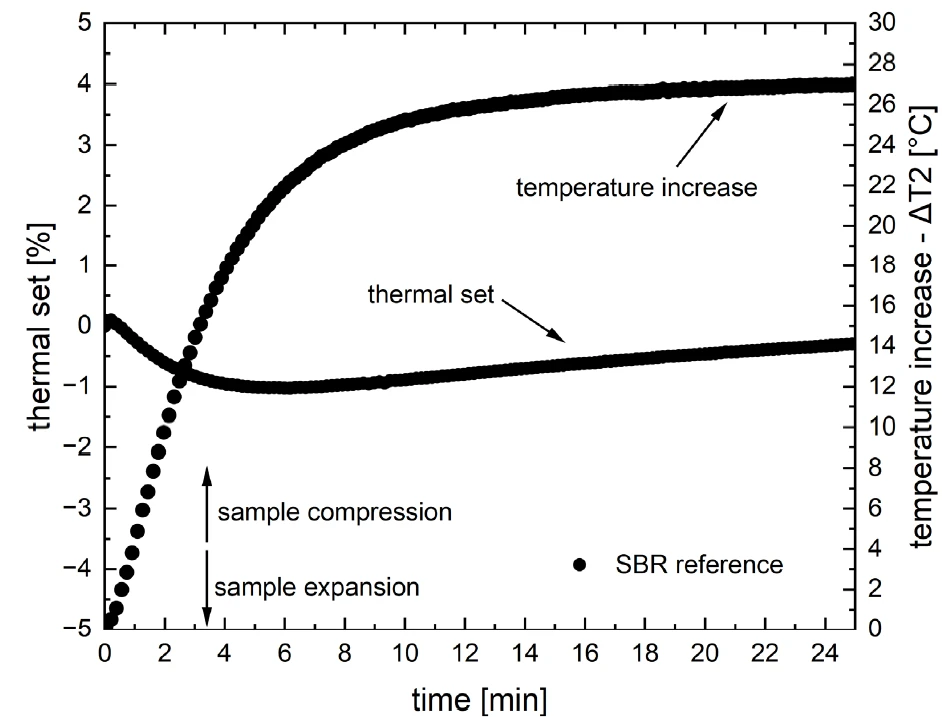
The NETZSCH DMA 523 also allows for the simultaneous measurement of the thermal set during the entirety of the HBU experiment. This property enables conclusions to be drawn regarding the shape stability of the rubber material during heavy dynamic loads. For instance, tank track pads should remain in their original shape to the greatest extent possible in order to guarantee their functionality. The thermal set is measured based on the sample length detected for the first measurement point at the start of the dynamic segment of the HBU experiment, i.e., after the end of the soaking time segment.
In figure 8, the evolution of the thermal set and the temperature increase of two SBR reference samples is displayed. During the first five minutes, the sample expansion dominates as the sample temperature across the entire sample volume rises most quickly during this time span. Only once the temperature increase starts to slow down does the sample length begin to decrease. After the sample has expanded by about 1% at the 5-minute mark, this expansion is compensated for by the decrease in sample length caused by the heavy dynamic loads applied to the SBR sample.
Conclusion
The NETZSCH DMA 523 Eplexor® provides straightforward access to Flexometer testing for rubber materials and beyond. It gathers data on the temperature evolution of elastomer samples and their viscoelastic properties, providing all necessary information for developing more durable rubber products that can withstand heavy loads during service. Furthermore, the shape stability of rubber samples can be measured by means of the thermal set detected during the HBU experiment.
However, the selection of equipment entails certain advantages and disadvantages in terms of application:
- The basic Flexometer sample holder is designed to detect the top surface temperature during the entire duration of HBU and BO tests. While this may be sufficient for elastomer compounds with distinct thermal degradation properties, certain different compounds may not show a difference in their surface temperature increase during the measurement.
- NETZSCH provides two solutions to gain more information from the inside of the elastomer compounds: On the one hand, there is the Flexometer sample holder with vertical needle thermocouple, and on the other, there is the horizontal needle thermocouple that can be used with the basic Flexometer sample holder as an add-on.
- The first option is designed to only detect a single temperature measurement point after the HBU measurement has concluded. In contrast to the manually inserted horizontal needle thermocouple, this procedure is automatically performed. This feature reduces the need for user invention between measurements, enhancing efficiency and consistency.
- A horizontal needle thermocouple permits measurement of the temperature within the center of the sample for the entire duration of the measurement. However, this add-on requires manual insertion before the experiment. The insertion of the thermocouple beforehand can weaken the sample structure by introducing a crack into the material. This, in turn, can affect the accuracy of the measured viscoelastic properties. Additionally, it may potentially influence the formation of cavities in the center of the sample, as the developing gas mixture has an easy pathway to diffuse to the surface along the needle thermocouple. The fundamental objective of HBU or BO measurements is to investigate a structurally pristine sample; this add-on should be utilized solely as an ancillary resource for potential simulations of the heat build-up, rather than as a substitute for conventional HBU and BO experiments with virgin samples. It is important to note that the friction between the thermocouple and the sample, as well as the thermocouple’s role in conducting heat away from the sample core to the exterior, are influential factors when this add-on is used.