Was bedeutet Kompatibilität von Wirkstoffen und Hilfsstoffen?
Ein Medikament besteht üblicherweise nicht nur aus einem einzigen Wirkstoff, sondern aus einer Mischung aus Wirkstoff und unterschiedlichen Hilfsstoffen.
In einer Tablette werden beispielsweise Hilfsstoffe verwendet, um Aussehen und Geschmack des Endprodukts zu verbessern, um ein Verkleben der Tablettenmasse mit dem Stempel der Tablettiermaschine zu verhindern oder um zu deren Auflösung in Wasser beizutragen, usw. Viele Hilfsstoffe sind pharmakologisch inert. Physikalische und chemische Wechselwirkungen zwischen Wirkstoff und Hilfsstoffen können jedoch die Stabilität, Sicherheit und therapeutische Wirksamkeit des Medikaments beeinträchtigen. In diesem Fall wird der Begriff Unverträglichkeit zwischen Wirk- und Hilfsstoff verwendet. Im umgekehrten Fall, wenn der Hilfsstoff den Wirkstoff nicht beeinflusst, sind beide Substanzen kompatibel.
Example: Drug-Excipient Compatibility with DSC
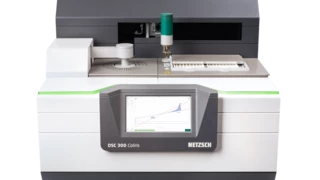
DSC measurements were carried out with the DSC 204 F1 Nevio on:
Diclofenac sodium (drug)
Magnesium stearate (excipient)
Physical mixture of both (weight ratio: 1:1)
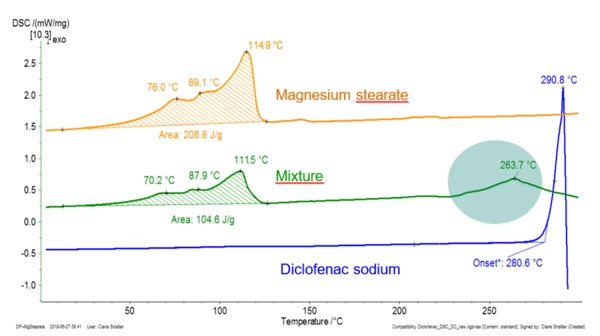
Diclofenac sodium (blue curve): The peak at 280.6°C (onset) results from melting of diclofenac. Decomposition occurs immediately after melting (exothermal effect).
Magnesium stearate (orange curve): The endothermal effect with 3 maxima at 76.0°C, 89.1°C and 114.9°C is due partly to melting of the sample and partly to evaporation of surface and bound water.
Mixture diclofenac sodium + magnesium stearate (green curve): The peak of magnesium stearate is detected. However, melting and decomposition of diclofenac are shifted to lower temperatures. This indicates an interaction between the drug and excipient.
--> Hint for possible incompatibility
DSC measurements on diclofenac sodium (blue curve), magnesium stearate (orange curve) and on the mixture (1:1) of both (green curve)
Example: Drug-Excipient Incompatibility with TGA
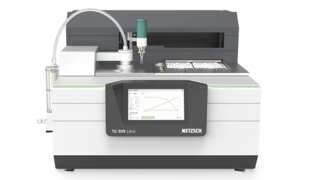
TGA measurements were carried out with the TG 209 F1 Nevio on:
Diclofenac sodium (drug)
Magnesium stearate (excipient)
Physical mixture of both (weight ratio: 1:1)
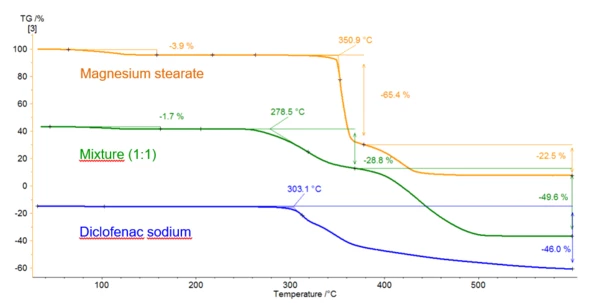
Diclofenac sodium (blue curve): The sample begins losing mass at 303.1°C. This indicates the decomposition of diclofenac.
Magnesium stearate (orange curve): The mass loss of 3.9% is due to the release of surface and bound water. The decomposition begins at 351°C.
Mixture of diclofenac sodium + magnesium stearate (green curve): Evaporation of the water present in magnesium stearate occurs in the same temperature range. However, decomposition of the mixture begins at lower temperature (279°C) than with the single components. This indicates an interaction between the drug and excipient.
--> Hint for incompatibility
TGA measurements on diclofenac sodium (blue curve), magnesium stearate (orange curve) and on the mixture (1:1) of both (green curve)