Introduction
Pure iron is frequently used as a reference and test material in materials science. Due to its well-known thermophysical and metallurgical properties, it is applied for the validation of measurement methods and for investigating fundamental correlations between microstructure, magnetism and thermal behavior. In addition to the temperature-dependent Specific Heat Capacity (cp)Heat capacity is a material-specific physical quantity, determined by the amount of heat supplied to specimen, divided by the resulting temperature increase. The specific heat capacity is related to a unit mass of the specimen.specific heat capacity (cp), the ferromagnetic-paramagnetic transition at the Curie temperature is of particular interest. This transition influences the thermophysical behavior of the material and appears as a characteristic effect in the heat-capacity curve.
The STA 509 Jupiter® enables the simultaneous acquisition of thermal and gravimetric signals (DSC-TGA), providing a powerful basis for comprehensive material characterization. In combination with a magnetic setup, the Curie transformation of pure iron can be clearly detected via the TGA signal in addition to the precise determination of the Specific Heat Capacity (cp)Heat capacity is a material-specific physical quantity, determined by the amount of heat supplied to specimen, divided by the resulting temperature increase. The specific heat capacity is related to a unit mass of the specimen.specific heat capacity— all within a single measurement.

Experiment/Measurement Conditions
The measurements were carried out on a common iron sample using the STA 509 Jupiter® under argon. The Specific Heat Capacity (cp)Heat capacity is a material-specific physical quantity, determined by the amount of heat supplied to specimen, divided by the resulting temperature increase. The specific heat capacity is related to a unit mass of the specimen.specific heat capacity was determined by means of DSC-cp evaluation. In parallel, the TGA signal was recorded. A magnetic setup was additionally used for the detection of the Curie transformation (see Figure 1).
Evaluation of the Specific Heat Capacity
The Specific Heat Capacity (cp)Heat capacity is a material-specific physical quantity, determined by the amount of heat supplied to specimen, divided by the resulting temperature increase. The specific heat capacity is related to a unit mass of the specimen.specific heat capacity (Specific Heat Capacity (cp)Heat capacity is a material-specific physical quantity, determined by the amount of heat supplied to specimen, divided by the resulting temperature increase. The specific heat capacity is related to a unit mass of the specimen.cp) is determined using a comparative method with a reference material, as described, for example, in DIN EN ISO 11357. The heat capacity is calculated by evaluating three separate measurements: the baseline, a standard material (sapphire) and the sample itself. For a reliable and meaningful Specific Heat Capacity (cp)Heat capacity is a material-specific physical quantity, determined by the amount of heat supplied to specimen, divided by the resulting temperature increase. The specific heat capacity is related to a unit mass of the specimen.cp determination, reproducible baseline and sapphire measurements are particularly important, as they form the basis for the subsequent evaluation. From these data sets, the Specific Heat Capacity (cp)Heat capacity is a material-specific physical quantity, determined by the amount of heat supplied to specimen, divided by the resulting temperature increase. The specific heat capacity is related to a unit mass of the specimen.cp value of the investigated material can be determined according to the stated equation.
The result of the evaluation is the temperature-dependent Specific Heat Capacity (cp)Heat capacity is a material-specific physical quantity, determined by the amount of heat supplied to specimen, divided by the resulting temperature increase. The specific heat capacity is related to a unit mass of the specimen.specific heat capacity of the investigated material. This provides a solid basis for material characterization and can also serve as an input parameter for further thermophysical calculations.
At the same time, the measurement is carried out with a magnetic setup (see Figure 1). The combination of both signals (TGA-DSC) enables a particularly clear and wellsupported detection of the magnetic transformation.
An overview of the measurement conditions used is given in Table 1.
Table 1: STA measurement parameters
| Instrument | STA 509 Jupiter® |
|---|---|
| Measuring heat | Type S TGA/DSC |
| Furnace | Rhodium |
| Crucible | Pt/Rh with lid (with Al2O3 liner) |
| Atmosphere | Ar with OTS® (70 ml/min) |
| Temperature program |
|
| Sample mass | 121.871 mg |
| Calibration standard | Sapphire (55.203 mg) |
Results and Discussion
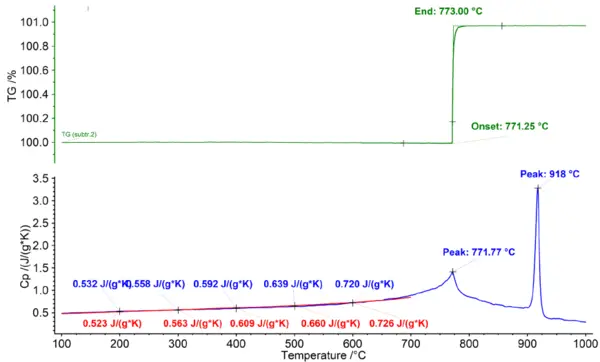
The measured Specific Heat Capacity (cp)Heat capacity is a material-specific physical quantity, determined by the amount of heat supplied to specimen, divided by the resulting temperature increase. The specific heat capacity is related to a unit mass of the specimen.specific heat capacity of pure iron initially shows the expected continuous increase. Up to approximately 700°C, the experimental values are in very good agreement with literature data. This demonstrates the high quality of the cp determination with the STA 509 and confirms the suitability of the system for precise thermophysical measurements on metallic materials. In the range of the Curie transformation, the cp curve exhibits a characteristic effect that can be assigned to the ferromagnetic-paramagnetic transition of iron. Furthermore, a transformation effect (solid-state transformation, α-Fe → γ-Fe) is visible at 918°C. This second-order Phase TransitionsThe term phase transition (or phase change) is most commonly used to describe transitions between the solid, liquid and gaseous states.phase transition leads to a pronounced change in the heat capacity curve and allows the transformation temperature to be determined.
Simultaneously with the cp measurement, the TGA curve was recorded using a magnetic setup. In the ferromagnetic state, pure iron interacts with the applied magnetic field. Upon reaching the Curie temperature, the material changes to the paramagnetic state, causing the magnetically induced force acting on the sample to change abruptly and the TGA curve to show an apparent mass increase. This effect is not caused by a real change in mass, but by the change in the magnetic force acting on the sample. Below the Curie temperature, the sample is attracted by the magnet. Above the Curie temperature, iron loses its ferromagnetic properties. As a result, the additional force no longer acts on the sample, which is registered as a signal change in the TGA curve.
The temperature of the characteristic TGA signal correlates excellently with the Curie transformation detected in the cp curve. The magnetic setup therefore provides independent confirmation of the magnetic Phase TransitionsThe term phase transition (or phase change) is most commonly used to describe transitions between the solid, liquid and gaseous states.phase transition. In the absence of the magnetic field, no relevant mass change would be expected in the temperature range investigated, since the sample is analyzed under an inert atmosphere in a gas-tight measuring system and therefore no OxidationOxidation can describe different processes in the context of thermal analysis.oxidation-related or other mass-changing processes take place.
Summary
The investigation of iron shows that the Specific Heat Capacity (cp)Heat capacity is a material-specific physical quantity, determined by the amount of heat supplied to specimen, divided by the resulting temperature increase. The specific heat capacity is related to a unit mass of the specimen.specific heat capacity can be reliably and accurately determined with the STA 509 Jupiter®. The measured cp values agree very well with literature data. In addition, the Curie transformation could be detected not only in the cp curve, but also simultaneously in the TGA curve using a magnetic setup. The characteristic increase in the TGA signal upon reaching the Curie temperature correlates very well with the transformation effect in the heat capacity curve. This agreement shows that the STA 509 Jupiter® is able to visualize the magnetic transformation simultaneously on two different signal levels. This increases the confidence in the interpretation and demonstrates the versatility of the system.
For material characterization, this means that, with a suitable measurement setup, both thermal and magnetically induced material effects can be investigated in a single experiment. This is of particular interest for iron-based materials and for the analysis of magnetic transformations.