Introduction
Pure iron is frequently used as a reference and test material in materials science. Its well-known thermophysical and metallurgical properties make it suitable for validating measurement methods and for investigating correlations between microstructure, magnetism and thermal behavior.
In addition to temperature-dependent Specific Heat Capacity (cp)Heat capacity is a material-specific physical quantity, determined by the amount of heat supplied to specimen, divided by the resulting temperature increase. The specific heat capacity is related to a unit mass of the specimen.specific heat capacity,Specific Heat Capacity (cp)Heat capacity is a material-specific physical quantity, determined by the amount of heat supplied to specimen, divided by the resulting temperature increase. The specific heat capacity is related to a unit mass of the specimen.cp, the ferromagnetic-paramagnetic transition at the Curie temperature is of particular interest. This transformation affects the thermophysical behavior of iron and appears as a characteristic effect in the heat-capacity curve.
The STA 509 Jupiter® simultaneously acquires thermal and gravimetric signals by DSC-TGA. Combined with a magnetic setup, it enables preciseSpecific Heat Capacity (cp)Heat capacity is a material-specific physical quantity, determined by the amount of heat supplied to specimen, divided by the resulting temperature increase. The specific heat capacity is related to a unit mass of the specimen.cp determination and clear detection of the Curie transformation of pure iron from the TGA signal within a single measurement.
Experiment and Measurement Conditions
The measurements were performed on an iron sample with the STA 509 Jupiter® under argon. Specific Heat Capacity (cp)Heat capacity is a material-specific physical quantity, determined by the amount of heat supplied to specimen, divided by the resulting temperature increase. The specific heat capacity is related to a unit mass of the specimen.Specific heat capacity was determined by DSCSpecific Heat Capacity (cp)Heat capacity is a material-specific physical quantity, determined by the amount of heat supplied to specimen, divided by the resulting temperature increase. The specific heat capacity is related to a unit mass of the specimen.cp evaluation while the TGA signal was recorded in parallel. A magnetic setup was used to detect the Curie transformation.
Table 1: STA measurement parameters
| Parameter | Condition |
|---|---|
| Instrument | STA 509 Jupiter® |
| Measuring head | Type S TGA/DSC |
| Furnace | Rhodium |
| Crucible | Pt/Rh crucible with lid andAl2O3 liner |
| Atmosphere | Ar with OTS®, 70 ml/min |
| Temperature program |
|
| Sample mass | 121.871 mg |
| Calibration standard | Sapphire, 55.203 mg |
Evaluation of Specific Heat Capacity
Specific Heat Capacity (cp)Heat capacity is a material-specific physical quantity, determined by the amount of heat supplied to specimen, divided by the resulting temperature increase. The specific heat capacity is related to a unit mass of the specimen.Specific heat capacity,Specific Heat Capacity (cp)Heat capacity is a material-specific physical quantity, determined by the amount of heat supplied to specimen, divided by the resulting temperature increase. The specific heat capacity is related to a unit mass of the specimen.cp, is determined by a comparative method using a reference material, as described, for example, in DIN EN ISO 11357. The evaluation requires three separate measurements: a baseline, a standard material and the sample.
Reproducible baseline and sapphire measurements are essential because they form the basis for the subsequent calculation. From these data sets, the temperature-dependentSpecific Heat Capacity (cp)Heat capacity is a material-specific physical quantity, determined by the amount of heat supplied to specimen, divided by the resulting temperature increase. The specific heat capacity is related to a unit mass of the specimen.cp value of the investigated material is obtained. The result provides a basis for material characterization and can be used as an input parameter for further thermophysical calculations.
At the same time, the measurement is conducted with the magnetic setup. The combination of TGA and DSC signals provides a particularly clear and well-supported detection of the magnetic transformation.
Results and Discussion
The measured Specific Heat Capacity (cp)Heat capacity is a material-specific physical quantity, determined by the amount of heat supplied to specimen, divided by the resulting temperature increase. The specific heat capacity is related to a unit mass of the specimen.specific heat capacity of pure iron initially shows the expected continuous increase. Up to approximately 700°C, the experimental values agree very well with literature data. This confirms the quality of thecp determination and the suitability of the STA 509 Jupiter® for thermophysical measurements on metallic materials.
In the range of the Curie transformation, thecp curve exhibits a characteristic effect that is assigned to the ferromagnetic-paramagnetic transition of iron. The peak temperature is approximately 771°C. A further transformation effect, the solid-state transformation α-Fe → γ-Fe, is visible at 918°C. This second-order Phase TransitionsThe term phase transition (or phase change) is most commonly used to describe transitions between the solid, liquid and gaseous states.phase transition produces a pronounced change in the heat-capacity curve and permits determination of the transformation temperature.
Independent Curie Detection by TGA
The TGA curve was recorded simultaneously with thecp measurement using a magnetic setup. In the ferromagnetic state, pure iron interacts with the applied magnetic field. At the Curie temperature, iron changes to the paramagnetic state and the magnetically induced force acting on the sample changes abruptly. The TGA curve consequently shows an apparent mass increase.
This signal is not caused by a real mass change. Below the Curie temperature, the sample is attracted by the magnet. Above the Curie temperature, iron loses its ferromagnetic properties; the additional force no longer acts on the sample and is registered as a change in the TGA signal.
The temperature of the characteristic TGA signal correlates very well with the Curie transformation in thecp curve. The magnetic setup therefore provides independent confirmation of the magnetic Phase TransitionsThe term phase transition (or phase change) is most commonly used to describe transitions between the solid, liquid and gaseous states.phase transition. Without a magnetic field, no relevant mass change is expected in the investigated temperature range because the sample is measured in a gas-tight system under inert atmosphere, excluding OxidationOxidation can describe different processes in the context of thermal analysis.oxidation-related or other mass-changing processes.
Key Measurement Results
The concurrentcp and TGA signals support confident interpretation of magnetic and structural transformations in pure iron.
Literature agreement
Curie transformation
Solid-state transformation
Conclusion
The investigation of iron demonstrates that the STA 509 Jupiter® can determine Specific Heat Capacity (cp)Heat capacity is a material-specific physical quantity, determined by the amount of heat supplied to specimen, divided by the resulting temperature increase. The specific heat capacity is related to a unit mass of the specimen.specific heat capacity reliably and accurately. The measuredcp values agree very well with literature data. In addition, the Curie transformation is detected simultaneously in thecp curve and, with the magnetic setup, in the TGA curve.
The characteristic increase in the TGA signal at the Curie temperature correlates closely with the transformation effect in the heat-capacity curve. This agreement makes the magnetic transformation visible on two independent signal levels and strengthens confidence in the interpretation.
For material characterization, an appropriate measurement setup enables thermal and magnetically induced effects to be investigated in one experiment. This is particularly relevant for iron-based materials and the analysis of magnetic transformations.
References
[1] NETZSCH-Gerätebau GmbH: NETZSCH Proteus® software, “cp Standard – Pure Iron”, reference data stored in 2006, accessed through Proteus® on June 11, 2026, version 9.9.0, Selb, Germany.
Related Devices
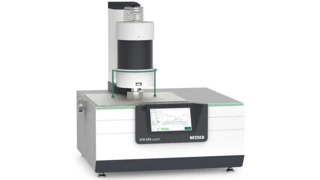
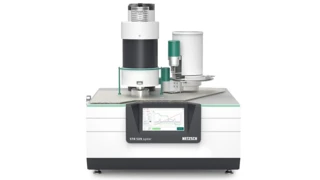
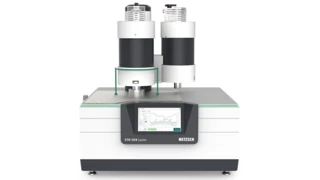
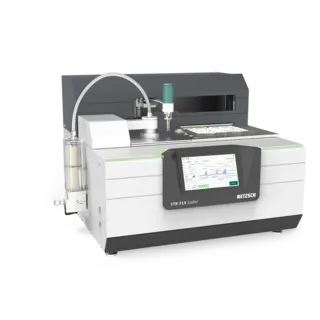
Explore the STA 509 Jupiter® instrument family for simultaneous DSC and TGA measurements in material characterization.
Download
Download Application Note 457 for the complete measurement description, measurement parameters,cp and TGA curves, and reference information.
Related Application Literature
Browse further application literature on simultaneous thermal analysis of metals and alloys.