Introduction
Differential scanning calorimetry (DSC) is a widely used analytical technique in the pharmaceutical industry for investigating the thermal properties of drug substances. One of the key applications of DSC is to determine the ideal solubility of a drug, which is crucial for developing effective and safe pharmaceutical formulations. In this Application Note, we will explore how DSC can be used to determine the ideal solubility of drugs, and the factors that can influence the solubility behavior.
Classification of Drugs Based on Solubility
Aqueous solubility is essential for a drug to reach its therapeutic target, given that the dissolution rate directly influences drug bioavailability. The United States Pharmacopoeia and European Pharmacopoeia classify drugs based on their approximate solubility range in mg/ml. For example, 100 to 1000 mg/ml is the solubility range for a molecule considered freely soluble, and 0.1 to 1 mg/ml is the range for a drug molecule characterized by very slight water solubility. Therefore, determining aqueous and non-aqueous solubility will define the best possible formulation approach for a good drug candidate.
Ideal solubility gives the saturated concentration of a solute, in mole fraction, when an ideal solvent is used, i.e., the theoretical case of a solute being dissolved in a solvent without any loss of energy during the dissolution process. In practice, this is not achievable because the solute-solvent interaction is usually non-ideal and the chemical interaction between the solute and the solvent may hinder the dissolution process. Examples of these intermolecular interactions are hydrogen bonds, dielectric properties, and dipole moment.
While the method of choice for determining the solubility of a molecule is UV spectrophotometry, the ideal solubility can be calculated when the Melting Temperatures and EnthalpiesThe enthalpy of fusion of a substance, also known as latent heat, is a measure of the energy input, typically heat, which is necessary to convert a substance from solid to liquid state. The melting point of a substance is the temperature at which it changes state from solid (crystalline) to liquid (isotropic melt).melting point and enthalpy of fusion of the substance are known.
But What Does Ideal Solubility Mean in Thermodynamic Terms?
In the dissolution process, the solute-solute bonds must be broken. The energy input required to break these bonds is equal to the energy needed to melt a solid; i.e., the enthalpy of fusion, (ΔHf). On the other hand, solvent-solvent bonds must also be broken while solutesolvent bonds must be formed. The energy input for this last step can be called enthalpy of mixing (ΔHmix). Thus, the enthalpy of dissolution is the sum of the enthalpy of fusion and the enthalpy of mixing:
ΔHsol = ΔHf + ΔHmix
If the enthalpy of mixing equals zero, then the enthalpy of dissolution (ΔHsol) equals the enthalpy of fusion:
ΔHsol = ΔHf
These are the main thermodynamic assumptions for the ideal dissolution of a crystalline material. Ideal dissolution leads to ideal solubility.
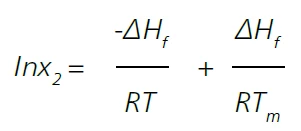
Other assmuptions area that ΔHf is positive (fusion is an EndothermicA sample transition or a reaction is endothermic if heat is needed for the conversion.endothermic event) and so is ΔHsol. However, in order for a spontaneous reaction to occur, the Gibbs energy (ΔG = ΔHf - TΔS) must be negative; thus, the entropy (S) must be positive. Considering that the Melting Temperatures and EnthalpiesThe enthalpy of fusion of a substance, also known as latent heat, is a measure of the energy input, typically heat, which is necessary to convert a substance from solid to liquid state. The melting point of a substance is the temperature at which it changes state from solid (crystalline) to liquid (isotropic melt).melting temperature and enthalpy of fusion are independent of the experimental temperature, and that the dissolution will provide a saturated solution, the Van’t Hoff equation can be applied as follows:
Where
x2 = saturated concentration of the drug in mole fraction unit
ΔHf = enthalpy of fusion (J/mol)
R = gas constant (J/K∙mol)
T = given temperature (K)
Tm = Melting Temperatures and EnthalpiesThe enthalpy of fusion of a substance, also known as latent heat, is a measure of the energy input, typically heat, which is necessary to convert a substance from solid to liquid state.
The melting point of a substance is the temperature at which it changes state from solid (crystalline) to liquid (isotropic melt).melting temperature (K)
The result yields the saturated concentration of a solute in the ideal solvent, in mole fraction. In other words, this would be the maximum achievable concentration of the drug in the best possible solvent. Aulton’s Pharmaceutics book [1] cites the acetylsalicylic acid example. The (calculated) ideal solubility of acetylsalicylic acid is 0.037 mole fraction; the best solvent listed is tetrahydrofuran (THF), the experimentally determined solubility of which is 0.036 mole fraction. THF is therefore close to being the ideal solvent for acetylsalicylic acid. However, it is important to keep in mind that the intermolecular interactions may also favor dissolution, yielding an experimental solubility that is probably higher than that estimated by the Van’t Hoff equation.
The DSC curve for acetylsalicylic acid with the experimental values for Melting Temperatures and EnthalpiesThe enthalpy of fusion of a substance, also known as latent heat, is a measure of the energy input, typically heat, which is necessary to convert a substance from solid to liquid state. The melting point of a substance is the temperature at which it changes state from solid (crystalline) to liquid (isotropic melt).melting temperature, (extrapolated) onset temperature and the enthalpy of fusion (area under the peak) are shown in figure 1. Both values agree very well with the reference values given by the National Institute of Standards and Technology (NIST), as can be seen in table 1.
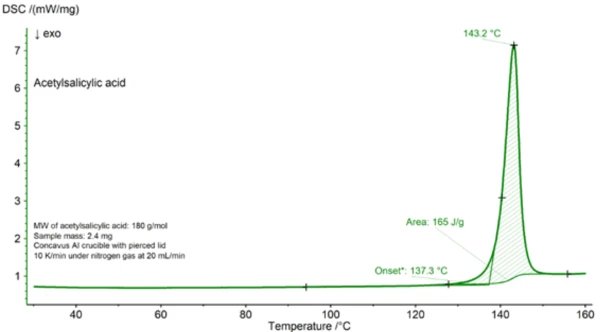
Table 1: Experimental and reference values for Melting Temperatures and EnthalpiesThe enthalpy of fusion of a substance, also known as latent heat, is a measure of the energy input, typically heat, which is necessary to convert a substance from solid to liquid state. The melting point of a substance is the temperature at which it changes state from solid (crystalline) to liquid (isotropic melt).melting temperature and enthalpy of fusion for acetylsalicylic acid
| Parameter | Experimentell | Reference (NIST Chemistry WebBook*) |
|---|---|---|
| Melting Temperatures and EnthalpiesThe enthalpy of fusion of a substance, also known as latent heat, is a measure of the energy input, typically heat, which is necessary to convert a substance from solid to liquid state. The melting point of a substance is the temperature at which it changes state from solid (crystalline) to liquid (isotropic melt).Melting temperature (extrapolated onset) | 410.4 K (137,3°C) | 405 ± 10 K |
| Enthalpy of fusion (area under the peak) | 29.7 kJ/mol (165 J/g) | 29.17 - 31.01 kJ/mol |
* https://webbook.nist.gov/cgi/cbook.cgi?ID=C50782&Units=SI&Mask=4#Thermo-Phase
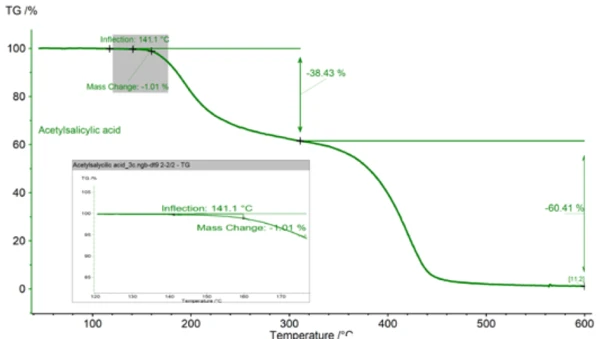
Care must be taken if the substance analyzed may possibly undergo thermal degradation during the DSC measurement. In the case of the acetylsalicylic acid example shown in figure 2, a mass loss of 1.01% was determined with a NETZSCH thermobalance, TGA. This value is acceptable, as ASTM E928-08 stipulates 1% as the maximum mass loss in the melting range. If TGA is not available, weighing the crucible and the sample before and after the measurement is the best way to monitor the mass loss.
Phase transitions, solid-solid interaction, changes in chemical composition, and purity determination are examples of applications of DSC – a sensitive technique that provides accurate and precise results.
Summary
In conclusion, using thermoanalytical methods of the NETZSCH portfolio can significantly contribute to determining the ideal solubility of drugs in the pharmaceutical development process. By providing valuable insights into the thermal properties of drug substances, DSC and TGA can help formulators and scientists optimize drug formulations for improved bioavailability and efficacy.