Lebensmittelwissenschaften bei NETZSCH
Thermoanalytische und rheologische Lösungen für die Analyse von Lebensmitteln
Lebensmittel sollen nicht nur den Hunger zu stillen, sondern auch zu unserem Wohlbefinden und unserer Gesundheit beitragen. Und für einige von uns bedeutet es sogar noch mehr: Spaß, Glück, Abenteuer und Geselligkeit. In jedem Fall brauchen wir eine ausgewogene Ernährung, die die notwendigen Eiweiße, Fette, Vitamine, Spurenelemente und Ballaststoffe enthält – und natürlich auch schmackhaft ist.
GENIESSEN SIE IHR ESSEN!
Um eine hohe Qualität der Lebensmittel sicherzustellen, die richtigen Zutaten und Zubereitungsarten zu finden und für ein gutes Mundgefühl zu sorgen ‒ also die Lebensmitteln auf Ihre Bedürfnisse abzustimmen ‒ werden in der Regel verschiedene Analysemethoden eingesetzt. Dazu gehören die thermische Analyse und die Rheometrie von NETZSCH. Sie spielen eine wichtige Rolle bei der Charakterisierung von Rohstoffen und Lebensmittelzusatzstoffen, bei der Bestimmung der geeigneten Konsistenz von Lebensmitteln und bei der Optimierung von Herstellungsprozessen.
Sehen Sie sich unsere kostenlosen Webinare on demand an - wann und wo immer Sie wollen!
Alternative Proteins – Processing and Rheological Characterization
The development of plant-based meat alternatives has become a rapidly growing area in the food industry. A key factor for consumer acceptance is the ability to replicate the familiar texture and taste of animal-based products. To achieve this, it is essential to understand and control the techno-functional properties of the protein ingredients used in these products.
In this webinar, we will delve into the latest extraction technologies and analytical methods used to isolate and refine functional plant proteins. These technologies are critical for producing high-quality ingredients with specific structural and functional characteristics. We will explore how these proteins can be tailored and optimized for use in extrusion-based processing, a common method for creating meat-like textures in plant-based products.
Digesting and Analyzing Specialized Nutrition – Physiological and Analytical Aspects
In this webinar, Prof. Dr. Simone Lipinski and Dr. Xiaoai Guo from the German Institute of Food Technologies discuss key aspects of how specialized nutrition is digested and analyzed. They introduce the standardized INFOGEST protocol to simulate human digestion and explain how rheological methods help characterize food texture and viscosity at different digestive stages.
The Use of Capillary Rheometry in the Fabrication of Polymer Scaffolds and Devices for Biomedical Applications
Polymers are now widely used for tissue repair and replacement in the form of implantable biomedical scaffolds. Examples include surgical meshes, cardiovascular stents, nerve conduits, and bone regeneration scaffolds and fixation devices; thermal processing is a common denominator in all these applications. This webinar will discuss the capillary rheometer as the ideal tool for assessing the flow properties and Thermal Stability and optimizing the process parameters during the development of the compounds; it is especially critically important in the evaluation of degradable polymers with a very narrow processing window. The presentation will also focus on using rheology as a referee in the molecular weight determination of a series of polymers, to produce small diameter fibers for mechanical testing, and filaments for use with 3D printers that run on fusion deposition modeling technology.
Rheodialysis - An Experimental Platform for Changing a Sample’s Chemical Environment during Rheological Testing
In this presentation we will discuss a technique known as rheodialysis, which extends the capabilities of standard rheology by incorporating a customised flow cell with a porous membrane into a parallel plate rheometer [4]. We have shown that this approach allows a sample’s chemical environment to be exchanged, while simultaneously probing its mechanical properties.
We will demonstrate experimental results that apply this technique to alginate biopolymer hydrogels assembled through diffusion of calcium ions. By probing alginate hydrogels at different plate separations, we shown that the resulting hydrogels have different properties owing to the slow diffusion calcium ions through the incipient gel network. We also show that the fractal dimension of these hydrogels varies with the distance from the source of ion diffusion and we model this process using reaction diffusion models.
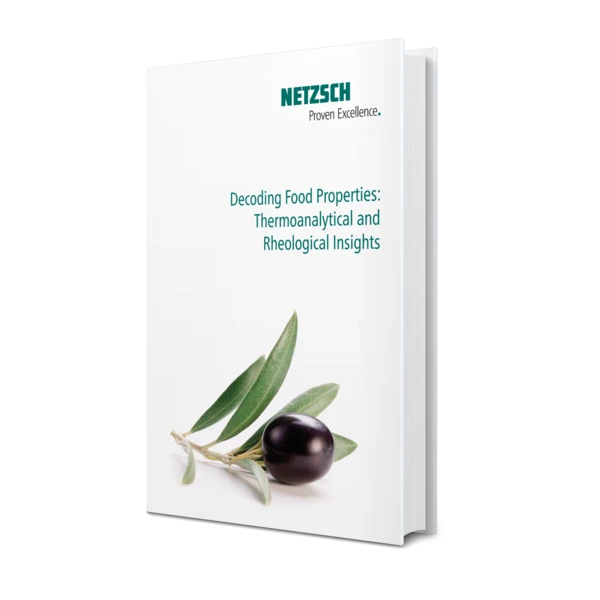
Entschlüsselung von Lebensmitteleigenschaften: Thermoanalytische und rheologische Einblicke
Laden Sie unser aktuelles Applikationsbuch (Englische Sprache) kostenlos herunter!
Das Buch erforscht die entscheidende Rolle der Rheologie und der thermischen Analyse für das Verständnis der physikalischen Eigenschaften und des Verhaltens von Lebensmittelsystemen. Es beschreibt kurz die Methoden (DSC, TGA, Evolved analysis), DMA, Rotations- und Kapillarrheometrie und Kinectis-Analyse mit Kinetics neo Software).
Darüber hinaus werden verschiedene Beispiele von Tests für die Qualitätskontrolle, Forschung und Entwicklung usw. gegeben (z. B. Polymorphismus von Zuckern, Gelatinierung von Stärke, Stabilität von Kräutersalaten, sensorische Wahrnehmung usw.).

“Das e-book "Decoding Food Properties" ist super verständlich und kompakt aufgebaut. Besonders beeindruckt hat mich die Darstellung rheologischer Methoden und der Abschnitt zur Qualitätskontrolle von Schokolade.”
Herstellung von veganen Proteinen mit Hilfe von Thermoanalyse und Rheologie
Ein Anwenderbericht von Prof. Dr. Tomas Kurz, ProteinDistillery GmbH, Ostfildern, über die Herstellung von Clean Label Proteinzusätzen mit überlegener Funktionalität und ernährungsphysiologischen Eigenschaften
Lösungen für die Lebensmittelverarbeitung
Feinvermahlung, Mischen von Feststoffen in Flüssigkeiten und Conchieren von Schokoladenmassen NETZSCH Maschinen und Anlagen für die Lebensmittel- und Süßwarenindustrie
NETZSCH Grinding & Dispersing ist ein innovativer, international tätiger Partner mit Vertriebs- und Servicestandorten in 35 Ländern. NETZSCH verfügt über jahrzehntelange Erfahrung in der Herstellung von Süßwarenmassen und in der Feinvermahlung von Lebensmitteln.
Sie profitieren von wirtschaftlichen, energieeffizienten Produktionsprozessen, die höchsten Hygienestandards entsprechen und von höchster Produktions- und Investitionssicherheit, die sich aus der langjährigen NETZSCH-Erfahrung in der Lebensmittelindustrie ergibt.
Rheometry and Rheological Characterisation
Ein Kapitel in "Food Texturology: Measurement and Perception of Food Textural Properties", verfügbar im Springer Verlag
Die Entwicklung von Rheometern hat unser Verständnis für die strukturellen Eigenschaften von Lebensmitteln erheblich verbessert. In diesem Kapitel wird das rheologische Verhalten eingehend erläutert, einschließlich der Ursprünge der modernen Rheometer. Es wird auf die Rolle der Testgeometrien und die spezifischen Arten von Messungen eingegangen, die durchgeführt werden können.
Unsere Partner