Material Characterization for Food
Solve Food Quality, Stability and Process Challenges with Reliable Material Data
NETZSCH helps food and beverage teams characterize material behavior for formulation, process development, quality control and shelf-life investigations.
Talk to our experts to identify the right analytical method and instrument for your food application.
Talk to a Food Analysis Specialist
Find the Right Characterization Approach for Your Food Application
The suitable method depends on the food matrix, the property to be measured and your laboratory workflow. Our specialists help identify an appropriate approach.
Discuss Your Food Application with an Expert
When Food Performance Matters, the Right Data Supports Better Decisions
Food products must deliver consistent quality throughout processing, storage and use. Whether you are developing a new formulation, investigating a texture or stability change, or establishing a quality-control workflow, meaningful characterization data supports informed decisions across R&D, quality assurance and process development.
Understand thermal behavior
Support formulation and process development
Investigate changes during storage and processing
Talk to a Food Analysis Specialist
Tell us about your food material, formulation, process or testing objective. A NETZSCH representative will contact you to discuss suitable next steps.
Not Ready to Talk Yet?
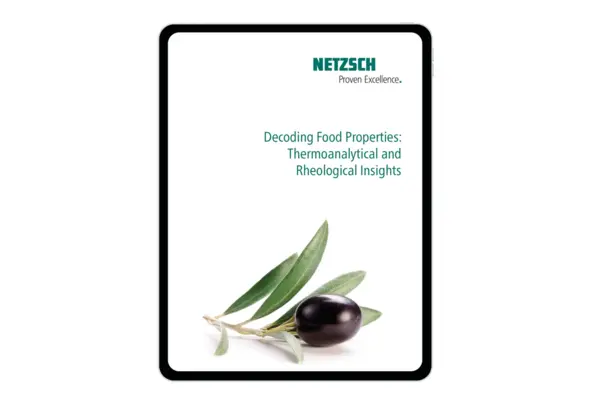
Explore the Ebook “Decoding Food Properties: Thermoanalytical and Rheological Insights”
Discover how thermal analysis and rheology reveal the physical properties and behavior of food systems. This publication introduces DSC, TGA, evolved gas analysis, DMA, rotational and capillary rheometry, and kinetic analysis with Kinetics neo software. Practical food applications illustrate CrystallizationCrystallization is the physical process of hardening during the formation and growth of crystals. During this process, heat of crystallization is released.crystallization and PolymorphismPolymorphism is the ability of a solid material to form different crystalline structures (synonyms: forms, modifications).polymorphism, starch gelatinization in baked goods and sauces, the stability of salad dressings containing herbs, and the flow and mouthfeel of creams, beverages, and emulsions.
Learn how these methods support food science, quality assurance, product development, and sensory research - helping professionals characterize food properties and make informed formulation and quality decisions.
Talk to a Food Analysis Specialist
You May Also Be Interested In
Dive deeper into NETZSCH Analyzing & Testing: explore products, food-analysis applications, technical resources, services and e-learning.