Introduction
Thermosets are materials that irreversibly harden under certain conditions, for example, when subjected to UV or heat. During this hardening reaction, called Curing (Crosslinking Reactions)Literally translated, the term “crosslinking“ means “cross networking”. In the chemical context, it is used for reactions in which molecules are linked together by introducing covalent bonds and forming three-dimensional networks.curing, the thermoset transitions from a liquid, flowable state into a structural part by forming a 3-dimensional network.
Curing results in profound changes in molecular weight, DensityThe mass density is defined as the ratio between mass and volume. density, viscosity, and thermal and mechanical properties.
DSC is a popular method for investigating Curing (Crosslinking Reactions)Literally translated, the term “crosslinking“ means “cross networking”. In the chemical context, it is used for reactions in which molecules are linked together by introducing covalent bonds and forming three-dimensional networks.curing reactions because it is easy to use and results are highly reproducible. Furthermore, intelligent software ensures automatic, autonomous, user-independent curve evaluations (see NETZSCH AutoEvaluation for DSC, TGA and STA explained on Vimeo).
Measurement Results and Discussion
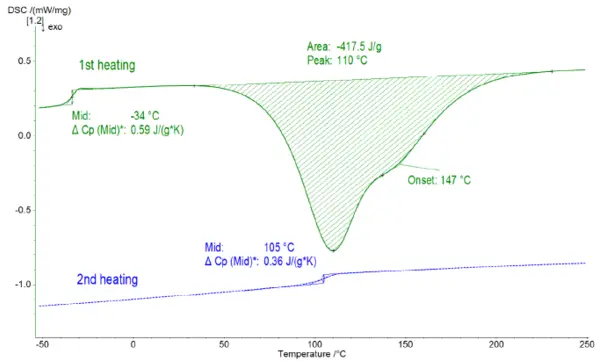
Figure 1 shows the typical curves of a thermoset measured during the first and second heating runs. The material consisted of an epoxy resin (based on bisphenol A) and a hardener (mixture of two diamines). The two components were mixed at a ratio of 1000:300 (w/w) and weighed into an aluminum (Concavus® type) crucible. The crucible was sealed with a pierced lid and introduced into the DSC cell.
In the 1st heating (green), the endothermal step detected at -34°C indicates the Glass Transition TemperatureThe glass transition is one of the most important properties of amorphous and semi-crystalline materials, e.g., inorganic glasses, amorphous metals, polymers, pharmaceuticals and food ingredients, etc., and describes the temperature region where the mechanical properties of the materials change from hard and brittle to more soft, deformable or rubbery.glass transition of the uncured polymer. The ExothermicA sample transition or a reaction is exothermic if heat is generated.exothermal peak at 110°C (peak temperature) stems from the Curing (Crosslinking Reactions)Literally translated, the term “crosslinking“ means “cross networking”. In the chemical context, it is used for reactions in which molecules are linked together by introducing covalent bonds and forming three-dimensional networks.curing reaction. It is associated with an enthalpy of 418 J/g.
In the 2nd heating, no ExothermicA sample transition or a reaction is exothermic if heat is generated.exothermal peak is detected anymore. This means that the material was fully crosslinked before the second heating. The Glass Transition TemperatureThe glass transition is one of the most important properties of amorphous and semi-crystalline materials, e.g., inorganic glasses, amorphous metals, polymers, pharmaceuticals and food ingredients, etc., and describes the temperature region where the mechanical properties of the materials change from hard and brittle to more soft, deformable or rubbery.glass transition temperature is detected at 105°C (midpoint).
This shows the huge influence of Curing (Crosslinking Reactions)Literally translated, the term “crosslinking“ means “cross networking”. In the chemical context, it is used for reactions in which molecules are linked together by introducing covalent bonds and forming three-dimensional networks.curing on the Glass Transition TemperatureThe glass transition is one of the most important properties of amorphous and semi-crystalline materials, e.g., inorganic glasses, amorphous metals, polymers, pharmaceuticals and food ingredients, etc., and describes the temperature region where the mechanical properties of the materials change from hard and brittle to more soft, deformable or rubbery.glass transition temperature of the material, in this case leading to an increase of more than 130°C.
Does the Reaction Stop when Processed at Isothermal Temperatures? Vitrification Takes Place!
This dependence of the Glass Transition TemperatureThe glass transition is one of the most important properties of amorphous and semi-crystalline materials, e.g., inorganic glasses, amorphous metals, polymers, pharmaceuticals and food ingredients, etc., and describes the temperature region where the mechanical properties of the materials change from hard and brittle to more soft, deformable or rubbery.glass transition on curing is crucial when working at very low heating rates or IsothermalTests at controlled and constant temperature are called isothermal.isothermal temperatures because the Glass Transition TemperatureThe glass transition is one of the most important properties of amorphous and semi-crystalline materials, e.g., inorganic glasses, amorphous metals, polymers, pharmaceuticals and food ingredients, etc., and describes the temperature region where the mechanical properties of the materials change from hard and brittle to more soft, deformable or rubbery.glass transition temperature may increase faster than the programmed, material temperature. As soon as the glass transition is higher than the material temperature, vitrification is observed, meaning that the material enters into a glassy state. The reaction rate slows down very strongly; curing may even stop completely. This has crucial consequences for the performance of the final product because the final properties depend on the Degree of CureThe degree of curing describes the conversion achieved during crosslinking reactions (curing). degree of cure.
In this study, vitrification during curing of a 2-component epoxy resin is investigated by means of temperature-modulated DSC (TM-DSC).
TM-DSC (Temperature-Modulated DSC): Separation of the Exothermal Curing Peak from the Endothermal Glass Transition Step
Glass transition and ExothermicA sample transition or a reaction is exothermic if heat is generated.exothermal peak may overlap. It is possible to separate the two effects by temperature-modulated DSC. This technique involves applying a sinusoidal temperature signal superimposed onto the ramp of the defined heating rate. As a result, the effects associated with changes in specific heat (“reversing”; for example, glass transition) are separated from the other ones (“non-reversing”; for example, curing peak). If the device is specific-heat-calibrated (for example, with sapphire), the reversing curve corresponds to the specific heat of the material measured.
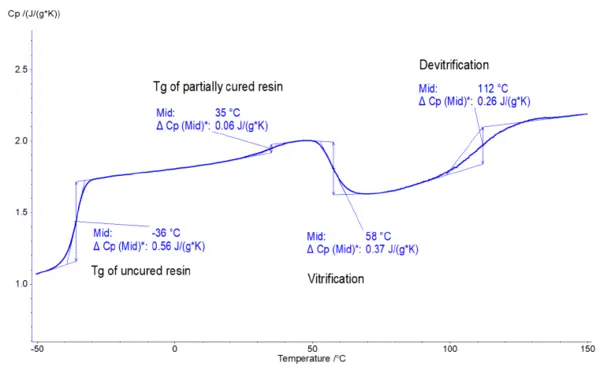
Figure 2 depicts the specific heat curve measured during curing at 0.1 K/min by means of temperature-modulated DSC. The glass transition of the uncured system is detected at -36°C. The slight increase in specific heat between 25°C and 45°C (mean temperature at 35°C) results from the glass transition of the partly cured material.
After that, vitrification takes place, associated with an ExothermicA sample transition or a reaction is exothermic if heat is generated.exothermal step in Specific Heat Capacity (cp)Heat capacity is a material-specific physical quantity, determined by the amount of heat supplied to specimen, divided by the resulting temperature increase. The specific heat capacity is related to a unit mass of the specimen.specific heat capacity at 58°C. Then, the resin is in a glassy state. As vitrification is a reversible phenomenon, further heating results in the transition into a rubbery state again. This is shown by the endothermal step at 112°C.
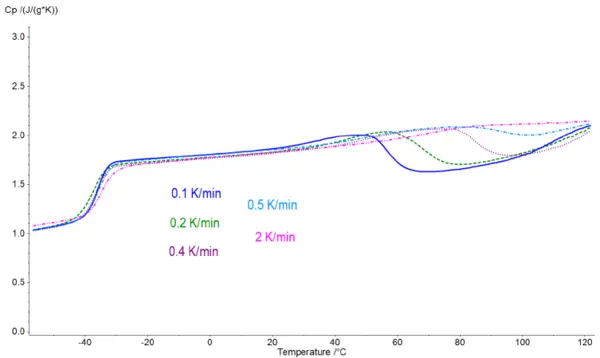
The same experiment was performed using different heating rates. The resulting curves are depicted in figure 3. The higher the heating rate, the higher the vitrification temperature, and the smaller the vitrification effect. At 2 K/min, no vitrification takes place. At this heating rate, the material temperature increases faster than the Glass Transition TemperatureThe glass transition is one of the most important properties of amorphous and semi-crystalline materials, e.g., inorganic glasses, amorphous metals, polymers, pharmaceuticals and food ingredients, etc., and describes the temperature region where the mechanical properties of the materials change from hard and brittle to more soft, deformable or rubbery.glass transition temperature.
Conclusion
Vitrification occurs when the Glass Transition TemperatureThe glass transition is one of the most important properties of amorphous and semi-crystalline materials, e.g., inorganic glasses, amorphous metals, polymers, pharmaceuticals and food ingredients, etc., and describes the temperature region where the mechanical properties of the materials change from hard and brittle to more soft, deformable or rubbery.glass transition temperature of the partially cured thermoset rises and reaches or exceeds the actual curing temperature. As the crosslink DensityThe mass density is defined as the ratio between mass and volume. density increases during reaction, chain mobility becomes progressively limited and the system can enter a glassy state even though the processing temperature remains constant. This situation is most frequently encountered at low heating rates, during IsothermalTests at controlled and constant temperature are called isothermal.isothermal curing below the ultimate Tg, or in highly filled systems with reduced molecular mobility. Once vitrified, the reaction becomes diffusion-controlled and the reaction rate decreases sharply; depending on processing conditions, it may even come to a complete stop.
This has direct implications for industrial curing schedules. If vitrification occurs too early, the material may solidify before achieving the desired Degree of CureThe degree of curing describes the conversion achieved during crosslinking reactions (curing). degree of cure, resulting in a lower final Glass Transition TemperatureThe glass transition is one of the most important properties of amorphous and semi-crystalline materials, e.g., inorganic glasses, amorphous metals, polymers, pharmaceuticals and food ingredients, etc., and describes the temperature region where the mechanical properties of the materials change from hard and brittle to more soft, deformable or rubbery.glass transition temperature and inferior mechanical and thermal performance. Affected properties may include stiffness, chemical resistance, CreepCreep describes a time and temperature dependent plastic deformation under a constant force. When a constant force is applied to a rubber compound, the initial deformation obtained due to the application of the force is not fixed. The deformation will increase with time.creep behavior, and dimensional stability. Since vitrification is reversible, further heating can lead to devitrification and restart of the curing reaction. For this reason, multi-stage cure cycles are often employed: a low-temperature step to achieve gelation, followed by a higher-temperature post-cure to complete crosslinking above the evolving Tg.
TM-DSC provides direct access to these effects by clearly visualizing vitrification, devitrification and the remaining reaction enthalpy, enabling optimization of cure schedules and ensuring that the final component reaches the targeted performance.
Vitrification can also be characterized by dielectric analysis (DEA) and laser-flash analysis (LFA). More information about this topic can be found under https://doi.org/10.1002/app.57077.